
Grain at $480 a Tonne or Silage at $90 — How Queensland Beef Finishers Are Doing the Maths
The cost-replacement case for building on-farm silage reserves to buffer dry-season grain bills — and the baling system that makes it viable for operations running 200 to 800 head.
The Grain Bill Problem on Queensland Beef Finishing Properties
For Queensland beef finishing operations — backgrounders and feeders running 200 to 800 head through a dry-season supplementation programme — grain is simultaneously the most effective and most expensive tool available. Rolled barley, wheat, or sorghum at AUD $420 to $520 per tonne (mid-2025 delivered prices to central Queensland finishing properties) produces reliable daily weight gains of 1.0 to 1.6 kg per head when pasture is exhausted and body condition scores are falling. But the financial exposure from a prolonged dry season where grain supplementation extends from the planned 60 days to 120 or 150 days is significant enough to turn a profitable finishing year into a marginal or loss-making one.
The alternative that a growing number of Queensland beef producers have moved toward is not avoiding grain entirely — grain’s energy density cannot be matched by any silage crop — but reducing grain dependency by substituting silage as the primary roughage and energy-buffer component in the supplementation programme. Well-made silage (ryegrass, sorghum, or mixed cereal), fed at 8 to 12 kg DM per head per day alongside a modest grain allocation of 1.5 to 2.5 kg per head per day, achieves comparable weight gains to full grain supplementation at 40 to 60% of the grain cost. The silage provides the rumen fill and digestible fibre that grass-only systems cannot deliver in dry conditions; the grain tops up the metabolisable energy to target performance levels.
This article covers the financial arithmetic of silage-as-grain-substitute for Queensland beef finishing operations, the forage crops and baling systems that make it work, and the storage logistics of building a silage reserve at the scale a 200 to 800 head operation needs. For an overview of how other Queensland and northern beef producers are already using on-farm silage to manage drought risk, our article on silage baling for beef cattle stations in drought covers the broader strategic framework.
The Cost-Replacement Calculation: Silage vs. Grain
What Silage Actually Replaces in a Beef Finishing Ration
The metabolisable energy (ME) content of well-made silage varies by species and fermentation quality, but commercial-grade round bale silage from sorghum or mixed cereal crops in Queensland conditions consistently achieves 9.0 to 10.5 MJ ME per kg DM. Rolled grain runs 12.5 to 14.0 MJ ME per kg DM. The energy ratio is approximately 1.0 kg grain equivalent = 1.3 to 1.5 kg good silage DM. This ratio is the starting point for the substitution calculation.
| Feed Input | ME (MJ/kg DM) | Cost ($/t DM, 2025) | Cost per MJ ME Delivered |
|---|---|---|---|
| Rolled barley | 12.8 | $460–$520 | $3.59–$4.06 |
| Rolled sorghum | 12.5 | $390–$450 | $3.12–$3.60 |
| Well-made sorghum silage | 9.5–10.5 | $75–$120 | $0.71–$1.26 |
| Ryegrass baleage (irrigated) | 10.0–11.0 | $90–$140 | $0.82–$1.40 |
| Poor-quality silage (<8.5 ME) | 7.5–8.5 | $60–$90 | $0.71–$1.20 |
Even accounting for the lower energy density of silage versus grain, well-made on-farm silage at AUD $75 to $140 per tonne DM delivers ME at 25 to 35% of the cost of grain. The substitution model that makes financial sense for most Queensland beef operations is: replace 50 to 70% of the grain ration (by DM) with silage in the dry-season supplementation programme, reduce grain to a top-up energy source rather than the primary feed, and use the cost saving per head per day to extend the feeding period or improve body condition scores before sale.
A 400-Head Operation: Two Scenarios Compared
| Metric | Full Grain Programme | Silage + Grain Programme |
|---|---|---|
| Feeding period (days) | 90 | 90 |
| Grain allocation (kg DM/hd/day) | 4.5 kg | 1.8 kg |
| Silage allocation (kg DM/hd/day) | 0 kg | 8.0 kg |
| Grain cost per head (90 days) | $83 | $33 |
| Silage cost per head (90 days) | $0 | $26 |
| Total feed cost per head | $83 | $59 |
| Total feed cost (400 head) | $33,200 | $23,600 |
| Annual saving (400 head) | — | $9,600 |
| Daily weight gain | 1.2–1.5 kg | 1.0–1.4 kg |
The modelled saving of AUD $9,600 per 90-day feeding period for a 400-head operation (at mid-2025 grain prices) is conservative — it assumes the silage reduces grain by only 60% of original allocation and that silage DM cost is AUD $95 per tonne. In drought years where grain prices rise to AUD $550 to $600 per tonne — as occurred in 2019 and 2023 — the saving from this substitution model increases to AUD $15,000 to $20,000 per feeding period for the same operation.
Which Forages Work for Queensland Beef Silage?
Whole-Plant Sorghum: The Queensland Standard
Whole-plant forage sorghum (Sorghum bicolor) is the most widely grown silage crop for Queensland beef operations for two reasons: drought tolerance and yield. On the brigalow scrub country of central Queensland and the downs country of the Darling Downs, forage sorghum hybrids (Jumbo, Sugargraze, BMR variants) produce 15 to 30 tonnes of fresh matter per hectare in a single growing season under rainfall or limited irrigation — providing large bale quantities from limited paddock area. Harvest at the soft-dough grain stage (whole-plant moisture 60 to 68%) produces silage with ME of 9.5 to 11.0 MJ per kg DM and starch content of 18 to 28% — genuinely competitive with grain as a rumen energy source at the silage price point.
The HCN (prussic acid) consideration in sorghum silage is real but manageable. Whole-plant sorghum baled at the correct harvest stage (soft-dough, not milk stage) and sealed within 2 hours of harvest has essentially zero HCN risk at feedout because the anaerobic fermentation process eliminates residual cyanogenic glycosides within the first 7 to 14 days post-baling. The risk applies to fresh-cut or recently frost-killed material — not to properly fermented baleage.
Mixed Winter Cereals: Reliability Over Peak Yield
For Queensland beef operations in the Darling Downs and southern inland Queensland where winter cropping is practised, whole-plant oats, barley, or wheat baled at the flag-leaf to early-dough stage provides a more reliable nutritional outcome than sorghum in seasons where the summer growing period is shorter than planned. Mixed cereal silage at 10 to 12% crude protein and 9.5 to 11.0 ME is the preferred silage component for growing cattle rations; for dry cows or maintenance-feeding programmes, pure cereal straw baleage at lower cost per tonne is adequate.
Ryegrass (Irrigated or High-Rainfall Patches): The Protein Component
On the tablelands country of Queensland or in irrigated cropping rotations, perennial or Italian ryegrass baleage at 13 to 17% crude protein provides the protein fraction that sorghum silage alone cannot supply. A combination of 60% sorghum silage (energy) and 40% ryegrass silage (protein) in the TMR trough closely matches the nutritional profile of a conventional grain-based diet at approximately 35 to 45% of the grain cost per head per day.
Baling System for 200 to 800 Head Queensland Operations
Volume Requirements: How Many Bales Per Head Per Feeding Period?
A 400-head beef finishing operation feeding 8 kg DM silage per head per day for a 90-day period requires: 400 × 8 × 90 = 288,000 kg DM of silage. At 55% DM content in the bale (45% moisture, a realistic target for Queensland sorghum silage at soft-dough stage), this is 523,600 kg fresh weight of baled silage. A 1.25 m round bale at typical sorghum silage density (200 to 240 kg DM/m³) weighs approximately 580 to 680 kg fresh weight. The operation needs 770 to 905 bales for a single 90-day feeding period.
For an operation planning two 90-day feeding periods per year (common in Queensland’s two distinct dry-season risk periods — late winter and late summer), total annual bale requirement runs 1,500 to 1,800 bales. At this volume, the economics of machinery ownership versus contracting align clearly on the ownership side — annual contractor costs for 1,500 to 1,800 bales at AUD $15 to $22 per bale (bale and wrap) run AUD $22,500 to $39,600 before transport and staging.
Equipment: Why Volume and Crop Density Drive the Baler Specification
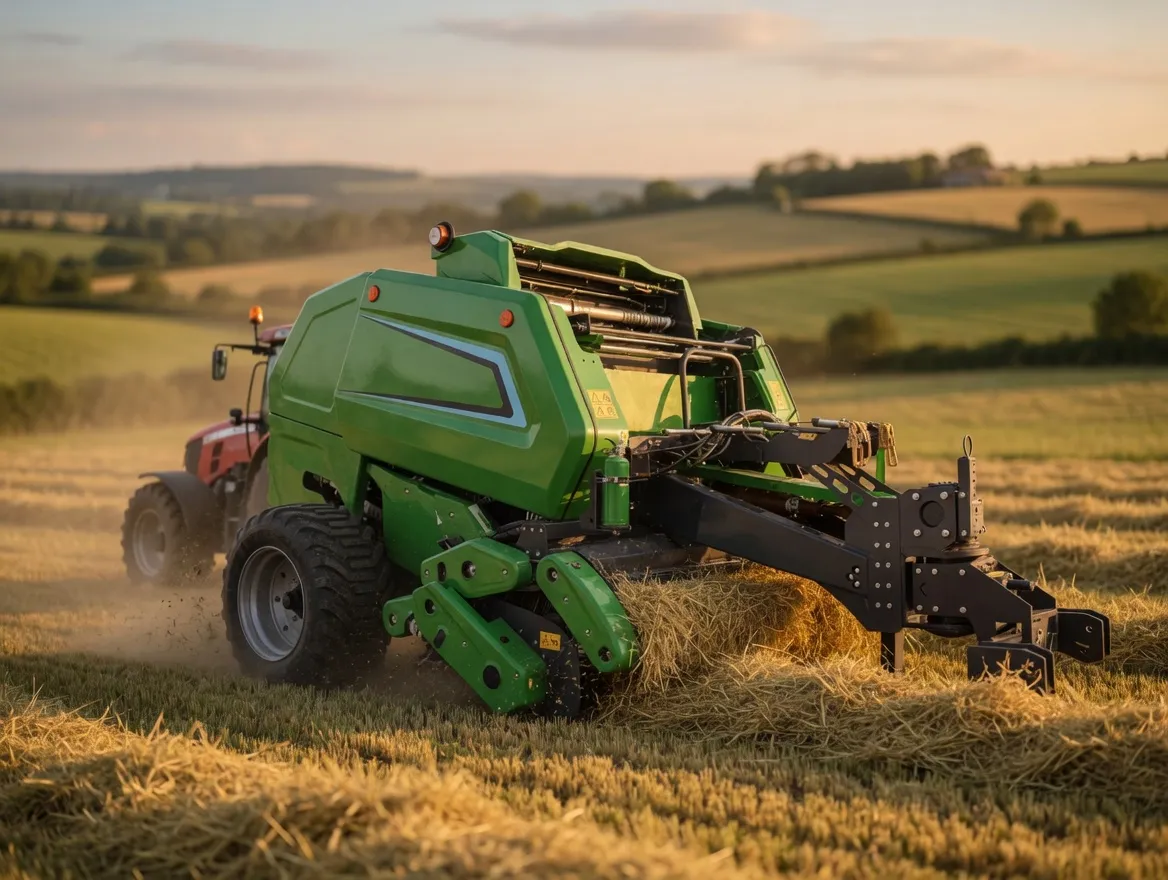
Queensland sorghum at soft-dough harvest stage is a heavy, dense crop — whole-plant material at 62 to 65% moisture entering the baler at a forage harvester-chopped particle length of 8 to 12 mm produces chamber loading conditions that require a higher-capacity baler than standard grass silage. The 9YG-2.24D S9000 Beyond round baler is specified for high-density silage crops at the volumes Queensland beef operations require — wider pickup width, larger-capacity chamber, and higher PTO torque rating accommodate the demanding conditions of chopped sorghum silage baling without the throughput bottlenecks that occur when a 1.0 m or standard 1.25 m baler is pushed beyond its rated crop density. Target bale production rate with the 9YG-2.24D in good sorghum conditions is 45 to 65 bales per hour — sufficient to complete 1,800 bales across 2 to 3 harvesting sessions per year without requiring contractor support.
Silage Storage: The Logistics Reality on a Remote Queensland Property
Site Selection for Queensland Conditions
Baled silage storage in Queensland faces two challenges that temperate-region silage management literature rarely addresses: UV film degradation from intense solar radiation, and the risk of bale puncture from native fauna (wallabies, possums, and in some areas, feral pigs and rodents that chew film for moisture access in dry conditions). Both risks are manageable with correct site selection and storage practice.
The optimal storage site for Queensland beef station baled silage is: hard-packed compacted gravel or concrete pad (prevents base rot from soil moisture contact), shaded by a simple open-sided corrugated iron shed or dense tree line (reduces UV film degradation from direct sun exposure by 60 to 80%), fenced to exclude wallabies and cattle (the most common cause of opportunistic bale puncture on Queensland properties), and positioned within 200 m of the feeding area to minimise loader transport distance during the feeding period.
Monitoring and Repair Through Dry-Season Storage
Queensland’s dry-season storage period (bales made in April to June, fed from July to September) spans 3 to 5 months of exposure to UV radiation, temperature extremes (35 to 42°C daytime, 10 to 18°C overnight in central Queensland winter), and varying humidity. Inspect stored bales fortnightly during the storage period — walk the storage row looking for any visible film punctures, splits at the bale end seam, or areas where film has become opaque and brittle from UV degradation. A silage repair tape kit in the property toolbox, applied within 24 hours of any detected puncture, prevents what is otherwise a manageable minor oxygen ingress from becoming a significant aerobic deterioration event in the weeks before the bales are needed for feeding.
Making the Decision: When Silage Baling Pays on a Queensland Beef Property
| Operation Profile | Annual Bale Need | Rec. Approach | Est. Annual Saving vs Full Grain |
|---|---|---|---|
| 200 head, 1 dry season | 400–500 bales | Contract baling + own wrapper | $5,000–$8,000 |
| 400 head, 2 dry seasons | 1,400–1,800 bales | Own baler + wrapper | $12,000–$22,000 |
| 600 head, 2 dry seasons | 2,000–2,600 bales | Own baler + high-cap wrapper | $18,000–$32,000 |
| 800 head, variable feeding | 2,500–3,500 bales | Dedicated baling setup, possibly contractor revenue | $24,000–$42,000 |
Annual bale requirement above 800 bales, own paddock area for forage crop, grain prices above AUD $420/t, and a feeding programme that includes at least one 60 to 90 day supplementation period per year. At these parameters, equipment ownership typically achieves payback in 3 to 5 years including quality-adjusted feed cost savings.
Annual bale requirement below 500 bales, no suitable irrigated or reliable dryland paddock for forage crops, or a property too remote for timely contractor access (which creates timing risk regardless of who owns the machine). At these parameters, the purchase of a small, well-priced forage crop and contractor baling remains the most cost-effective approach.
Frequently Asked Questions From Queensland Beef Operations
Talk to Us About Your Queensland Beef Silage Programme
Tell us your herd size, feeding period length, and available paddock area for forage crops — we’ll help you calculate whether on-farm silage production changes your dry-season feed cost equation.