
The mechanical failures that cost sheep farmers the most — when they happen, how long they take to fix, and the preventive maintenance schedule that keeps harvest windows intact.
Downtime Is Not Bad Luck — It Is Deferred Maintenance
Every sheep farmer who has had a baler break down mid-harvest knows the cost is not just the repair bill. It is the hay sitting in windrows getting rained on; the contractor who cannot come for three days because the weather window has already changed everyone’s schedule; and the quiet calculation of how many tonnes of marketable hay became livestock-feed hay because the moisture crept back up while the machine waited for parts.
Baler breakdowns during Australian sheep country’s peak hay and silage season — September to January in NSW, Victoria, and SA — are rarely sudden mechanical failures with no warning. They are almost always the predictable consequence of deferred maintenance: tines that were worn but not replaced, a belt that had been cracking for two seasons, a PTO shaft U-joint that had play in it last year and was left for ‘next time’. Understanding which components fail most frequently, when they fail relative to the maintenance cycle, and what the preventive schedule looks like that keeps most failures from happening during harvest is the practical content of this article.
For context on which round baler specifications are most reliable for the sheep farm harvest volume and crop mix typical of NSW and SA mixed Merino operations, our article on minimising harvest downtime on sheep farms with a reliable round baler covers the machine selection side of the reliability equation — this article focuses on the maintenance management side.
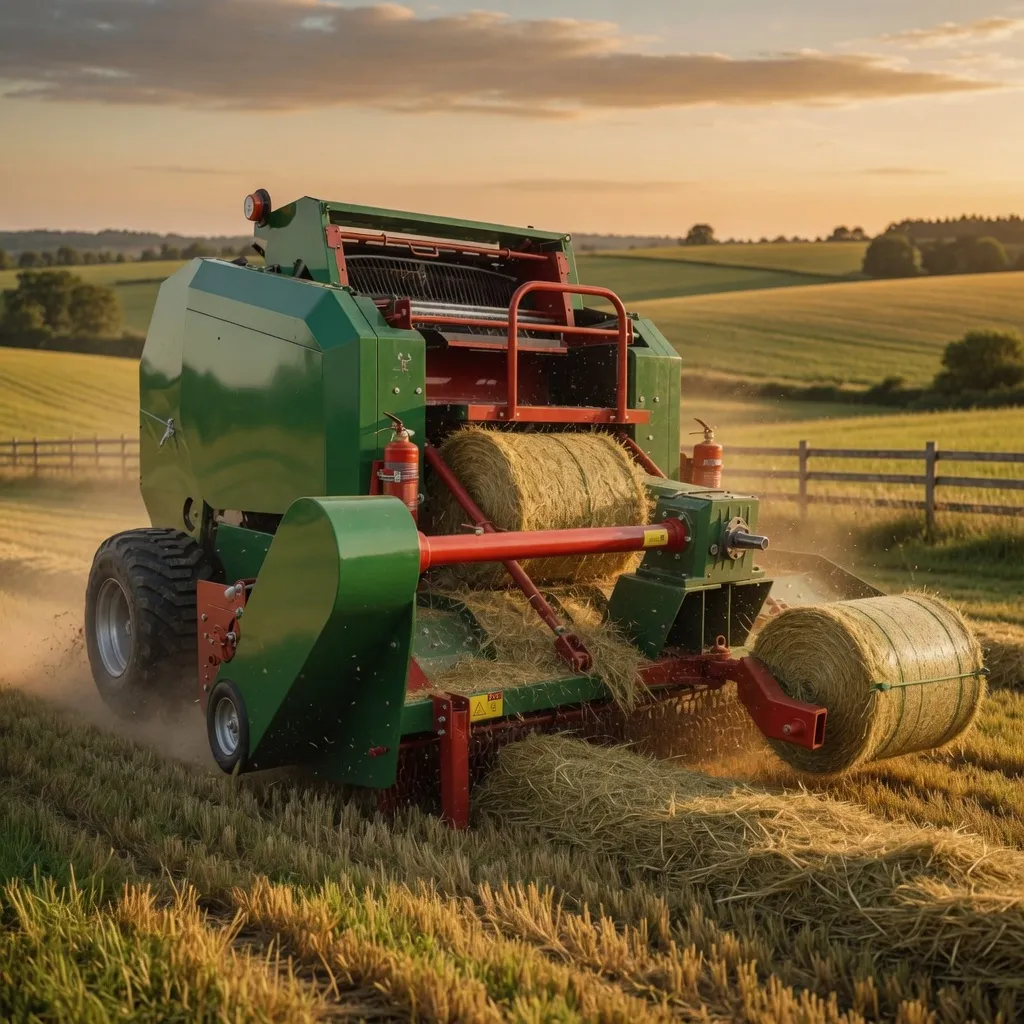
The Six Failure Modes That Account for 80% of Harvest Downtime
| Failure Mode | Typical Cause | Warning Signs | Average Repair Time |
|---|---|---|---|
| Pickup tine breakage | Worn tines striking rocks or hard ground | Bent tips, reduced ground clearance | 30 min (if spares on hand) |
| Net wrap knife failure | Dull knife from straw abrasion | Ragged wrap ends, incomplete cuts | 45–90 min |
| Belt failure (belt-drive balers) | Cracking belts, misaligned tracking | Surface cracks visible, squealing | 2–4 hours |
| PTO shaft U-joint failure | Worn U-joints from overloading | Vibration, clicking under load | 1–3 hours |
| Chamber roller bearing | Worn bearings from lack of grease | Grinding noise, bale shape issues | 3–6 hours (parts critical) |
| Hydraulic seal failure | Age, heat cycling | Slow hydraulic response, oil seeping | 1–4 hours |
Why Pickup Tine Failure Is the Most Expensive in Sheep Country
Pickup tine failure in cereal hay and straw baling — the primary sheep farm application — is caused by tine tip wear from abrasion against the cut stubble surface and by occasional tine impact on rocks in paddocks with limestone outcrops or clay pans. The individual tine replacement cost (AUD $6 to $15 per tine) is trivial; the cost is entirely in timing. A tine failure that stops baling at 2 PM on a Thursday with rain forecast for Saturday morning can result in 3 to 4 tonnes of hay per hour sitting in the paddock through a 15 mm rain event — converting premium-grade oaten hay at AUD $220 per tonne into livestock-grade material at AUD $120 per tonne. The downtime cost is not the tine; it is the grade reduction on 30 to 60 bales.
The Pre-Season Inspection: What to Check Before October
A set of worn tines wears unevenly — some tines fail before others, leaving the pickup operating at reduced efficiency before the first tine actually breaks. Replacing as a full set before each season (AUD $180 to $450 depending on machine) eliminates mid-season tine failure from the risk register entirely.
A sharp net wrap knife cuts cleanly in under 0.3 seconds; a dull knife saws at the net wrap, producing frayed ends and sometimes incomplete cuts that leave net wrap wrapped around the bale ejection mechanism. The knife is a wear item that costs AUD $25 to $80 and takes 20 minutes to replace — do it before the season, not after the first failed cut.
Run the baler empty at PTO speed for 2 minutes and observe each belt. Surface cracking on the belt crown, fraying at the belt edges (tracking problem), or any belt that slips visibly under no-load conditions are replacement items. Belt failure mid-harvest on a 150 km/h day is a 2 to 4 hour unplanned stop.
Most baler manufacturers specify 20 to 35 grease points that require lubrication at 50-hour and 200-hour intervals. Pre-season is the 200-hour equivalent interval for machines that sit idle through winter. A grease gun and 2 hours of time before the season is worth more than any single spare part.
At minimum: one full set of pickup tines, one net wrap knife, two U-joints for the PTO shaft, one set of hydraulic O-rings for your most common seal sizes, and one spare belt if your machine uses them. This parts kit costs AUD $400 to $800 and eliminates the ‘waiting for parts’ downtime that turns a 3-hour repair into a 3-day delay.
The 9YG-1.0C type round baler is designed for the maintenance realities of Australian sheep farm operations — its component access panels are designed for field serviceability without specialised tools, and its wear item list is limited to the common categories above without the complex sensor and automation systems that add maintenance complexity on premium commercial machines.
Mid-Season Maintenance: The 200-Bale Check
Every 200 bales during an active sheep farm season (a reasonable benchmark for a mixed hay-and-straw operation making 600 to 900 bales per year), perform the following checks during a natural break in operations (end-of-day or weather interruption):
| Check | What to Look For | Action if Found | Time Required |
|---|---|---|---|
| Tine tips | Wear below 70% of original length | Replace individual worn tines | 15 min |
| Net wrap feed rollers | Rubber surface glazing, groove wear | Replace rubber surface | 30 min |
| Bale chamber rollers | Flat spots, unusual noise | Flag for inspection — may need service dealer | 10 min |
| Hydraulic connections | Weeping seals, oil staining | Replace O-rings at next scheduled stop | 20 min |
| PTO shaft joints | Play above 3 degrees rotation | Replace U-joint — do not defer | 45 min |
Frequently Asked Questions
Discuss Your Baler Maintenance Programme
Tell us your machine model, annual bale volume, and current service regime — we’ll advise on the maintenance schedule and parts inventory that keeps your harvest moving.