Beskrivelse
Compact Entry-Level Roll Drum Round Baler for Small Farms and Tight-Budget Operations
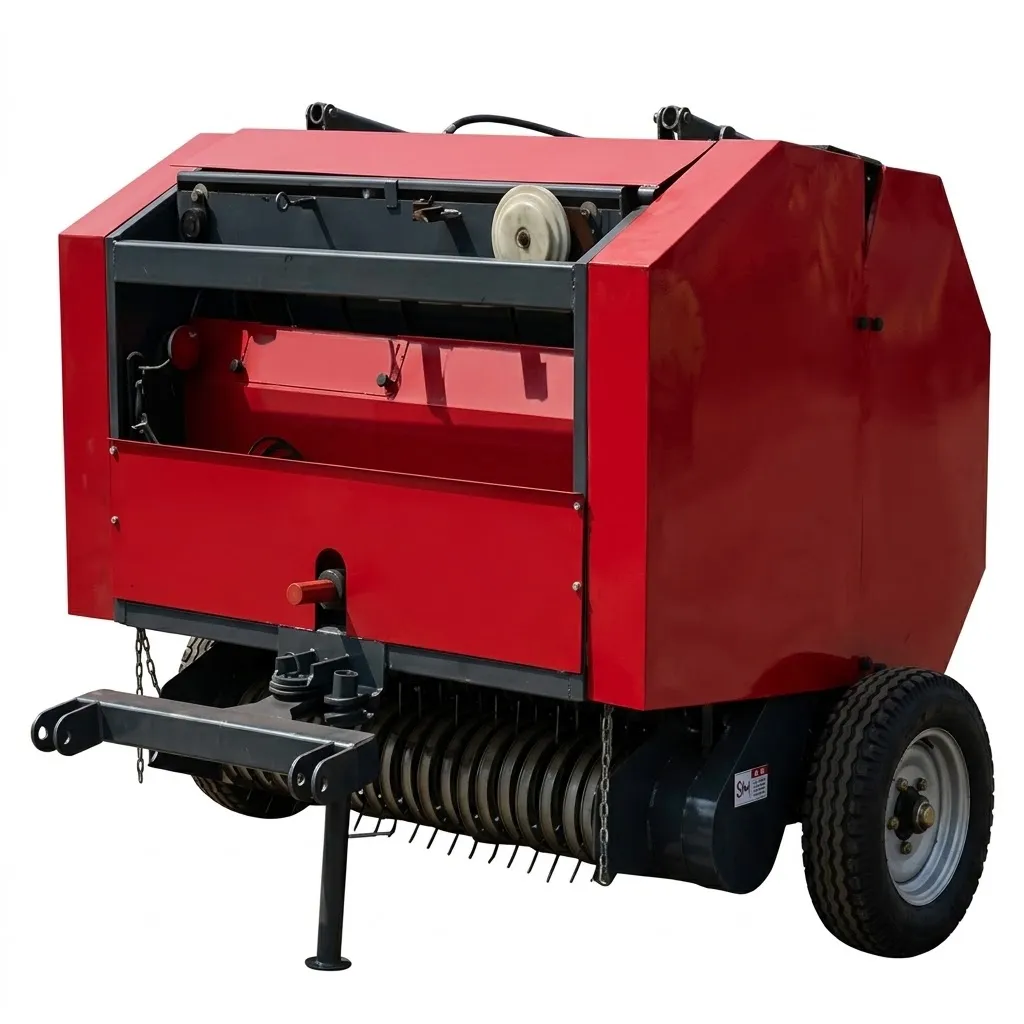
The 9YQ-1250 is the most compact and accessible machine in EverPower’s round baler lineup — a 1000 kg trailed roll drum baler that brings genuine roll drum chamber technology to farms and operations that a heavier, higher-horsepower machine would exclude. At 40.4 to 60 kW (approximately 55 to 80 hp), the 9YQ-1250 runs from the smallest four-wheel-drive and larger two-wheel-drive tractors found on lifestyle properties, small mixed farms, and entry-level sheep and cattle operations — equipment that cannot pair with the 9YQ-1950’s minimum of 36.7 kW as a meaningful floor, let alone the 9YG-2.2’s 110 kW minimum.
The 9YQ-1250 uses spring tooth direct feeding — the pickup reel’s spring tines carry crop material directly into the roll drum compression chamber without a secondary fork stage or screw feeder in between. This simplest-possible feeding arrangement is matched to the machine’s 1250 mm pickup width and 40.4–60 kW power range: at this scale, the crop volume per machine cycle does not require the surge-buffering function that the dual-stage feeder provides in the wider, heavier 9YQ-1950 and 9YQ-2300 models. The result is a mechanically simpler machine with fewer components to maintain and fewer potential failure points across the season.
The compression chamber uses 16 Φ152 mm rollers around a Φ800 mm compression zone within a 1250 mm chamber width — producing the smallest bale in the EverPower round baler range. The Φ800 mm bale diameter and rope wrapping (rather than net wrap) produce a bale format that can be manually handled by one or two people in light crops — a practical consideration on small farms where a loader or bale handler may not always be available. For an overview of how round balers fit into a broader silage and hay operation, see our guide on what a silage baler is and how it works.
Complete Technical Specifications
Full technical documentation including PTO shaft configuration, roller maintenance schedule, and spare parts diagrams available on request — contact our team.
Roll Drum Bale Quality at 1000 kg — Why the 9YQ-1250 Exists in the Range
Most roll drum round balers weigh 2000–4000 kg and require 80–200 hp tractors. The 9YQ-1250 challenges that assumption. At 1000 kg and 40.4–60 kW, it delivers the same core advantage of roll drum chamber design — consistent radial compression, no belt slip, no belt replacement — to farms that are excluded from every other roll drum baler in this category by tractor size, capital cost, or operational scale.
🚜 Transport and Manoeuvrability
At 1000 kg, the 9YQ-1250 can be towed behind a 55 hp tractor and transported on a standard single-axle trailer without a heavy vehicle licence or wide-load permit concerns in most states. The overall dimensions — 2050 mm long, 2250 mm wide, 1580 mm high — make it the most compact machine in the EverPower range for both paddock operation and road transport, fitting through standard farm gates and turning in small paddock headlands that larger machines cannot navigate without multi-point turns.
💰 Lowest Total Operating Cost in the Range
The 9YQ-1250’s operating cost structure is deliberately simple. Rope wrapping rather than net wrap eliminates the per-bale consumable cost of net material — rope costs significantly less per bale than net wrap, and the simpler tying mechanism has fewer components to service. A lower-horsepower tractor burns less fuel per hour. Fewer mechanical components — no dual-stage feeder, no net-wrap cut-and-clamp mechanism — mean fewer wear items and simpler servicing across the season. For a small farm producing moderate annual bale volumes, this cost structure is more appropriate than a machine sized for contractor-scale throughput.
How the 9YQ-1250’s Mechanical Systems Work Together
Every component in the 9YQ-1250 is matched to the machine’s compact scale and the crop volumes it is designed to process. Simplicity is a feature here — not a limitation.
1250 mm Spring-Tooth Pickup with Direct Feed
The 1250 mm spring-tooth pickup reel captures windrows suited to small farm mowers and smaller combine header cuts. Spring tines flex on contact with the ground surface, following slight irregularities without snapping — the same tine design used across EverPower’s wider machines, scaled to the 1250 mm pickup width. What makes the 9YQ-1250 different from the wider models is what happens next: rather than passing picked-up material through a fork stage or screw feeder, the spring tines carry crop directly into the roll drum chamber. This spring tooth direct feed approach works reliably at the volume levels a 1250 mm pickup width presents — the machine’s scale is matched to this simpler feeding arrangement.
Why direct feed is appropriate at this scale
The surge-buffering function of the dual-stage feeder in the 9YQ-1950 and 9YQ-2300 is necessary at wider pickup widths because the crop volume per machine cycle is proportionally larger — more material arrives at the feeder inlet per unit of forward travel. At 1250 mm pickup width, the crop volume per cycle is small enough that the spring tines can carry it directly into the chamber without the kind of surging that would overwhelm a direct-feed approach at 1950 or 2300 mm. The result is a simpler system with fewer moving parts that delivers consistent performance within its designed crop volume envelope.
16-Roller Roll Drum Chamber — Φ800 mm Fixed Bale Diameter
Despite the 9YQ-1250’s compact scale, the compression chamber uses the same roll drum technology as the larger machines in the range — 16 Φ152 mm hardened steel rollers arranged around the Φ800 mm compression zone within a 1250 mm chamber width. The fixed-diameter roller array applies consistent radial compression on the forming bale at all 16 contact points simultaneously, producing the uniform core-to-surface bale density that distinguishes roll drum output from variable-chamber belt designs even at this smaller bale scale.
Φ800 mm bale — practical handling at small farm scale
The Φ800 mm bale diameter is meaningfully smaller and lighter than the Φ1000 mm bales from the 9YQ-1950 and 9YQ-2300. In light-to-medium hay crops, a Φ800 mm rope-tied bale can be moved by two people without loader assistance — a practical advantage on small farms where a front-end loader or bale handler may not be permanently attached to the tractor, or where bales need to be fed out in locations inaccessible to tractor and loader. The smaller bale also uses less rope per tie cycle and less stretch film per bale when film-wrapped for silage, reducing per-bale consumable cost at both the baling and wrapping stages.
Rope Wrapping — Lowest Consumable Cost Per Bale in the Round Baler Range
The 9YQ-1250 uses rope wrapping rather than net wrap to tie the formed bale — making it the only model in EverPower’s round baler range with this tying method. Rope wrapping costs substantially less per bale than net wrap: a standard twine or rope spool at a given price covers far more bales than an equivalent-cost net wrap roll. For a small farm producing hundreds rather than thousands of bales per season, this consumable cost difference is significant over the machine’s working life.
Rope vs net — application considerations
Net wrap holds a bale’s shape more tightly than rope — particularly for high-moisture silage bales that are soft when ejected and benefit from the even circumferential compression that net provides across the full bale surface. Rope-tied bales are best suited to drier hay crops (oaten hay, cured pasture, ryegrass hay) where the bale has sufficient structural integrity to hold its form during storage and handling without the additional shape retention that net wrap provides. For operations intending to produce high-moisture silage bales specifically, contact our team to discuss whether the 9YQ-1950 with automatic net wrap is a better match for your silage application.
Power Range 40.4–60 kW — Genuine 55 hp Entry Point
The 9YQ-1250 is rated from 40.4 kW (approximately 55 hp) at the lower end — a threshold that places it within reach of common small farm tractors across Australia. A 55–65 hp two-wheel-drive or four-wheel-drive tractor runs the 9YQ-1250 in light to medium hay crops without straining the drive system. The upper limit of 60 kW (approximately 80 hp) means smaller farms can also pair the machine with a slightly larger tractor when one is available, operating comfortably within the rated range in both cases.
What “55 hp minimum” means in Australian farm context
A 55–65 hp tractor is the most common size on Australian lifestyle properties, smaller mixed farms, and sheep operations where the tractor is shared across multiple farm tasks — cultivation, spreading, post driving, and general carrying — rather than being dedicated to any single operation. These farms often have difficulty justifying the cost and tractor-size requirement of larger balers. The 9YQ-1250 is specifically designed for this operational context: the baler pairs with the tractor the farm already owns, without requiring an upgrade to a higher-horsepower machine to make baling possible.
9YQ-1250 vs the Rest of the EverPower Round Baler Range
The 9YQ-1250 occupies a clearly distinct position at the entry end of the range. The following comparison across all four roll drum models helps identify where the 9YQ-1250 fits and where a step up to a larger machine is warranted.
✓
✓
✓
✓
✓
✓
→
→
→
→
Best Crop Types and Farm Applications for the 9YQ-1250
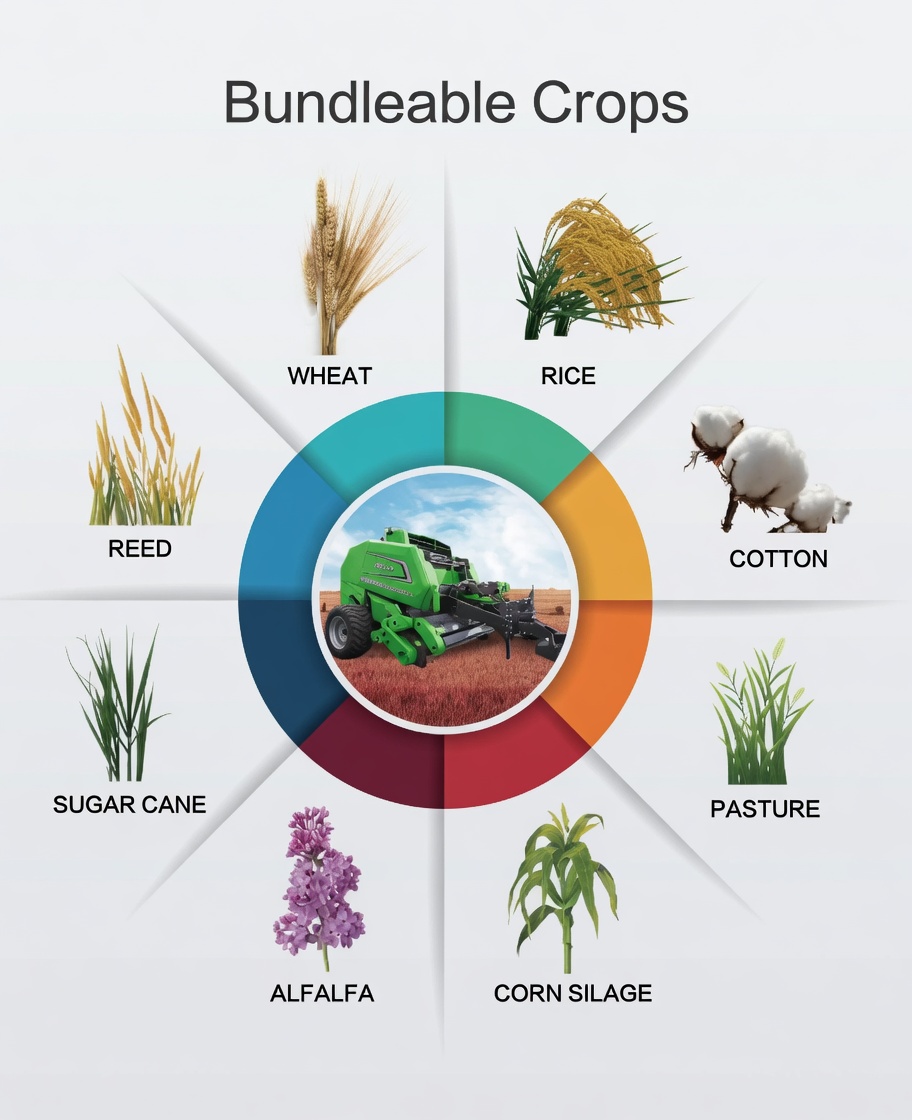
The 9YQ-1250’s spring tooth direct feed and rope wrapping system are best matched to dry or semi-dry hay crops at below 20% moisture. The machine is designed for farms producing moderate bale volumes from light-to-medium windrows on small paddock areas.
Oaten and Wheaten Hay
The primary application. Cured oaten and wheaten hay at 14–18% moisture bales cleanly through the spring tooth direct feed into the roll drum chamber. Light straw-type material feeds evenly from a 1250 mm reel at the crop volumes the 9YQ-1250 is designed to process, and rope wrapping holds the dried hay bale shape reliably through storage and handling.
Cured Ryegrass and Mixed Pasture Hay
Ryegrass and mixed pasture cut and left to cure to below 20% moisture bales well in the 9YQ-1250. At this moisture level, the bale holds its shape under rope tying and stores reliably in a shed or under cover outdoors. For high-moisture silage applications from the same crop types, the 9YQ-1950 with net wrap is the more appropriate machine.
Vetch, Clover, and Legume Hay
Cured vetch and clover hay at below 18% moisture bales cleanly through the 9YQ-1250. The spring tooth pickup handles the fine-stemmed, leafy material well at 1250 mm width, and the roll drum chamber compresses the light material consistently. Ensure full curing to below 18% before baling — legume material at higher moisture is more prone to heating in storage under rope-tied bales than cereal straw.
Sheep and Small Livestock Farms
Sheep farms and small mixed livestock properties baling moderate quantities of hay for supplementary feeding are the natural market for the 9YQ-1250. The Φ800 mm bale format is manageable for sheep-farm feeding systems, and the annual volumes these operations typically bale — hundreds rather than thousands of bales — are well within what the machine can deliver across a season.
Lifestyle and Hobby Farms
Lifestyle properties with horses, a few cattle, and paddocks producing hay each season benefit most from the 9YQ-1250’s combination of small tractor compatibility, compact size, and low consumable cost. The machine handles the baling needs of these properties without requiring a capital investment in a machine sized for volumes they will never produce.
Light Post-Harvest Straw Baling
Light wheat and cereal straw windrows from a small combine — particularly in lower-yield seasons — are well-matched to the 9YQ-1250’s 1250 mm pickup and direct feed system. For heavier post-harvest straw baling from wide-header combines, a square baler in the 9YF series may be more appropriate for the windrow widths and volumes involved.
Getting the Best from the 9YQ-1250 Each Season
The 9YQ-1250’s simpler mechanical design means fewer maintenance checkpoints than the larger dual-stage feeder machines — but the fundamentals of good baling practice still apply. These habits keep the machine producing consistent bales across the season.
Bale Below 20% Moisture — Strictly
The 9YQ-1250 uses rope wrapping — not net wrap. Rope holds a bale’s shape adequately in dry hay but is less forgiving of high-moisture bales that are soft when ejected and likely to slump before the rope holds them in storage. Keep crop moisture below 18% for reliable rope-tied bale shape retention across all the hay types this machine handles. Use a hay moisture meter if field conditions are variable near the end of a curing window.
Match Windrow Width to the 1250 mm Reel
If your mower or mower-conditioner produces a windrow wider than 1250 mm, rake or merge windrows before baling to bring them within the reel’s 1250 mm capture width. Operating the 9YQ-1250 over a 1600 mm windrow with a 1250 mm reel leaves 350 mm of windrow width uncollected on every pass — material that must either be re-baled in a second pass or left on the ground. A correctly matched windrow width means every bale is a full-weight bale with no leftover crop strips in the field.
Inspect the Rope Tying Mechanism Before Each Run
The rope wrapping mechanism is the 9YQ-1250’s tie system — check it before the first bale of each session. Inspect the rope routing path for kinks, the tying bill hook for timing and wear, and the rope spool level. A wrapping failure mid-field produces an untied bale that must be re-run — a simple pre-run check prevents this far more reliably than reacting to a failure in the paddock. Keep a spare rope spool in the tractor cab for fast changeover when the current spool runs out.
Pre-Season Roller Check — All 16
Inspect all 16 compression rollers before the first bale of each season for bearing play, surface wear, and correct seating in their journal positions. The 9YQ-1250’s 16-roller array applies compression on the smaller Φ800 mm bale — any roller with elevated bearing play or surface wear creates a detectable soft band on the bale circumference at that angular position. Catching and replacing worn rollers pre-season takes an hour; diagnosing the same issue mid-season while the crop is sitting in the field takes longer and costs more.
Set Pickup Height for the Crop Surface
The 9YQ-1250’s 1250 mm spring tooth reel needs correct height setting for clean crop capture without soil contamination. Set too low on flat, firm paddock surfaces and tines drag soil into the direct-feed channel. Set too high and fine hay material at the windrow base — particularly leaf material from lucerne or clover — is left on the ground uncollected. Adjust height at the start of each new paddock and check again when surface conditions change noticeably during the run.
Grease All Points — Simpler on This Machine
The 9YQ-1250’s simpler mechanical design means fewer grease points than the dual-stage feeder machines — but consistent lubrication at each fuel stop is equally important here for roller bearings, reel shaft bearings, and PTO shaft joints. At 1000 kg operating weight, the bearings and drive components work within a lower load envelope than the heavier machines, but correct greasing maintains the service life that the compact design is sized for. The maintenance schedule provided with each machine lists all service points and recommended intervals.

Entry-Level Roll Drum Baler Technology, Factory-Direct from EverPower Australia
The 9YQ-1250 is available directly from EverPower Baling Machinery Australia Pty Ltd, 27 Harley Crescent, Condell Park NSW 2200. Learn more at silage-baler.com/about-us.
Factory-Direct Pricing — No Distributor Margin
EverPower manufactures and supplies the 9YQ-1250 direct to Australia without a reseller chain. For a small farm buyer where budget is a primary constraint in the purchase decision, this direct supply model means more machine value per dollar spent compared to purchasing through a distributor or dealer network that adds margin at each tier.
NSW Spare Parts — Tines, Rollers, Rope Mechanism
Spring pickup tines, compression roller bearings, and rope wrapping mechanism components for the 9YQ-1250 are held at our Condell Park NSW facility. For a small farm where the machine may only be used for a few weeks per year, having locally available parts means a repair can be completed quickly rather than waiting weeks for international freight — keeping the machine ready for the next season without long lead times for simple wear items.
Setup Support for First-Time Baler Buyers
Our Sydney-based team provides setup guidance for first-season buyers — including pickup height setting, rope routing and tension adjustment, PTO connection, and basic maintenance schedule — by phone and email in English. Contact us at 61 2 9708 3322 or [email protected]. Many buyers of the 9YQ-1250 are first-time baler operators — we account for this in our support approach.
Frequently Asked Questions
Common questions from small farm owners and lifestyle property buyers evaluating the 9YQ-1250 Round Hay Baler.