
The Labour Bottleneck Every Hay Operation Faces After the Baler
For most Australian hay operations, the baler is the headline machine — it is the piece of equipment that determines how many bales per hour the paddock produces. But the baler is only half the productivity equation. Once a small square bale is ejected onto the ground, it must be picked up, transported, and stacked in a shed or on a truck. This post-baler handling is where labour hours accumulate, where worker injuries occur most frequently, and where the effective throughput of the whole operation is actually determined. A baler producing 80 small square bales per hour means nothing if the shed stacking crew can only process 50 per hour — the baler will be slowed, bales will accumulate in the paddock in the sun and weather, and the day’s output will be limited by the slowest human in the chain rather than by the machine. The 9JYY-4.5 Hay Baler Conveyor from EverPower Baling Machinery Australia is a purpose-built belt conveyor that connects the baling operation to the shed stacking operation, moving bales continuously from the paddock pickup point to the stack height required without additional manual lifting. This guide covers how it works, what operations it suits, how to set it up correctly, and what to consider when evaluating it against other bale-handling options.
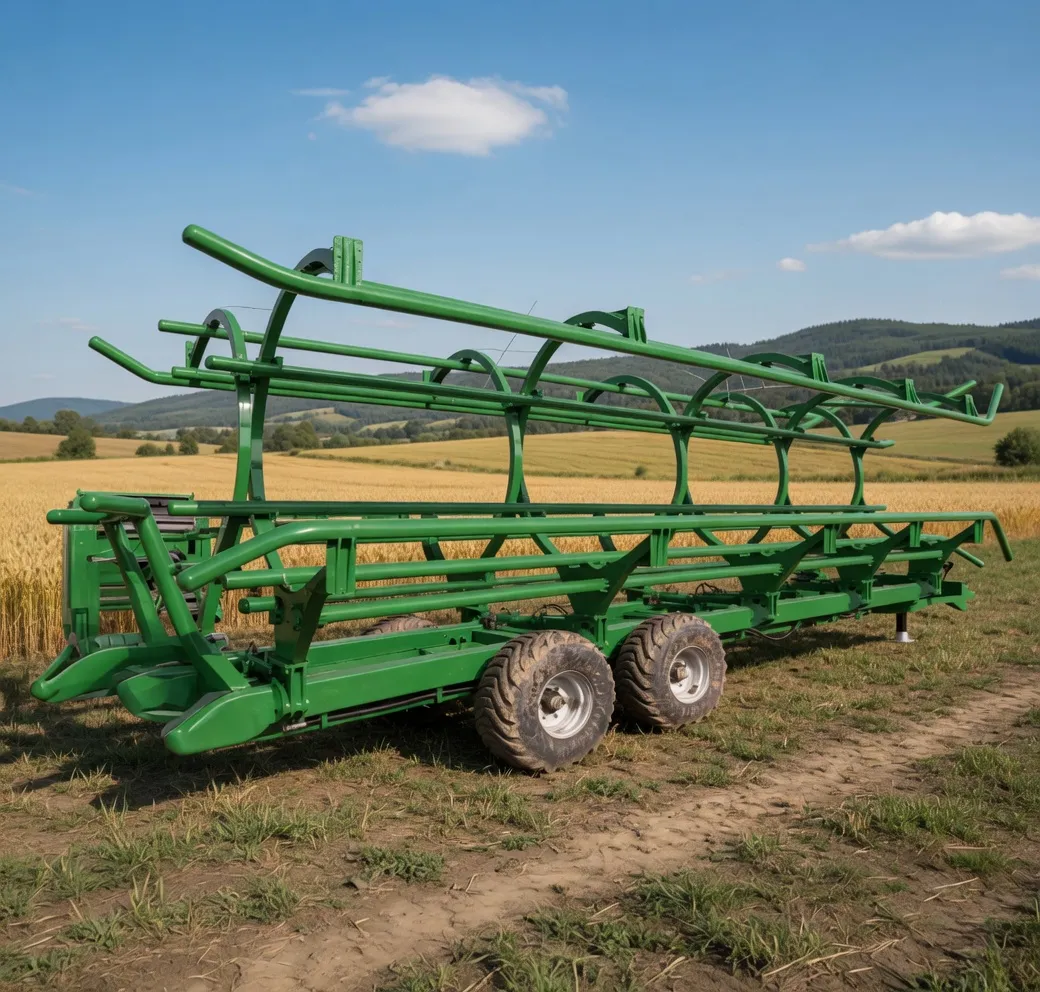
The 9JYY-4.5 Hay Baler Conveyor moves small square bales from ground level to shed stack height continuously, eliminating the manual lifting that is the most time-consuming and injury-prone part of the hay handling operation.
What Is the 9JYY-4.5?
The 9JYY-4.5 is a motorised belt conveyor with a 4.5-metre working length, designed specifically for small square hay bales in the 15–35 kg weight range. The conveyor carries bales on a continuous belt from a ground-level infeed point — typically positioned at the shed doorway or truck loading position — upward at an adjustable angle to the stack or truck deck height required. The 4.5-metre length allows the conveyor to reach stack heights of approximately 2.2–2.8 metres at typical operating angles of 25–35 degrees, covering the full height of a standard Australian hay shed stack without repositioning.
The belt is driven by an electric motor — typically 0.75–1.1 kW, single-phase 240 V — which means it can run from a standard shed power outlet without 3-phase infrastructure. Belt speed is set for consistent bale flow at approximately 0.3–0.5 m/s — fast enough to maintain continuous bale throughput, slow enough for the stacker at the top to position each bale accurately without rushing. The model designation reflects the machine category (9JYY = conveyor for hay bale operations) and the working length (4.5 metres).
Key Specifications
Who Uses the 9JYY-4.5? Five Typical Operations
Small square bale hay producers
Operations baling and stacking 5,000–50,000 small square bales per season. The 9JYY-4.5 replaces or reduces the manual relay chain — the line of people passing bales hand-to-hand from the paddock pickup point into the shed. One person feeds bales onto the conveyor at ground level; one person at the top stacks. The middle of the relay chain is eliminated.
Hay retailers and feed merchants
Businesses receiving hay deliveries and stacking into retail sheds. Manual unloading of truck deliveries — typically 300–500 bales per truck — is the highest-injury-risk activity in the operation. A conveyor positioned at the truck tail allows the driver or one person on the truck to slide bales onto the conveyor while one person in the shed stacks, reducing both the labour requirement and the manual handling risk.
Equine and lifestyle properties
Horse properties and small hobby farms receiving annual hay deliveries of 200–1,000 bales. These operations often have no dedicated farm labour — the owner handles deliveries personally. A conveyor allows one person to unstack a truck and stack a shed without assistance, removing the need to organise helpers for delivery days.
Livestock farms with regular small bale supplementary feeding
Operations feeding 20–60 small square bales per day as supplementary hay to sheep, goats, or cattle. A conveyor positioned from the hay shed to a feed preparation area reduces the daily carry distance and lifting required, making it practical for one person to prepare and distribute the full day’s hay allocation without physical strain.
Hay baling contractors
Contract baling operations that provide a complete bale-and-stack service. Carrying a 9JYY-4.5 on the service vehicle allows the contractor to complete the stacking phase without relying on the farm to provide manual labour — a service differentiator that justifies a higher per-bale contract rate and reduces scheduling dependencies.
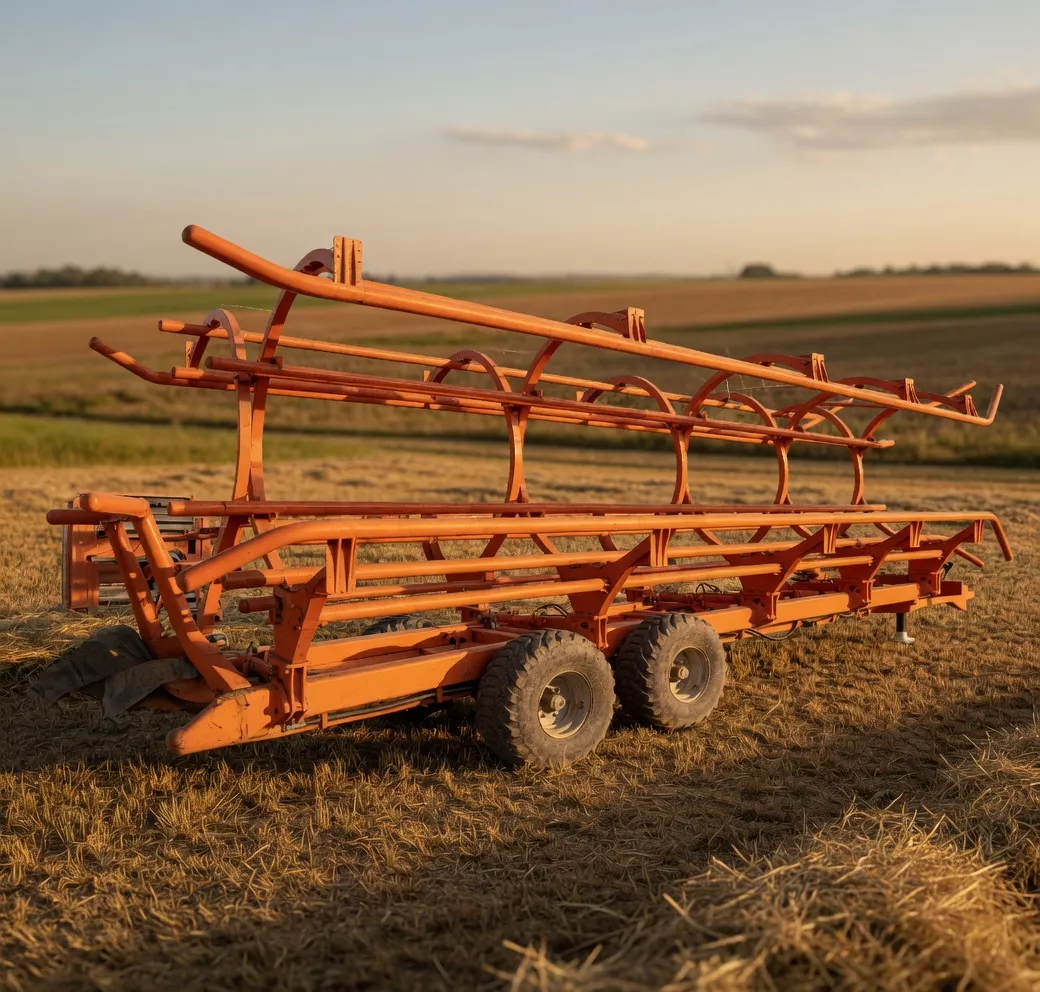
Positioned at the shed entrance or truck tailgate, the 9JYY-4.5 eliminates the middle steps of the manual relay chain — reducing crew requirements from 3–5 people to 2 while increasing throughput per person.
Setup: Getting the 9JYY-4.5 Running in Under 15 Minutes
Position the lower end
Place the conveyor’s lower (infeed) end at the point where bales will be fed onto it — shed doorway, truck tailgate, or the spot in the paddock where the bale accumulator deposits bales. The lower end should sit at a comfortable working height for the feeder (approximately 400–600 mm above ground).
Set the elevation angle
Adjust the conveyor’s angle using the elevation support legs to deliver bales to the stack height required. For a 2.4-metre stack, set the upper end to 2.6–2.7 metres (allowing the stacker to position bales without raising them above head height). Lock the elevation adjustment before starting the motor.
Connect power
Plug the 240 V single-phase motor into a standard shed outlet or extension lead rated for the motor current (typically 6–8 amps). Confirm the extension lead is rated for outdoor use and the run length does not cause excessive voltage drop — a 25-metre lead of 1.5 mm² cable is adequate for the 9JYY-4.5 motor current.
Test run before loading
Run the belt empty for 30 seconds and confirm it tracks centrally without drifting to either side. A belt that drifts to one side indicates the tracking adjustment needs correction before bales are loaded — a bale that falls off a misaligned belt at 2.5 metres height is a safety hazard.
EverPower 9JYY-4.5: Available in Australia
The 9JYY-4.5 is available from EverPower Baling Machinery Australia at the Condell Park NSW warehouse. Contact EverPower at +61 2 9708 3322 or [email protected] for current pricing and delivery timeframes. The 9JYY-4.5 weighs approximately 65–80 kg and can be transported in a standard ute tray or trailer — no special lifting equipment is required for site deployment.
Recommended Product: 9JYY-4.5 Hay Baler Conveyor
4.5-metre motorised belt conveyor for small square hay bales up to 35 kg. 0.75–1.1 kW single-phase 240 V motor — runs from any standard shed outlet. Adjustable elevation from 20–40 degrees, reaching stack heights of 2.2–2.8 m. Up to 400–500 bales per hour throughput. Approx. 65–80 kg — transportable in a ute tray. Available from EverPower’s Condell Park NSW warehouse, Australia-wide delivery.
Frequently Asked Questions
Cut Hay Stacking Labour in Half. Start With the 9JYY-4.5.
EverPower can advise on setup, power requirements, and delivery for the 9JYY-4.5 on your property.
EverPower Baling Machinery Australia Pty Ltd | 27 Harley Crescent, Condell Park NSW 2200
📞 +61 2 9708 3322 | ✉️ [email protected]