Baling Hay for Export: Meeting Overseas Buyer Standards
What Japan, South Korea, and the UAE actually specify when they order Australian hay — moisture limits, density, visual quality, and the baling management that keeps containers moving.
Australian Export Hay: A $500 Million Industry Built on Bale Consistency
Australia exports approximately 1.0 to 1.5 million tonnes of hay annually, generating AUD $450 to $600 million in export revenue at current prices. South Australia’s grain belt and Murray Mallee, Western Australia’s Wheatbelt, and NSW’s Riverina supply the majority. The primary destinations — Japan, South Korea, the UAE, and increasingly China — are large commercial dairy and equine operations that purchase in container loads of 18 to 24 tonnes and specify hay quality in precise numerical terms that differ meaningfully from the domestic market.
The gap between domestic hay production and export hay production is not primarily about growing better grass — it is about baling, handling, and documentation consistency. An SA or WA hay producer making good oaten or wheaten hay for domestic sheep feeding can produce it at 17% moisture and bale it in variable weights without penalty. The same producer exporting to a Japanese hay importer must deliver bales at below 14% moisture (Japan’s quarantine authority imposes re-import inspection on any lot testing above 14%), within a specified weight range (typically ±5% of the contracted bale weight), with no visible mould or weed contamination, and with phytosanitary documentation that certifies freedom from regulated pests.
This article covers the specific baling management requirements for export hay production — the moisture targets, density standards, handling protocols, and visual quality criteria that determine whether a container clears Japanese customs or is rejected at the port. For context on which silage baler configurations work best across oaten hay, ryegrass, and lucerne — the three primary Australian export hay species — our article on which silage baler works best for ryegrass, lucerne, and oats covers equipment selection across these species in detail.
What Overseas Buyers Actually Specify — Market by Market
Japan: The Most Demanding Market and the Largest Volume
Japan imports approximately 900,000 to 1,100,000 tonnes of hay annually — predominantly from Australia and the USA — for its intensive dairy and beef cattle sector. Japan’s Ministry of Agriculture, Forestry and Fisheries (MAFF) and the Plant Protection Station impose some of the strictest import phytosanitary requirements of any hay market globally. Key specifications for Australian hay exported to Japan:
| Parameter | Japan Specification | Risk if Missed |
|---|---|---|
| Moisture at port arrival | ≤14% (MAFF standard) | Fumigation cost + re-inspection |
| Weed seeds | Zero tolerance for 10 listed species including wild oat | Full container rejection |
| Mould (visible) | Zero on bale surface | Rejection at port inspection |
| Bale weight consistency | ±5% of contracted weight | Yen-per-kg price adjustment |
| Pest insects | Zero live insects at inspection | Fumigation at importer’s cost to exporter |
| Phytosanitary cert | DAFF-issued, per shipment | Shipment held at port without cert |
South Korea: Volume Growth, Similar Standards to Japan
South Korea’s hay import market has grown at 8 to 12% annually since 2018, driven by expanding dairy and beef finishing sectors. Korean specifications are broadly similar to Japan’s moisture and mould requirements, with some differences in weed seed tolerance lists. Korean importers typically specify Timothy hay and oaten hay from Australia for equine and dairy use, and are increasingly specifying lucerne for dairy protein supplementation. The Korean market has shown willingness to pay AUD $15 to $30 per tonne premiums for hay certified under the Sustainable Agriculture program or with verified paddock-level traceability documentation.
UAE and Middle East: Volume, Less Documentation Intensity
The UAE and Saudi Arabia import large volumes of Australian and US hay for their dairy and equine industries, with somewhat less documentation intensity than Japanese requirements. Moisture specifications of ≤16% (versus Japan’s ≤14%) provide more production flexibility for Australian exporters. The Middle East market is the most price-sensitive of the three major destinations — buyers are less willing to pay quality premiums but require very consistent bale weights for container loading efficiency. A container of 220 bales with ±10% weight variation loads consistently; the same container with ±25% weight variation produces void space that reduces the tonnes per container and increases the per-tonne freight cost.
Baling Management for Export-Specification Hay
Moisture: The Most Critical and Most Commonly Failed Specification
The single most common cause of export hay rejection at Japanese and Korean ports is moisture above the specification limit. A bale that leaves the SA grain belt at 13.5% moisture in October may arrive at Osaka in late November at 15 to 16% moisture — not because the hay absorbed water, but because the ‘dry’ reading in October reflected the surface and outer layers, while the interior moisture was still equilibrating. Export hay must be tested from the bale core, not the surface. A bale that measures 13.5% on the surface probe may measure 15 to 17% from an extracted core sample.
The export-standard moisture testing protocol: after raking and before baling, test moisture from the windrow base (the slowest-drying layer) at 5 to 8 points across the paddock. Do not begin baling until the base reading is below 13% consistently — the bale interior will average 0.5 to 1.5 percentage points above the windrow base reading. In SA and WA conditions with low humidity and consistent summer sunshine, this typically requires 4 to 6 days from mowing for oaten hay.
Bale Weight Consistency — Why It Drives Container Economics
A standard 20-foot reefer container carries 18 to 22 tonnes of hay depending on bale density. At the contracted bale weight (typically 280 to 350 kg for large round bales in the Japanese export market), the container holds 51 to 78 bales. A ±5% weight tolerance means the container loads predictably — a ±20% weight variation means some containers are underloaded (costing freight per tonne) and others risk overloading (a legal compliance issue for container truck weights in Japan). The importer’s purchasing agreement typically includes a weight adjustment clause that docks the price per bale when average weight falls below specification.
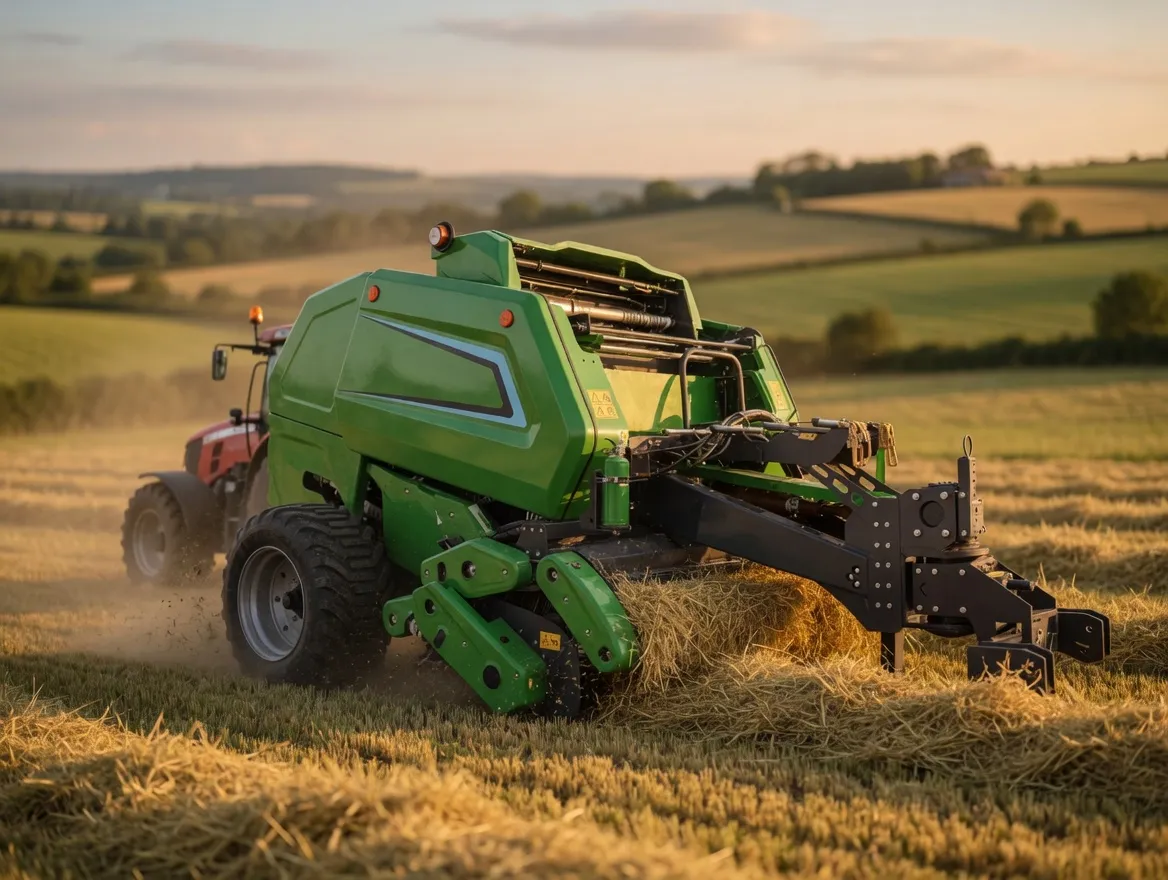
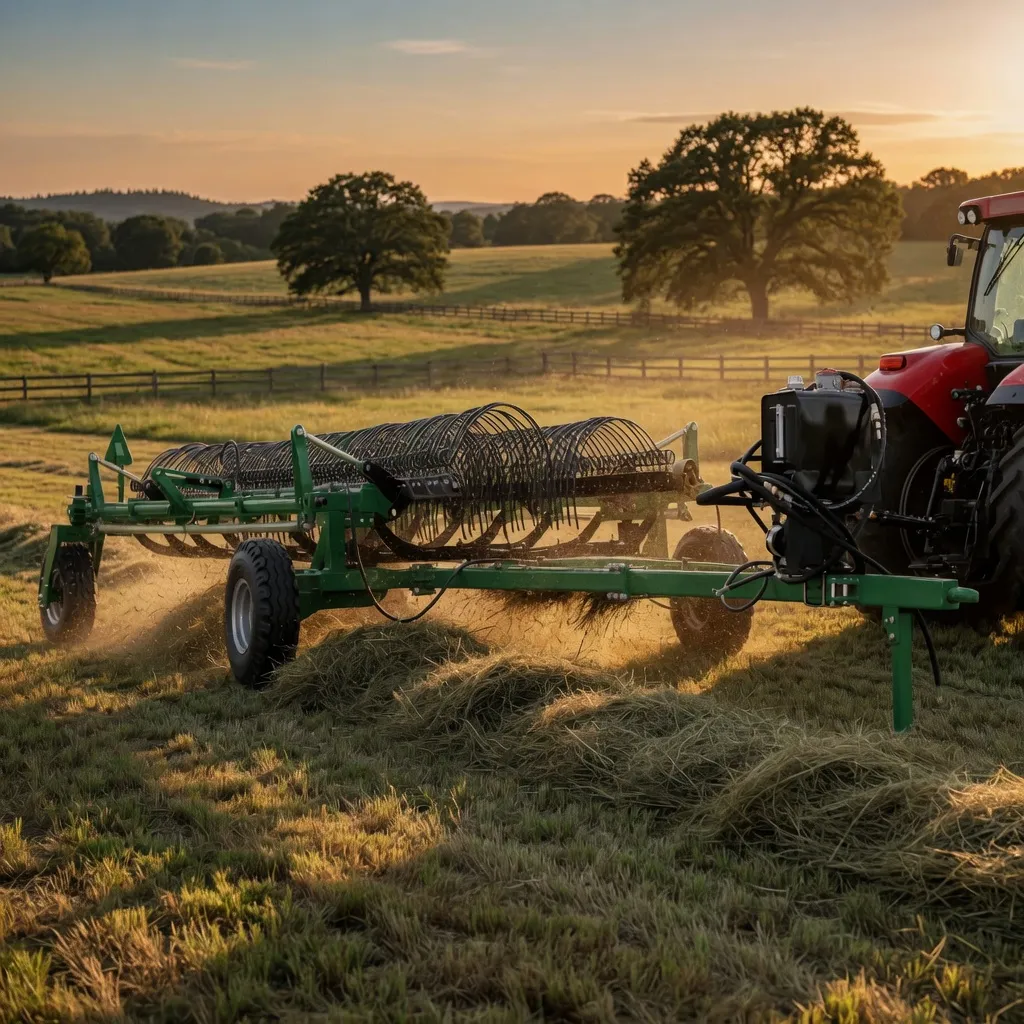
Consistent bale weight from a round baler requires: consistent windrow width and density (achieved with the correct rake setup and consistent forward speed), variable-chamber pressure control that adjusts to windrow density variation, and periodic bale weight checks throughout the baling session. Weigh every 10th bale against a certified portable scale and adjust chamber pressure if weight drift exceeds ±4% from the target. The 9YG-2.24D S9000 Beyond round baler provides the chamber pressure control and high-density bale capability that export specification weight consistency requires — at commercial daily throughput rates suited to the large paddock areas typical of SA and WA export hay operations.
Weed and Pest Control: The Hidden Rejection Risk
Japan’s Regulated Weed Seed List — Know It Before You Bale
Japan’s regulated weed seed list for imported hay includes wild oat (Avena fatua), nodding thistle (Carduus nutans), and several other species common in SA and WA cereal hay paddocks. A single regulated weed seed per 900 gram sample (the standard inspection sample size) triggers rejection of the entire container. For SA and WA hay producers baling from paddocks with any wild oat presence, the risk is real and the consequences (loss of container value of AUD $8,000 to $14,000 plus return freight if applicable) are severe.
Prevention requires paddock selection and pre-baling inspection: only use paddocks with documented clean weed status for the two years prior to export hay cutting, walk paddocks at the visual inspection stage 3 to 4 weeks before cutting to confirm absence of regulated species, and if any doubt exists about weed status, do not bale those paddocks for export. The cost of a domestic-market alternative for a suspect paddock is always lower than the cost of a rejected shipment.
Fumigation Requirements and Timing
Most Australian hay for Japan and Korea is fumigated in-container at the port of loading with methyl bromide or phosphine (depending on destination country requirements and Biosecurity Australia approvals). Fumigation adds AUD $180 to $350 per container to the export cost and takes 48 to 72 hours at the port, which must be factored into container booking and vessel cut-off timing. Some hay exporters fumigate on-farm in sealed containers before transport to port — this approach reduces port handling and reduces moisture pick-up from ambient conditions during port storage.
Handling and Transport: Getting Bales to Port in Specification
Bale Handling Without Quality Loss
Export hay bales that meet specification at the farm gate can lose specification during handling. The most common handling-related quality failures are: bale spike damage that creates visible puncture marks on the outer wrap (a cosmetic defect that Japanese port inspectors note, and that signals potential internal damage); plastic net wrap fragments that detach during handling and are found loose in the container (a contamination rejection trigger); and bale deformation from handling equipment with poorly maintained or incorrectly sized attachments.
Use bale handling attachments rated for the full bale weight with a minimum 20% safety margin. For 320 kg export hay bales, this means a 400 kg+ rated bale spike or squeeze attachment. Inspect all bales during loading for visible damage, deformation, or net wrap separation and segregate any damaged bales from the export lot before they reach the container. The 9JYYD-4.5 hay baler conveyor provides a gentle mechanical handling path from bale ejection to stacking that minimises impact damage compared to direct loader-spike handling on uneven field surfaces.
Documentation: What Export Hay Paperwork Actually Requires
| Document | Issuing Authority | When Needed | Cost |
|---|---|---|---|
| Phytosanitary Certificate | DAFF (Australian Dept. Agriculture) | Per shipment, before vessel loading | AUD $80–$180/shipment |
| Fumigation Certificate | Licensed fumigator | After fumigation, per container | Included in fumigation fee |
| Certificate of Origin | Chamber of Commerce | For tariff preference claims | AUD $30–$60 per cert |
| Hay Quality Analysis | NATA-accredited laboratory | Per lot, 1 sample per 20 t minimum | AUD $45–$90 per sample |
| Bill of Lading | Shipping line | Per container | Included in freight |
| Grower Declaration | Exporter’s own form | Per lot | No cost — internal document |
Export hay buyers in Japan increasingly require grower-level declarations confirming: paddock was not spray-irrigated with treated water, no prohibited pesticides were applied in the 12 months prior to cutting, and no regulated weed species were observed at pre-cutting inspection. This is not a government-issued document — it is a voluntary declaration from the grower to the exporter. Japanese importers request it to complete their own supplier due diligence records. Provide it proactively; buyers remember the suppliers who make their paperwork easy.
Frequently Asked Questions From SA and WA Export Hay Producers
Discuss Your Export Hay Baling Setup
Tell us your target market, crop species, annual volume, and current moisture management — we’ll specify the right baler and handling equipment for export-specification production.