
Hay Stacking Injures More Australian Farm Workers Than Almost Any Other Task
Manual hay stacking is among the most physically demanding and injury-prone tasks in Australian agriculture. SafeWork NSW agricultural injury data consistently identifies hay handling as a high-risk activity for musculoskeletal disorders — back strain, shoulder rotator cuff injuries, wrist tendinopathy, and knee injuries from repeated crouching and twisting on uneven stacked surfaces. The mechanics are straightforward: a 25 kg bale lifted from ground level to 2.4 metres requires the worker’s spine to absorb a compressive load significantly above safe manual handling guidelines, particularly when the lift is combined with a lateral twist to place the bale in position. Multiplied across 400–800 bale lifts in an 8-hour day, the cumulative spinal load produces micro-trauma that accumulates over seasons until a single event causes acute injury. The 9JYY-4.5 Hay Baler Conveyor does not eliminate all physical work from hay stacking, but it eliminates the specific movements that generate the highest injury risk — the vertical lift to height, and the sustained overhead hold while positioning — replacing them with lateral slides and pushes that keep the spine in a neutral, low-risk posture throughout.
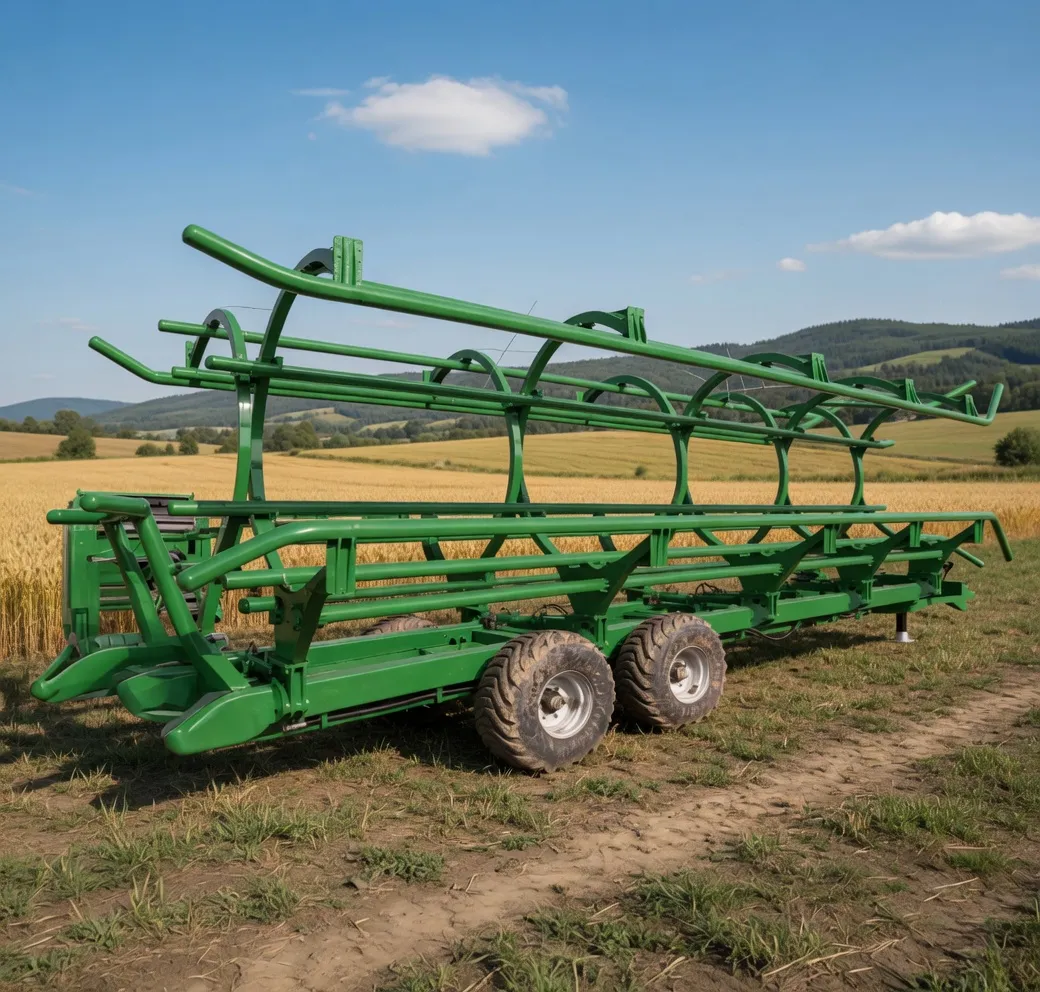
The 9JYY-4.5 replaces high-risk vertical lifting with low-risk sliding and pushing — keeping workers’ spines in safe neutral postures throughout a full stacking day rather than accumulating compressive load with every bale lift.
Understanding the Biomechanics of Manual Bale Lifting
When a worker lifts a 25 kg bale from ground level, the spine acts as a lever. The lumbar vertebrae are the pivot point; the back muscles are the force generators; the bale’s weight at arm’s length is the load. Due to the mechanical disadvantage of the lever system, the compressive force on the L4/L5 disc during a floor-to-overhead lift of a 25 kg bale is approximately 3,500–4,500 Newtons — well above the 3,400 N threshold beyond which Australian manual handling guidelines recommend engineering controls be implemented.
The situation worsens when the worker is standing on an unstable surface (the top of a hay stack), performing the lift with a twisting motion (turning to place the bale in position), or operating with fatigue from previous lifting (later in the day). Each of these factors multiplies the spinal load above the baseline figure. A fatigued worker performing a twisted overhead lift of a 25 kg bale on an uneven surface can impose spinal compressive loads of 6,000–8,000 N — well into the range associated with acute disc injury.
With the 9JYY-4.5, the feeder performs a slide-and-push motion from approximately hip height to the belt surface — a movement with a spinal compressive load of approximately 800–1,200 N. The stacker at the top performs a lateral push from the belt end to the stack position — approximately 600–900 N. Neither movement involves overhead lifting, trunk flexion beyond 30 degrees, or lateral twisting under load. These loads fall well within safe manual handling guidance for continuous repetitive work.
The Three Highest-Risk Movements in Manual Hay Stacking — and How the Conveyor Eliminates Each
Floor-to-overhead lift
In manual stacking, the top-layer stacker lifts each bale from chest height (where it arrives from the person below) to above shoulder height to place it on the top layer. This overhead lift with a loaded bale is the single highest-risk movement in the entire operation. The 9JYY-4.5 eliminates this by delivering bales at the stacker’s chest height at all stack levels — when the stacker positions themselves at the correct height, the bale arrives at a level that requires a push rather than a lift to position.
Sustained carry over distance
In a manual relay chain, each person carries a bale for 3–4 metres before passing it to the next person. Carrying a 25 kg bale with arms extended for any distance requires continuous isometric contraction of the spinal erector muscles — sustained muscle contraction that causes fatigue accumulation faster than intermittent lifting. The 9JYY-4.5 eliminates this: the feeder handles the bale for under 1 metre before it is on the belt; the stacker handles it for under 0.5 metres from the belt to the stack.
Repetitive forward bending from ground level
In operations where bales must be picked up from the paddock ground — during a bale-up session or from a low-level accumulator — bending to hip level or lower to grip each bale is a high-risk repetitive posture, particularly 400+ times in a day. The 9JYY-4.5’s infeed is positioned at 400–600 mm above ground level — the infeed height — bringing the bale pickup point to a level where minimal forward bending is required.
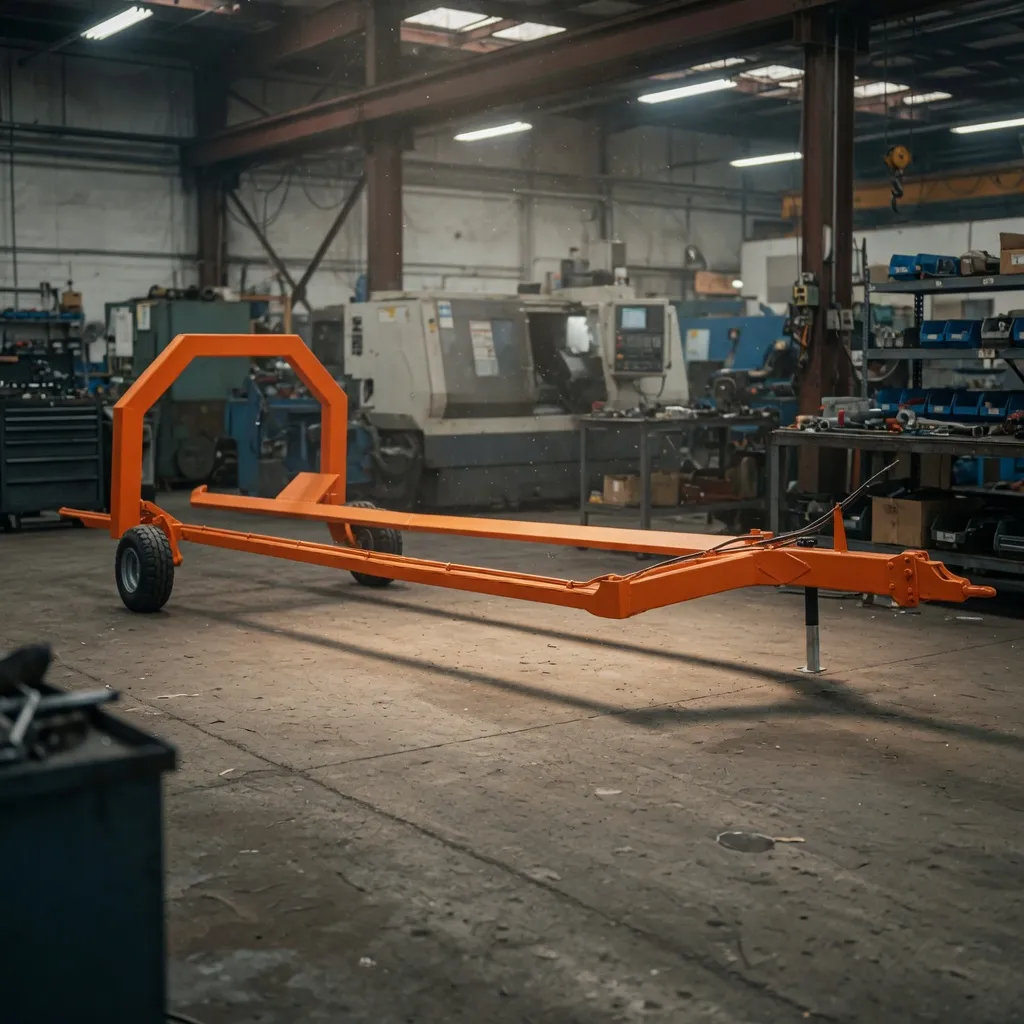
Combining a bale transporter with the 9JYY-4.5 conveyor addresses manual handling risk at every stage — from field to shed — creating a system where no worker needs to carry a bale more than one step or lift it above hip height at any point.
What Australian Manual Handling Regulations Require
Safe Work Australia’s Model Work Health and Safety Regulations require employers to manage the risk of musculoskeletal disorders from manual tasks. The hierarchy of controls — eliminate, substitute, isolate, engineer, administrate, PPE — places engineering controls (such as a conveyor) above administrative controls (such as job rotation and rest breaks) in effectiveness and enforceability. An employer who provides a conveyor has implemented an engineering control that significantly reduces the musculoskeletal risk profile of hay stacking. An employer who relies only on job rotation and safe-lifting training to manage the same risk is applying a lower-effectiveness control that may not satisfy a regulator’s assessment if a worker is injured.
This regulatory context means the 9JYY-4.5 is not just a productivity tool but a compliance tool for operations that employ paid workers for hay stacking. The investment in a conveyor can be justified in part as a risk management expenditure that reduces both WorkCover premium exposure and potential liability in the event of a worker injury claim.
The Role of Fatigue in Hay Stacking Injuries
Most hay stacking injuries do not occur on the first bale of the day — they occur on the 300th or 400th bale, when the worker’s muscles are fatigued and their movement quality has deteriorated from the morning standard. Fatigued muscles generate less force per contraction, which means the spine and joints absorb a higher proportion of each movement’s load as passive structural stress rather than active muscle support. A manual stacker who is performing overhead lifts correctly at 8:00 AM is performing them with progressively worse form by 2:00 PM — the injury risk doubles or triples as the day progresses.
The 9JYY-4.5 dramatically reduces the fatigue accumulation rate. The energy expenditure of a slide-and-push pattern at the conveyor is approximately 30–40% of the energy expenditure of a lift-and-carry pattern for the same number of bales. The stacker on a conveyor system is measurably less fatigued at 2:00 PM than a manual chain stacker who processed the same number of bales — which means they are performing the reduced movements with better form, lower injury risk, and sustained throughput.
Recommended Product: 9JYY-4.5 Hay Baler Conveyor
Eliminates floor-to-overhead lifting, sustained bale carry, and repetitive deep forward bending — the three highest-risk movements in manual hay stacking. Engineering control that satisfies Safe Work Australia’s hierarchy of controls for musculoskeletal risk. Reduces stacker energy expenditure by approximately 65–70% compared to manual overhead stacking. Available from EverPower’s Condell Park NSW warehouse with Australia-wide delivery.
Frequently Asked Questions
Protect Your Workers. Protect Your Business. Use a Conveyor.
EverPower can confirm the 9JYY-4.5 suits your operation and provide current delivered pricing to your location.
EverPower Baling Machinery Australia Pty Ltd | 27 Harley Crescent, Condell Park NSW 2200
📞 +61 2 9708 3322 | ✉️ [email protected]