
A Conveyor That Fails Mid-Delivery Costs More Than Its Maintenance
The 9JYY-4.5 Hay Baler Conveyor has a simple mechanical design — a continuous belt, a drive roller, a tension roller, and a single-phase motor. With fewer moving parts than almost any other piece of farm machinery, it rarely fails unexpectedly when correctly maintained. The failures that do occur almost always have a traceable history: a belt that was running off-centre and not corrected, a drive roller bearing that was grinding before it seized, a belt tension that had been slack for a season before it finally started slipping under full load. Understanding the maintenance tasks that prevent these failures — and recognising the early warning signs that precede them — keeps the 9JYY-4.5 running reliably through every delivery day. This guide also covers the safety checks that are particularly important for a machine that carries 25–35 kg bales to heights of 2.5 metres, where a dislodged bale is a serious falling-object hazard.
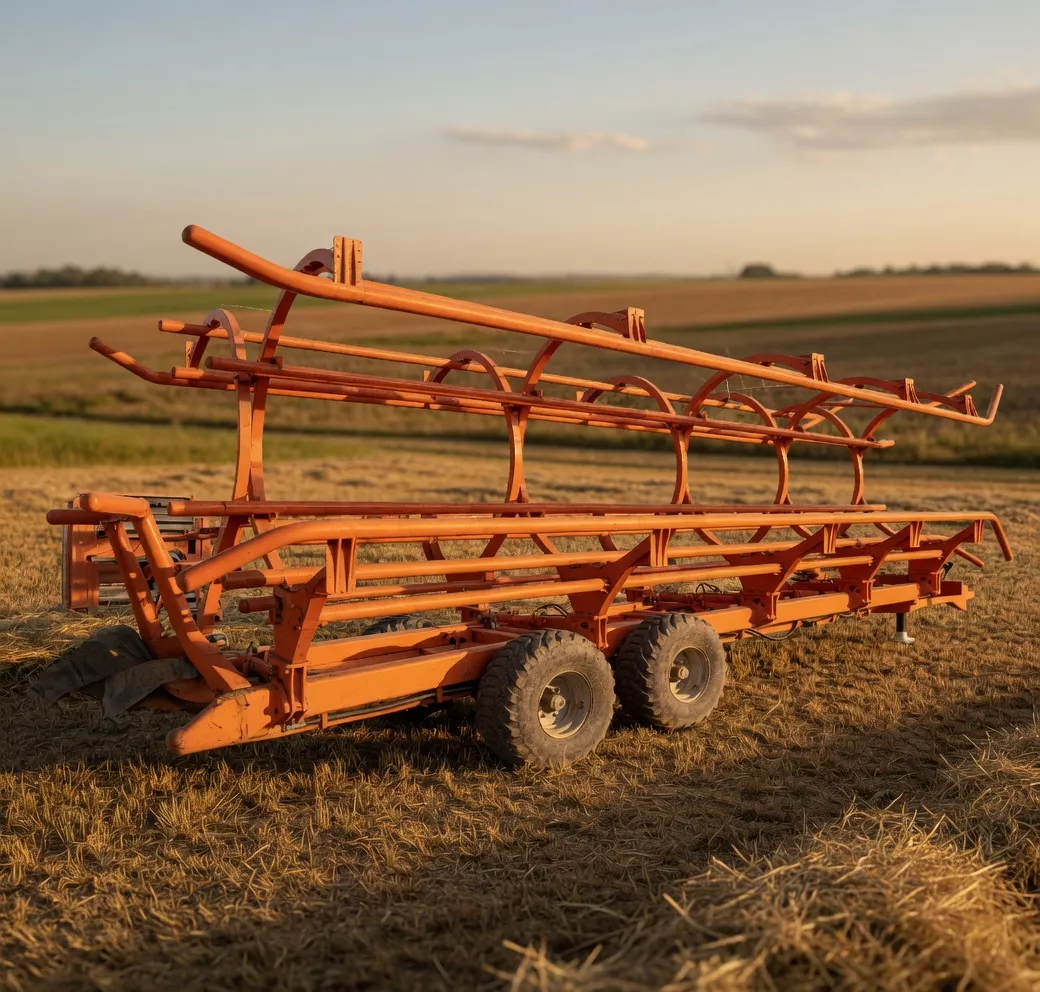
The 9JYY-4.5’s simple mechanical design makes maintenance straightforward — most service tasks take under 15 minutes with basic hand tools and can be completed by the operator without specialist knowledge.
Belt Maintenance: The Most Important Wear Item
The conveyor belt is the primary wear component of the 9JYY-4.5 and the most critical safety element — a belt that fails under load drops bales from height. Three conditions require belt attention: misalignment (tracking off-centre), loss of tension (belt slipping on the drive roller), and surface wear or damage (cuts, delamination, or edge fraying).
Belt tracking: A correctly tensioned and aligned belt runs with equal distance between each belt edge and the corresponding frame rail throughout its full travel. Check tracking by running the belt empty and observing from the end — the belt should maintain a consistent central position without drifting to either side. If the belt drifts toward one side, use the belt-tracking adjustment bolts on the tension roller to tilt it slightly toward the opposite direction. Make small adjustments (one quarter turn per check) and re-observe before making further corrections — over-correcting creates oscillation that is harder to stop than steady drift.
Belt tension: Correct tension allows the belt to deflect approximately 20–30 mm under moderate hand pressure midway between the drive and tension rollers on the return (lower) run. Too loose and the belt slips on the drive roller under load, reducing effective belt speed and generating heat that accelerates drive roller surface wear. Too tight and bearing loads increase, accelerating roller bearing fatigue. Check and adjust tension at the start of each use season and after any belt extension due to stretching in service.
Surface inspection: Run a hand along the full belt surface at the start of each use season. Look and feel for cuts deeper than 5 mm, edge fraying that extends more than 20 mm from the belt edge, delamination bubbles where the belt layers have separated, and foreign material embedded in the belt surface that could catch on bale strings or twine. Any cut that exposes the belt’s internal fabric reinforcement layer should be flagged for replacement before the next use session — fabric exposure accelerates belt failure under the cyclic stress of bale loading.
Roller Maintenance: Bearings and Drive Surface
The 9JYY-4.5 has two primary rollers — the drive roller (motor end) and the tension roller (lower end) — plus one or more intermediate return rollers on longer models. Each roller runs in sealed bearings at both ends. Sealed bearings are largely maintenance-free but have a finite service life determined by load cycles and contamination. Agricultural environments expose roller bearings to dust, chaff, hay seed, and moisture — all of which accelerate bearing wear if the seals are compromised.
Check roller bearing condition by spinning each roller by hand with the belt stationary and the motor disconnected. A bearing in good condition spins freely and silently. A bearing showing early wear has a slight roughness — a subtle grinding sensation under the fingers. A bearing approaching failure has audible roughness and may have lateral play (the roller wobbles slightly side-to-side when pushed). Replace any bearing at the first sign of roughness — the cost of a sealed bearing is negligible compared to the cost of a seized roller that tears the belt or stops the operation mid-delivery.
The drive roller surface must maintain adequate grip on the belt to transmit motor torque without slipping under full load. Check the drive roller surface for hay seed, dust, and dried plant material packed into any surface texturing — these reduce grip. Clean the drive roller with a stiff brush before each use season. If the surface has worn smooth and slipping occurs under load even with correct belt tension, a new drive roller is required.
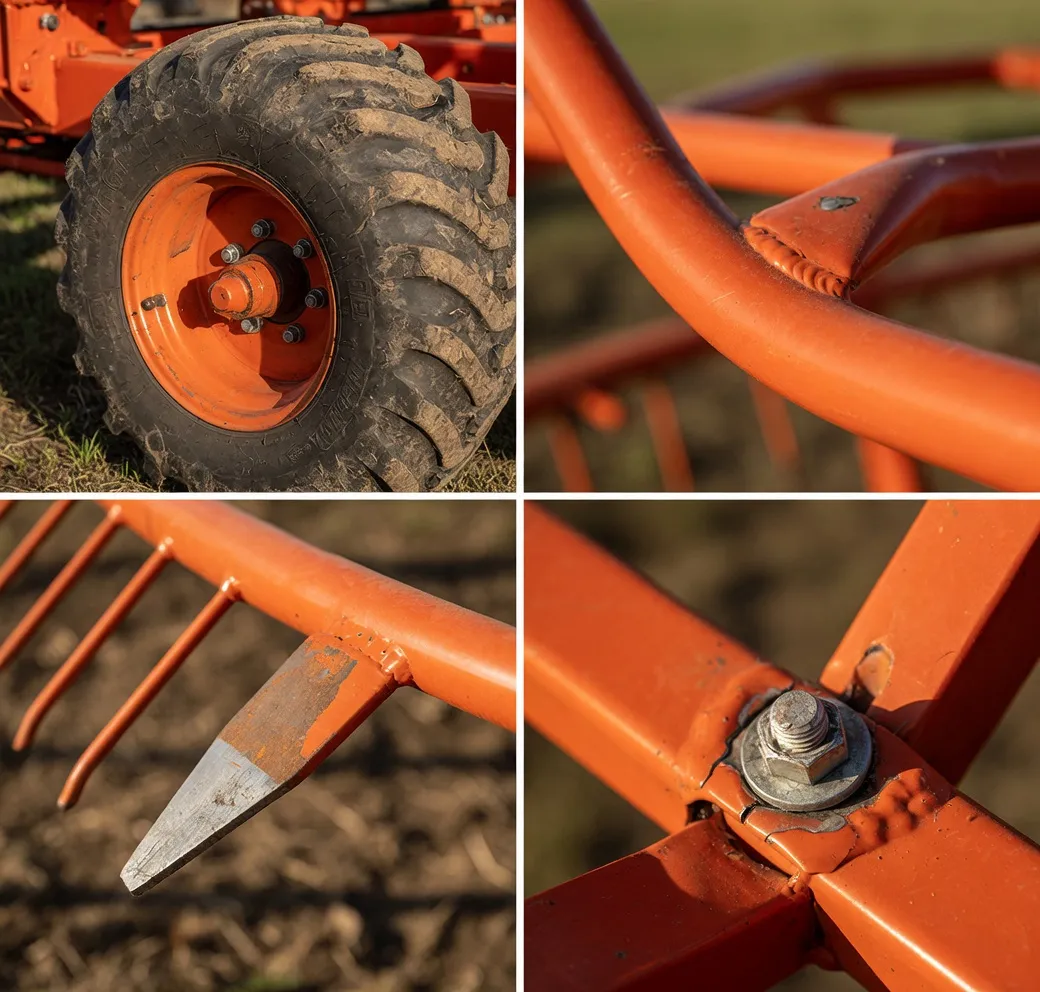
Belt tracking, roller bearing condition, and drive roller surface grip are the three maintenance areas that determine whether the 9JYY-4.5 operates reliably through a full stacking season — all are checkable in under 10 minutes before each use session.
Motor and Electrical Maintenance
The 9JYY-4.5’s single-phase electric motor is a simple, reliable component. Maintenance requirements are minimal: keep the motor housing clean and ventilated, check the power cable and plug for damage at the start of each season, and confirm the overload protection (thermal cutout or circuit breaker) functions correctly.
Motor overheating: If the motor becomes hot to the touch during normal operation (above 60°C on the motor housing), the cause is either overloading (bales heavier than 35 kg, or belt tension too tight increasing drive load), or ventilation blockage (hay dust packed around the motor cooling vents). Check and correct both before continuing. A motor that trips its thermal cutout repeatedly is being overloaded — reduce load or clean the ventilation path before restarting.
Power cable: The cable from the motor to the plug is exposed to foot traffic, vehicle wheels, and hay debris during operation. Inspect the full cable length at the start of each season for cuts, abrasion, and damage at the strain relief fittings near the motor and plug. Any damage to the cable outer sheath exposes the internal conductors to moisture and contact — replace the cable before use if damage is found. Do not use damaged cables outdoors or in wet conditions under any circumstances.
Safety Checks Before Every Use
Stability check
With the conveyor at operating angle, check that the support legs and feet are stable and cannot shift during operation. A conveyor that shifts under load at height is a serious hazard. Place rubber mats or timber chocks under support feet on smooth concrete surfaces. Confirm the upper end is resting against a solid structure or is secured if it is not self-supporting at the set angle.
Belt tracking confirmation
Run the belt empty for 30 seconds and observe tracking before placing any load on the belt. A belt that is off-centre at the start of the day will worsen under load — correct it empty, not loaded. Do not operate with a consistently off-tracking belt; this causes accelerated edge wear and can result in the belt running off the rollers entirely under full load.
Clear zone at the top end
Confirm the area below the upper end of the conveyor is clear of people and obstacles before starting. A bale that slides off the top end of the belt — from the stacker being momentarily distracted or the belt delivering a bale before the previous one is cleared — falls from height and is a serious injury hazard to anyone standing below.
Emergency stop access
Confirm both the feeder at the bottom and the stacker at the top know where the motor switch or power plug is and can reach it quickly. In the event of a jam, a person caught between a bale and the belt, or any emergency, the motor must be stopped immediately. Establish a clear stop signal between the feeder and stacker before starting each session.
Maintenance Schedule Summary
Recommended Product: 9JYY-4.5 Hay Baler Conveyor
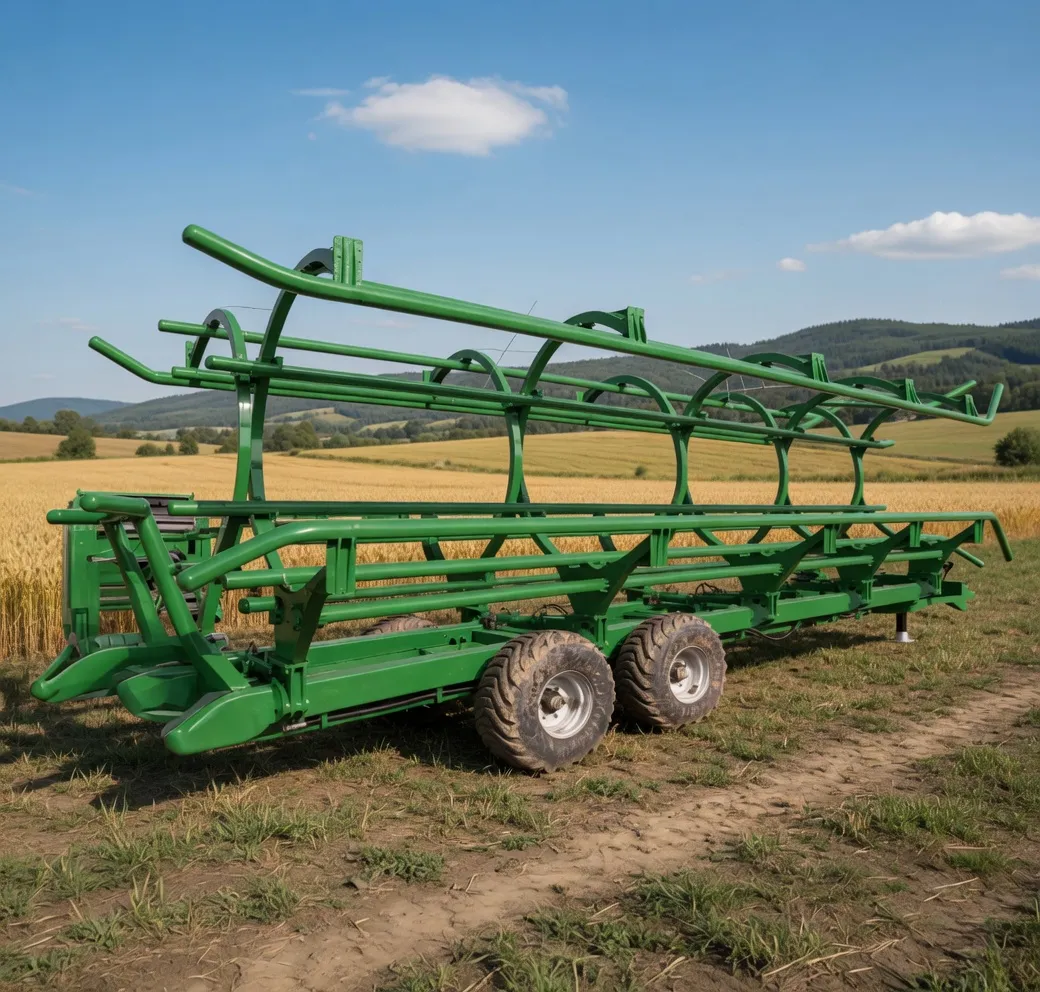
Simple belt-and-roller design with minimal maintenance requirements. Belt, roller bearings, drive chain, and motor available as replacement parts from EverPower’s Condell Park NSW warehouse. Technical support available by phone during the hay season. Pre-season inspection takes under 30 minutes; weekly in-season maintenance under 10 minutes.
Frequently Asked Questions
10 Minutes of Checks. A Full Season of Reliable Operation.
EverPower stocks all 9JYY-4.5 wear parts and can advise on maintenance schedules for your annual baling volume.
EverPower Baling Machinery Australia Pty Ltd | 27 Harley Crescent, Condell Park NSW 2200
📞 +61 2 9708 3322 | ✉️ [email protected]