
Film Width Determines Coverage — and Coverage Determines Whether Fermentation Succeeds
Silage film width is one of the least discussed variables in bale wrapping, yet it directly determines whether the bale ends — the flat faces of a round bale — are adequately covered by the wrapping pass. A film that is too narrow relative to bale width leaves the bale ends with fewer overlapping layers than the cylindrical surface, creating weaker barrier zones where oxygen ingress is most likely. A film that is unnecessarily wide wastes material at the overlap zones without improving coverage quality. The 9YCM-850 is designed for 850 mm film width — the standard for Australian 1.2–1.5 m diameter round bales — and this pairing produces adequate end coverage when the bale width is within the machine’s specified range. Understanding how film width interacts with bale geometry, and when to specify a different film width, prevents the silent losses that occur when operators use the wrong film specification for their bale size.

The 9YCM-850 is matched to 850 mm film width — the standard for Australian round bales produced by most 1.2 m and 1.5 m diameter balers. Matching film width to bale width is the starting point for adequate end coverage.
How Film Width Affects Coverage Geometry
When the 9YCM-850 wraps a bale, the film arm deposits a helical band of film across the full bale surface — both the cylindrical side and the two flat ends. The film width (850 mm) divided by the advance distance per arm orbit (determined by bale rotation speed and bale diameter) determines how much the film band overhangs each bale end with each pass. This overhang folds over the bale end and is pressed against the flat face by the tension of subsequent passes.
For a 1,200 mm wide bale wrapped with 850 mm film at 50% overlap, each film pass covers 425 mm of the bale’s 1,200 mm width (after accounting for overlap). The film arm passes from one end to the other and back again across the bale surface, depositing film that overhangs approximately 100–150 mm past each end. On a final pass at each end, the overhang folds onto the bale face and is held down by the tension of the next pass. This is why the bale ends on a well-wrapped bale appear smooth and tight — the film has been folded and pressed against the face rather than simply stopping at the edge.
If the bale is wider than the film-plus-overhang geometry allows — for example, a 1,500 mm wide bale wrapped with film that only overhangs 80 mm past each end — the bale end receives inadequate coverage from the overhang fold, and the only protection at the ends comes from the layers that were applied directly as the arm passed near the edge. This reduced end coverage is why bale end spoilage is a common problem when operators use 500 mm or 600 mm film on wide Australian bales that were designed for 850 mm film wrapping.
Film Width Options and Their Applications
Film Thickness: 25 Micron vs Higher Gauge Options
Standard silage film used in Australia is 25 microns thick before pre-stretching — becoming approximately 15–17 microns after application at 55–70% pre-stretch. This is adequate for most farm-scale silage and hay-preservation applications when at least four layers are applied. Some manufacturers offer 35-micron film for high-puncture-risk environments — the thicker film provides greater resistance to bird beak penetration and thorn puncture at a cost of approximately 20–30% higher per-roll price and slightly lower pre-stretch performance due to reduced film elasticity at higher gauges.
For the majority of Australian operations, 25-micron film at six layers provides better overall protection than 35-micron film at four layers: the six-layer coverage creates multiple film barriers that a puncture must penetrate completely before oxygen ingress begins, whereas the thicker 35-micron film at four layers provides one robust barrier that — once punctured — allows immediate oxygen access. Multi-layer defence with standard film is more reliable than single-thickness defence with premium film in high-bird-pressure environments.
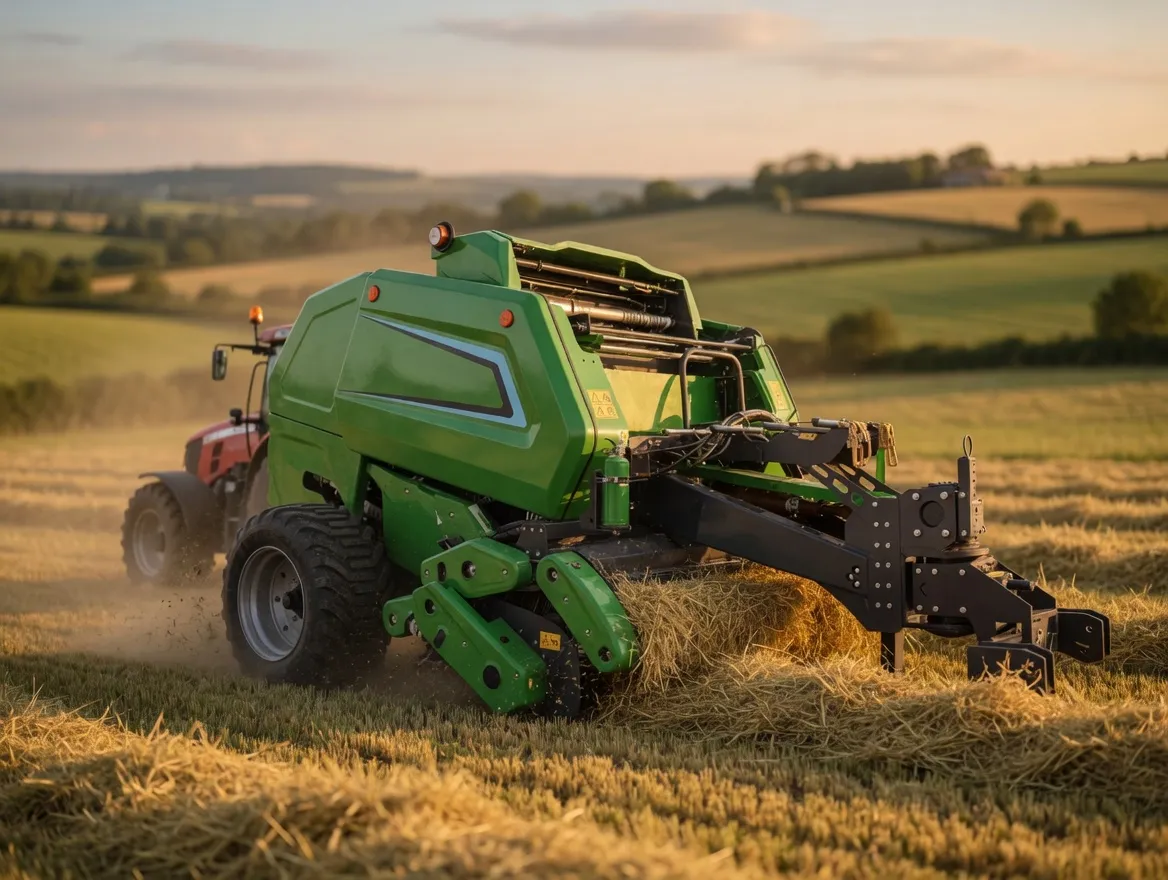
The bale width produced by your baler must be matched to the film width of your wrapper — confirm your baler’s chamber width specification against the 9YCM-850’s 850 mm film design before purchase.
UV Stabilisation: Non-Negotiable for Australian Outdoor Storage
UV radiation in Australia — particularly in latitudes above the Tropic of Capricorn and during the extended summer months — is among the highest in the world. Non-UV-stabilised polyethylene film degrades under Australian sunlight within 4–8 months, becoming brittle, losing elasticity, and eventually cracking at stress points such as bale end folds and pre-stretch seam lines. Once the film loses structural integrity, even a minor external contact — a wallaby walking across a bale row, a tractor tyre brushing past — can tear the degraded film completely, creating large oxygen ingress zones rather than small puncture sites.
UV-stabilised film contains UV absorbers (typically benzophenones or hindered amine light stabilisers) that absorb UV radiation and dissipate it as heat rather than allowing it to break polymer bonds. Quality UV-stabilised film maintains adequate mechanical properties for 18–24 months of outdoor storage under Australian conditions. Always specify UV-stabilised film when purchasing for outdoor storage — the cost premium over non-UV-stabilised film is 5–15%, which is negligible against the feed value of a full season’s silage storage.
How Much Film Does Each Bale Consume?
Film consumption per bale depends on bale circumference (diameter × π), bale width, number of layers, and pre-stretch ratio. As a practical reference for the 9YCM-850 with 850 mm film, 55% pre-stretch, and 50% overlap on a standard 1.2 m diameter × 1.2 m wide bale: four layers consumes approximately 50–60 m of film per bale; six layers consumes approximately 75–90 m. A 1,500 m film roll therefore wraps approximately 17–30 bales depending on bale size and layer count. At AUD $130–$160 per roll, film cost per bale ranges from AUD $4.50 (four layers, large roll) to AUD $9.50 (six layers, smaller roll).
Recommended Product: 9YCM-850 Bundling Film Wrapping Machine
Designed for 850 mm × 1,500 m rolls — the standard silage film width for Australian 1.2–1.5 m round bales, widely stocked by Australian rural suppliers. 55–70% pre-stretch for optimal film economy and tight coverage. 4–6 adjustable layers. Handles bale widths 800–1,300 mm. Available from EverPower’s Condell Park NSW warehouse with Australia-wide delivery.
Frequently Asked Questions
Match Your Film to Your Bale. Cover Every Surface.
EverPower can confirm the correct film specification for your bale size and storage conditions before you purchase the 9YCM-850.
EverPower Baling Machinery Australia Pty Ltd | 27 Harley Crescent, Condell Park NSW 2200
📞 +61 2 9708 3322 | ✉️ [email protected]