The Mechanics Behind Every Wrapped Bale
A bundling film wrapping machine looks simple from the outside — a rotating table, an arm that spins film around a bale, a finished wrapped bale that rolls off the end. But the quality of silage that bale eventually produces depends on precise mechanical coordination between three elements: the rate at which the bale rotates, the speed at which the film arm orbits, and the tension and pre-stretch applied to the film during application. When these three elements are correctly calibrated, each bale receives a uniform, overlapping film barrier that excludes oxygen at every point on the surface. When any element is incorrect — film tension too loose, arm speed mismatched to bale rotation, pre-stretch outside the design range — the bale develops coverage gaps that allow oxygen ingress, aerobic fermentation, and eventual silage spoilage. Understanding exactly how the 9YCM-850 controls these three elements in practice clarifies both how to set the machine up correctly at the start of the season and what to check when wrapped bale quality is inconsistent.
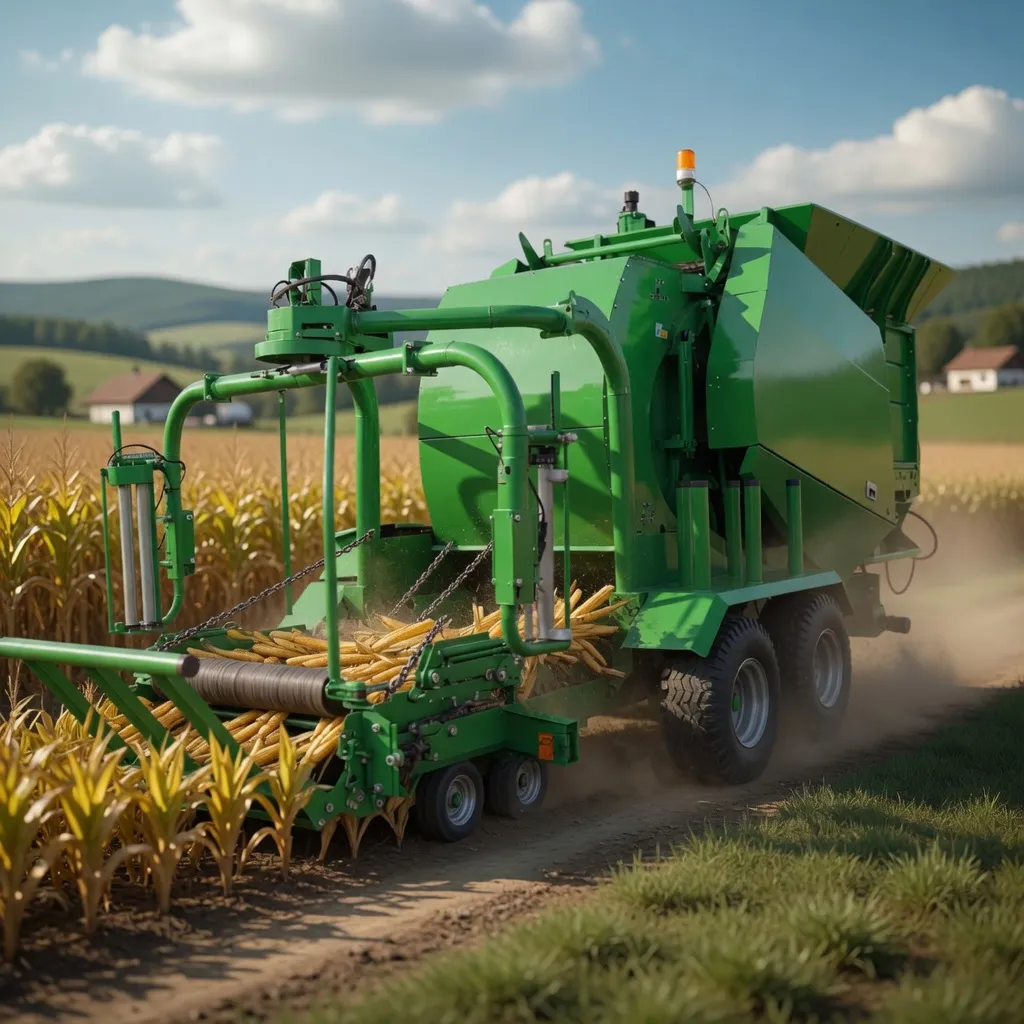
The 9YCM-850 applies film in a continuous helical pattern with 50% overlap between passes — the coordination between bale rotation speed and arm orbit speed determines how many effective layers of film each point on the bale surface receives.
Stage One: Bale Loading and Table Rotation
The 9YCM-850’s bale table is a driven rotating platform mounted at working height — approximately 400–500 mm above ground level — on the machine frame. The table surface carries a pair of driven rollers that rotate the bale around its horizontal axis during wrapping. These rollers are driven by a hydraulic motor connected to the tractor’s hydraulic system via the rear remote outlets. Hydraulic flow from the tractor controls roller speed — and therefore bale rotation speed — through a flow control valve on the machine.
Bale loading is performed by the tractor operator: either by pushing the bale onto the table with the front loader bale spike, or in inline configurations where the baler ejects directly onto the wrapper table. Once on the table, the rollers begin rotating and the bale surface is stabilised for the film application pass. The key requirement at this stage is that the bale is approximately round in cross-section and sits stably on the rollers without rocking. Oval or misshapen bales — common from poorly adjusted net-wrap balers or from baling wet crop — create variable surface distance from the film arm, which produces inconsistent film stretch and coverage gaps at the flatter sections of the bale.
Stage Two: Film Arm Orbit and the Helical Coverage Pattern
While the bale rotates on the table, a film dispensing arm revolves around the bale on a fixed circular orbit. The arm is mounted on a rotating ring that encircles the bale — in the 9YCM-850, this ring is driven by a chain or belt connected to a second hydraulic motor, maintaining a constant orbit speed independent of bale rotation speed. The film dispenser on the arm holds the film roll and applies film to the bale surface under controlled tension as it passes.
The combination of bale rotation (around the horizontal axis) and arm orbit (around the bale circumference) creates a helical film application pattern. Each pass of the arm around the bale deposits a band of film approximately 850 mm wide (the film roll width); because the bale has rotated a set amount between each pass, the next band is offset by half a film width — creating a 50% overlap. This 50% overlap is why a “four-layer” specification actually delivers eight layers of film at every point on the bale: each pass contributes one layer of film to each point it covers, and with 50% overlap, every point is covered by two passes per revolution cycle.
Stage Three: Film Pre-Stretch and Tension Control
The film dispenser on the 9YCM-850’s arm includes a pre-stretch mechanism — a set of two rollers rotating at different speeds. Film passes between these rollers: the exit roller rotates faster than the entry roller, causing the film to elongate between them before it contacts the bale surface. The 9YCM-850 applies pre-stretch of 55–70%, meaning a 1,000 mm length of unstretched film becomes 1,550–1,700 mm of stretched film by the time it exits the pre-stretch rollers.
Pre-stretching serves two purposes. First, it reduces film consumption per bale: stretching the same mass of film to 1.7× its original length means each roll covers 70% more surface area than it would without pre-stretching, directly reducing the cost per bale. Second, pre-stretched film has elastic memory — it wants to return to its shorter length. Once applied to the bale surface, the stretched film contracts slightly, conforming tightly to the bale contour and self-sealing each overlap zone as the overlapping layers’ contracting forces press against each other. This contraction is what creates the tight, wrinkle-free film surface visible on a well-wrapped bale — and the tightness is what excludes oxygen at the overlap seams.
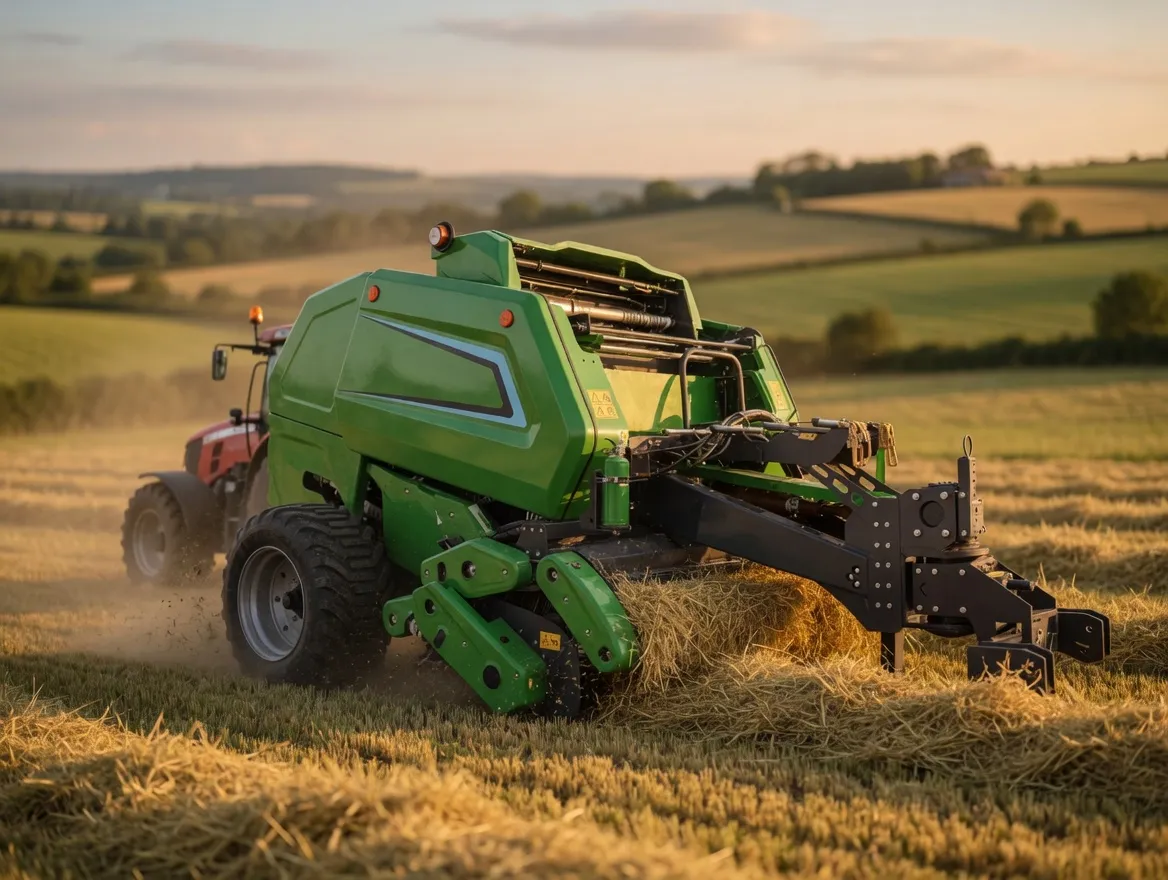
Round bale density and shape consistency directly affects wrapping quality — a dense, round bale wraps with uniform film tension while a loose or oval bale creates variable coverage and weak points in the film barrier.
What Determines How Many Effective Layers a Bale Receives
The number of effective film layers at any point on the bale surface is determined by the ratio of bale rotation speed to film arm orbit speed, expressed as the number of complete arm orbits per complete bale rotation. The 9YCM-850 is designed so that at its standard speed settings, the arm completes two orbits per bale rotation — this, combined with 50% overlap, delivers four nominal layers (eight effective layers with overlap counting). Changing this ratio — either by adjusting the hydraulic flow to the table drive or the arm drive — changes the layer count. Slowing the table relative to the arm increases layers; speeding the table decreases layers.
In practice, most operators set the machine at the factory default and adjust only when switching between very different bale sizes or when increasing layers for difficult storage conditions. A larger diameter bale has more surface per rotation and requires the arm to orbit slightly faster relative to bale rotation to maintain the same layer count — the 9YCM-850 accommodates this within its adjustment range for bale diameters from 1,000 to 1,600 mm.
Stage Four: Film Cut and Bale Discharge
At the completion of the wrapping cycle, the film must be cut cleanly and the tail end pressed against the bale surface to prevent unravelling. The 9YCM-850 includes an automatic or semi-automatic film cutter — a blade mechanism that severs the film at the arm’s position when the operator signals cycle completion. After cutting, the remaining tail of film is tucked onto the bale surface by the final residual tension in the applied layers — the contracting film holds the tail in place without adhesive or tape.
Once the film is cut, the bale is discharged from the table either by tilting the table rearward (on machines with a tipping table) or by the operator moving the tractor forward slightly to allow the bale to roll off the table onto the ground. The bale should be placed immediately in its intended storage position — rolling or moving wrapped bales after the film has been applied risks puncture from ground contact at the film seam edges. Position the bale gently at the storage site and do not drag it across rough ground.
Common Mechanical Faults and Their Causes
Recommended Product: 9YCM-850 Bundling Film Wrapping Machine
Hydraulic-driven table and arm system for uniform helical film application on 1,000–1,600 mm round bales. 55–70% film pre-stretch for tight, self-sealing wrap. Adjustable layer count (4–6 standard). 60–90 second cycle time. Compatible with standard 850 mm × 1,500 m silage film rolls. 3-point linkage Category I/II mount, 45–75 HP tractor. Available from EverPower’s Condell Park NSW warehouse with Australia-wide delivery.
Frequently Asked Questions
Understand the Machine. Wrap Every Bale Right.
EverPower can walk you through 9YCM-850 setup, hydraulic configuration, and layer count adjustment for your bale size and storage conditions.
EverPower Baling Machinery Australia Pty Ltd | 27 Harley Crescent, Condell Park NSW 2200
📞 +61 2 9708 3322 | ✉️ [email protected]