Rake Selection: Getting Windrows Right Before the Baler
Finger-wheel, rotary, or lateral rake — what the choice means for DM losses, windrow consistency, and which crops each handles well across Australian hay and silage operations.
The Rake: The Equipment That Determines What the Baler Receives
Of all the equipment in a hay or silage production chain — mower, rake, baler, wrapper — the rake receives the least attention in purchasing decisions and causes the most preventable dry matter losses in the field. A mismatch between rake type and crop or conditions is invisible in the field because the losses it causes — leaf shatter, windrow inconsistency, soil contamination — are distributed across every bale produced rather than appearing as a visible failure at any single point.
The choice between a finger-wheel rake, a rotary rake, and a lateral (tow-behind) rake determines: how much leaf material the crop retains from mowing to baling (particularly critical for legumes and oaten hay where leaf carries disproportionate nutritional value), how consistent the windrow width and density is (which drives bale weight consistency at the baler), and how much soil is picked up from the paddock surface (which determines ash content and abrasive wear on the baler chamber). Getting this decision right is worth AUD $500 to $3,000 in prevented losses per season on a 600-bale operation.
This article covers the three main rake types used in Australian hay and silage production, which crop and condition combinations each handles best, and the rake products available through EverPower. For context on how the mowing decision upstream of raking affects what the rake receives, our article on baling oaten hay and straw on a mixed farm covers the full pre-baling chain for mixed farm operations.
Three Rake Types: Mechanism, Advantages, and Best Applications
1. Finger-Wheel Rake — The Most Versatile Australian Choice
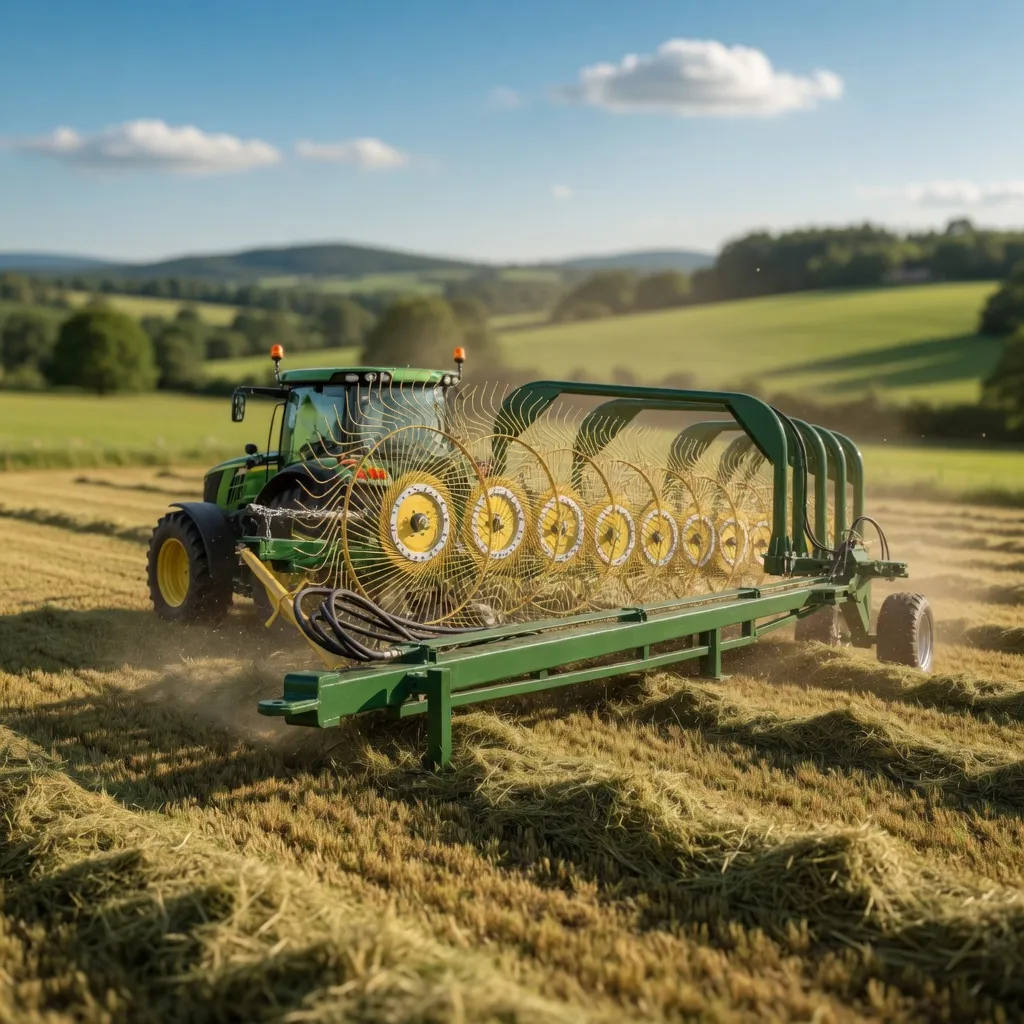
A finger-wheel rake (also called a star rake or tedder rake in different markets) uses a series of rotating wheel-shaped raking heads with steel tines arranged in a star pattern. Each wheel rotates freely on its own axis as the machine travels forward, with the tines sweeping material from both sides of the machine toward a central windrow. There is no power requirement — finger-wheel rakes are ground-driven by the tines contacting the soil surface.
The key advantage of the finger-wheel rake is its gentle action. Because tines sweep material with the rotation of the wheel rather than throwing it with high-speed centrifugal action, the crop is moved without the aggressive mechanical contact that causes leaf shatter in dry, fragile crops. This makes the finger-wheel rake the correct choice for: oaten and wheaten hay at 14 to 17% moisture where every leaf retained in the windrow contributes to the delivered feed value; dry lucerne hay where leaf shatter loss is the primary quality concern; and light, fine-stemmed grass hay where aggressive raking action scatters rather than consolidates the windrow.
The 9LZY-9.0 finger-wheel rake handles the full range of Australian hay and silage crop types and is the recommended starting point for mixed farm operations that bale different crops through the season. Its 9.0 m working width covers up to 4 mower-width swaths in a single pass — reducing the number of rake passes needed per paddock on wider mowing operations.
2. Rotary Rake — Speed and Volume at the Cost of Leaf
A rotary rake uses one or more powered rotor heads, each carrying multiple tine arms that spin at 300 to 500 RPM. The centrifugal action of the rotating tines sweeps material aggressively toward the windrow, achieving high forward speeds (10 to 14 km/h) and processing larger windrow widths per pass than finger-wheel rakes at equivalent tractor speed. Rotary rakes are the standard choice in high-volume, contractor-scale hay operations in SA, WA, and the Riverina where paddock sizes justify the throughput premium.
The trade-off is leaf loss. A rotary rake operating on dry oaten hay at 14% moisture in warm conditions generates visible dust clouds and leaf fragment loss that a finger-wheel rake on the same material does not. Studies comparing leaf retention in dried lucerne raked with finger-wheel versus rotary rakes consistently show 8 to 15% more leaf DM retained by finger-wheel raking — and since leaf carries 20 to 25% CP versus 8 to 10% CP in the stem, this loss is nutritionally significant. Use rotary rakes where throughput is the primary constraint, not where leaf retention matters most.
3. Lateral (Tow-Behind) Rake — Large Paddock Windrow Consolidation
A lateral rake (also called a side-delivery rake) uses a series of tine bars or finger wheels arranged in a long lateral configuration that sweeps material from the full working width into a single windrow at one side. The 9LH-12 towed lateral rake (12-metre working width) is the correct tool for large-paddock operations where the mower has deposited material over 5 to 6 metre wide swaths and a single-pass consolidation into baler-width windrows is needed. The lateral rake’s working width (up to 12 metres) covers multiple adjacent mower swaths per pass, reducing the number of tractor passes needed to consolidate large paddocks before baling.
| Rake Type | Best Crop | Speed | Leaf Retention | Soil Pickup Risk | Working Width |
|---|---|---|---|---|---|
| Finger-wheel (9LZY-9.0) | All crops, especially legume/cereal hay | 6–9 km/h | Excellent | Low-Medium | 9.0 m |
| Rotary (twin or single) | High-volume grass hay, grass silage | 10–14 km/h | Moderate | Medium | 3.5–8.0 m |
| Lateral tow-behind (9LH-12) | Large paddock consolidation, all types | 7–10 km/h | Good | Low | Up to 12 m |
Rake Settings That Directly Affect Silage Quality
Tine Height: The Most Important Adjustment
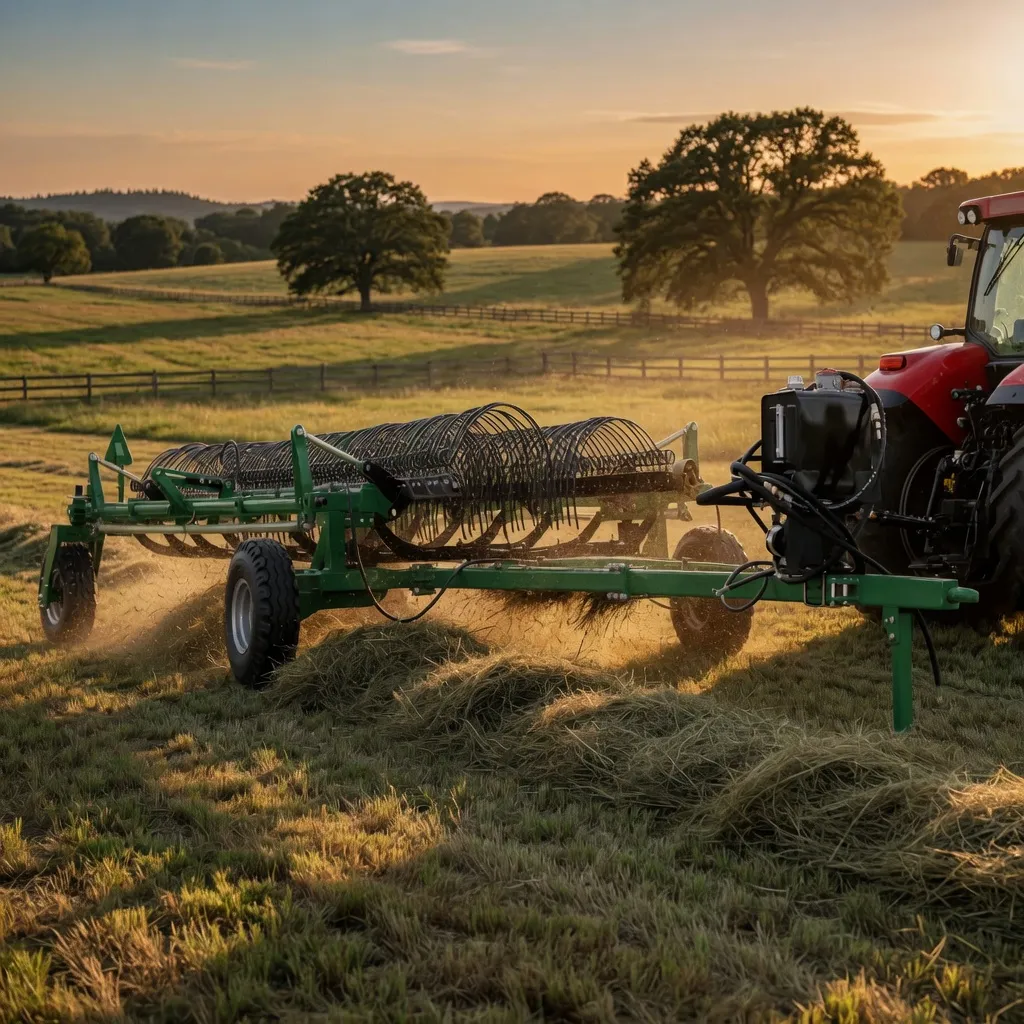
Tine height — the distance between the rake tine tips and the soil surface — is the primary setting that determines soil contamination of the windrow. Set tines too low (below 4 cm from soil) and the rake excavates soil particles into the windrow, raising bale ash content (a quality defect for both hay and silage), increasing abrasive wear on baler pickup tines and chamber rollers, and introducing soil bacteria that compete with LAB in silage fermentation.
Set tines too high (above 10 cm from soil) and the rake misses the windrow base layer — leaving 10 to 20% of the cut material on the ground rather than picking it up for baling. This is a direct DM loss. The correct setting for most Australian hay and silage crops is 5 to 8 cm from soil surface — confirmed by checking for soil streaks in the formed windrow (a sign of too-low setting) and checking for material left behind after the rake has passed (a sign of too-high setting).
Windrow Width: Matching to Baler Pickup
The rake should produce a windrow width of 60 to 80% of the baler pickup width — wide enough for efficient pickup, narrow enough for clean pickup edges without the baler running wide. A 1.25 m baler with a 1.8 m pickup should receive a 1.1 to 1.4 m windrow from the rake. Windrows wider than the pickup width produce baling losses at the windrow edges; windrows significantly narrower than the pickup width result in a sparse bale feed that produces bales below target weight. Adjust the rake’s tine angle and machine width to hit the correct windrow output width for your baler.
Forward Speed: The Speed-Leaf Trade-Off
Faster raking means more throughput but more mechanical aggression on the crop. For legume and cereal hay at below 16% moisture, 6 to 7 km/h is the maximum speed that avoids significant leaf shatter. For fresh grass silage at 60 to 70% moisture, 8 to 9 km/h is achievable without quality penalty because the high-moisture material is soft and does not shatter. Match raking speed to crop dryness — the dryer the crop, the slower the rake.
Crop-Specific Rake Recommendations
| Crop | Rake Type | Speed | Tine Height | Key Issue to Avoid |
|---|---|---|---|---|
| Lucerne hay | Finger-wheel | 6–7 km/h | 5–7 cm | Leaf shatter — slowest speed needed |
| Oaten/wheaten hay | Finger-wheel | 6–8 km/h | 6–8 cm | Leaf and flag loss — gentle action |
| Ryegrass silage | Any — finger-wheel preferred | 7–9 km/h | 5–8 cm | Soil pickup in wet conditions |
| Mixed grass-legume silage | Finger-wheel | 7–8 km/h | 5–7 cm | Legume leaf loss in drier conditions |
| Wheat/barley straw | Rotary or finger-wheel | 8–10 km/h | 6–9 cm | Stem fragmentation at high speed |
| Large paddock consolidation | 9LH-12 lateral | 7–10 km/h | 5–8 cm | Even windrow across full working width |
Frequently Asked Questions
Match the Right Rake to Your Crop and Operation
Tell us your crop mix, paddock size, and baler specification — we’ll advise on the right rake type and working width for your hay or silage production chain.