
Tropical Crop Silage: Sugarcane and Buffel Grass in the NT
How Northern Territory beef stations and north Queensland pastoral properties are baling tropical grasses and crop residues during the wet season — while the paddocks are accessible and the feed is available.
The Wet Season Opportunity — and Why Most NT Stations Miss It
Northern Territory beef stations and north Queensland’s Gulf Country pastoral properties face a counterintuitive feed security challenge: the wet season (November to April) produces abundant forage growth that cannot be consumed by the standing herd before it matures and loses nutritional value, while the dry season (May to October) produces essentially no new growth and the herd must subsist on standing dry matter of progressively decreasing quality. The seasonal mismatch between feed availability and feed demand is the central production management challenge of the northern Australian beef industry.
The logical solution — baling the wet-season surplus for dry-season feeding — faces two operational constraints that most NT and north QLD stations have historically not resolved: paddock access during the wet (when ground conditions are soft, roads are cut, and station vehicles struggle to reach remote paddocks), and the crop characteristics of tropical grasses (thick stems, dense growth, high moisture) that make baling with standard round balers challenging.
Both constraints are now more manageable than they were 10 years ago. Buffel grass (Cenchrus ciliaris), the dominant improved pasture species across NT’s Victoria River District and central Australia, can be baled from accessible tracks and bore areas during the late wet to early dry transition (March to May) when paddocks are drying out but forage is still at peak biomass. Sugarcane tops from NT’s Katherine and Daly River irrigation areas are available in quantity during the October to January crushing season. This article covers the specific management of both crops for silage baling in the NT context.
For context on how other remote northern beef operations approach silage production, our article on silage baling for beef cattle stations in drought covers the strategic planning framework.
Buffel Grass: The NT’s Silage Opportunity
Nutritional Value at Different Growth Stages
| Growth Stage | Crude Protein (DM) | ME (MJ/kg DM) | NDF | Silage Suitability |
|---|---|---|---|---|
| Vegetative (wet season peak) | 10–15% | 8.5–10.0 | 60–70% | Good — high WSC, fast ferment |
| Flowering (late wet) | 7–10% | 8.0–9.5 | 65–75% | Acceptable with inoculant |
| Mature (early dry transition) | 5–8% | 7.5–8.5 | 70–78% | Marginal — consider hay instead |
| Standing dry (mid dry season) | 2–5% | 6.0–7.5 | 75–82% | Not suitable for silage |
The Baling Window: March to May
The optimal buffel grass silage baling window in the NT is March to May — the late wet to early dry transition when: (1) buffel has reached 0.8 to 1.5 m height with good leaf-to-stem ratio and 10 to 14% crude protein; (2) paddock moisture is declining from saturated wet-season levels but accessible tracks are firming; (3) plant moisture at 65 to 75% is within the wilting range achievable in 24 to 36 hours of dry-season conditions. Baling before March risks access issues; waiting past June means the buffel has senesced and protein has dropped to below 7%.
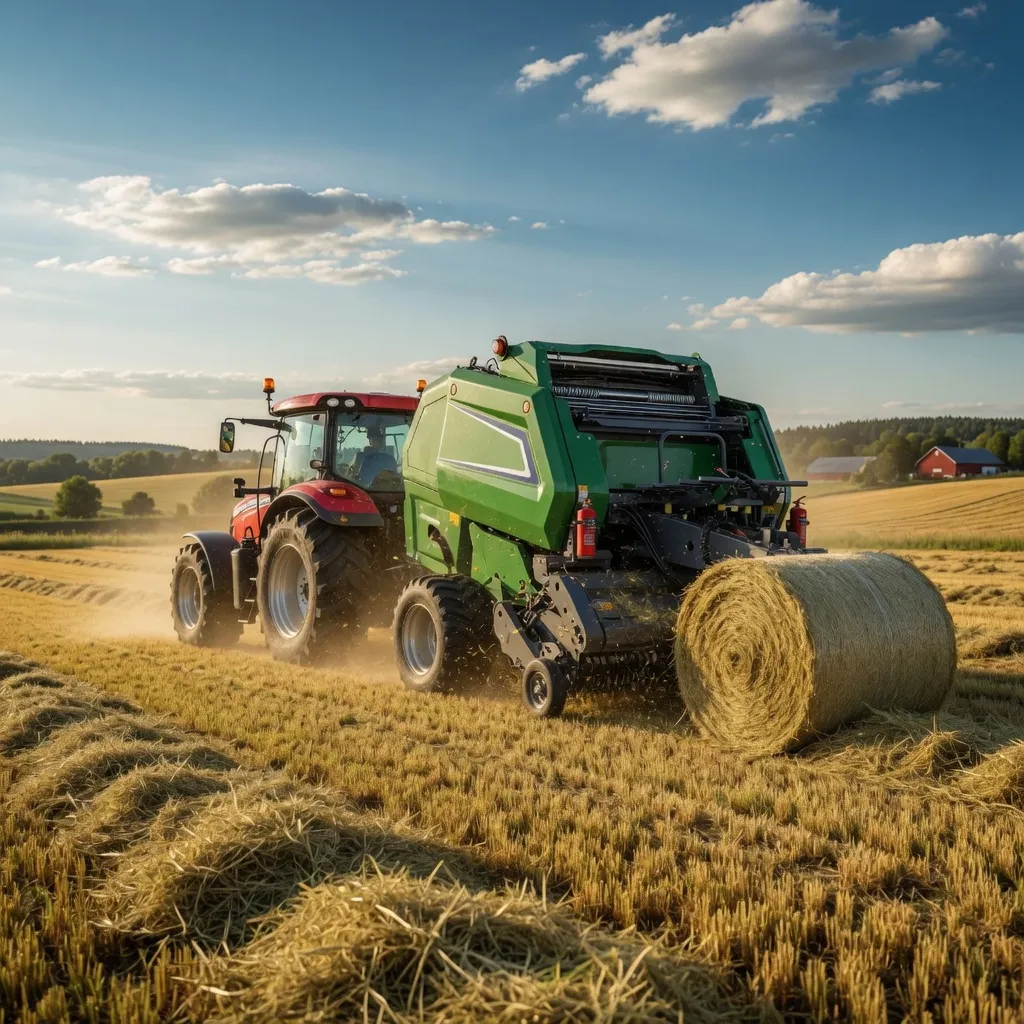
Buffel grass at 1.0 to 1.5 m height requires a mower with sufficient blade clearance for dense tropical grass stands — the 9GS-5.0 double-blade mower handles buffel efficiently at this height. Pre-chopping with a forage harvester is not required for buffel (unlike sugarcane tops) because the grass stems at 4 to 8 mm diameter are within the baler pickup’s handling range without prior size reduction. The 9YG-1.25A variable-chamber round baler handles buffel grass silage at the variable windrow densities typical of uneven tropical pasture stands. Apply LAB inoculant at all baling events — buffel’s WSC content is moderate but its dense lignified stem fraction creates fermentation challenges that inoculant support reliably addresses.
Sugarcane Tops: Katherine and Daly River Area Operations
The Top-Cutting Season in NT Irrigated Agriculture
The Katherine and Daly River regions of the NT have small but productive sugarcane growing areas supplying the Katherine Sugar Mill. After mechanical harvesting (October to January), green tops — the fresh growing tips removed during harvest — contain 9 to 13% crude protein and ferment reliably when baled within 24 hours of harvest and wrapped with silage film. The same management protocol as tropical Queensland sugarcane tops applies: pre-chop to 30 to 50 mm, field wilt 4 to 12 hours depending on ambient conditions, apply LAB inoculant, wrap within 1 hour using white or silver UV-resistant film, and store in shade.
For NT beef operations within 100 km of the Katherine cane area, contracted sugarcane top silage from the harvest season (baled from October to January) provides a reliable high-protein supplement for the following August to October dry-season feed gap — the most nutritionally deficient period in the NT cattle year.
Remote Station Logistics: Making Tropical Baling Practical
The biggest logistical constraint for NT silage production is moving the baler and wrapper to and from remote paddocks in the late wet season when track conditions are still marginal. The practical solution adopted by successful NT silage producers is to mow and windrow buffel from accessible paddocks within 2 to 5 km of the homestead or a reliable dry-season track, then bale and wrap on the accessible track shoulder or homestead yard. Sacrificing maximum yield from remote paddocks for reliable access to the baling equipment is consistently the better production decision.
Green or black silage film stored in NT dry-season ambient temperatures (35 to 42°C, direct sun) fails through UV degradation within 4 to 6 months — well within the storage period needed to carry silage from May baling to September to October dry season feeding. White or silver UV-stabilised film extends storage life to 12 to 16 months under the same ambient conditions. Budget for white film specifically for all NT silage production.
Frequently Asked Questions
Discuss Your NT or North QLD Silage Programme
Tell us your station location, available pasture area, and dry-season feed gap — we’ll help plan the baling system for tropical conditions.