Why SA Sheep and Goat Farmers Are Ditching Hay — and What to Know Before You Follow
The honest comparison between dry hay and haylage for operations running 100 to 400 head in South Australia’s Mediterranean climate — when baleage genuinely outperforms hay, when it doesn’t, and what the switch actually costs.
The Hay-to-Haylage Conversation Spreading Through SA Sheep Country
South Australia’s sheep and goat farming regions — the Mid North, Clare Valley, Barossa hinterland, and Eyre Peninsula — have historically been committed to dry hay production. The Mediterranean climate (hot, dry summers; mild, wet winters) produces reliable hay-making conditions from October through February, and the traditional management cycle of making cereal or legume hay in November and December, storing it through summer, and feeding it from April to August fits the regional rainfall and feed availability patterns well.
The conversation that is now spreading through these communities is about baleage — wrapped silage bales, or more precisely haylage (material baled at 35 to 55% DM, higher than true silage but lower than hay) — as an alternative or complement to the dry hay programme. The drivers of this conversation are real: hay-making windows in SA’s Mid North have become less reliable as spring rainfall timing has shifted; some producers have had expensive hay losses from rain-on-bales events in October and November; and the question of whether lower-DM baleage performs as well as dry hay in ewe flock nutrition during late pregnancy and early lactation is genuinely debated in the local farming community.
This article is for SA sheep and goat producers who are in the early stages of this conversation — not yet committed to switching, but seriously evaluating whether baleage makes sense for their specific operation. We cover the comparison honestly, including where baleage loses relative to hay, and what the transition costs if you decide to proceed. For existing dry sheep farming silage practice, our article on silage baling for sheep farms managing feed through dry seasons provides the established practice context.
Hay vs. Haylage: An Honest Side-by-Side for SA Small Ruminant Operations
What Each System Actually Delivers — and What It Costs
| Factor | Dry Hay (14–16% moisture) | Haylage (40–55% moisture) | Winner for Small SA Farms |
|---|---|---|---|
| Weather dependency | High — 3–5 fine days needed | Low — 24–36h wilt only | Haylage |
| Rain-damage risk | High — one event ruins a cut | Low — baled before rain reaches | Haylage |
| Nutritional quality (DM) | Good if made well | Good to very good if fermented well | Draw |
| Palatability for sheep | High — familiar | Medium to high (adjust to smell) | Hay slightly |
| Storage life | 3–4 years if kept dry | 12–18 months (film-sealed) | Hay |
| Storage requirement | Barn preferred, outdoor OK | No barn needed — film protects | Haylage |
| Feed-out flexibility | High — open any time | Lower — oxidises fast once opened | Hay |
| Equipment cost additional | None if hay baler owned | Wrapper AUD $18,000–$35,000 | Hay |
| Film cost per bale | Nil | AUD $8–$14 per bale | Hay |
| Cost per tonne DM (dryland) | AUD $80–$140 | AUD $90–$160 | Draw |
The honest conclusion from this comparison is that haylage is not unambiguously superior to hay for small SA sheep operations — it trades specific advantages for specific disadvantages. The switch makes economic sense when: (a) your hay-making windows are genuinely unreliable in your location, (b) you have had repeated quality losses from rain-on-bales events, (c) you have no barn for hay storage, or (d) you want to capture the nutritional advantage of a higher-quality early-cut fermented product for a specific livestock class (pregnant ewes, high-production does). The switch does not make sense when: you reliably make excellent dry hay, you have secure barn storage, or your livestock are primarily low-demand dry ewes and wethers that perform well on mature hay.
The SA Climate Factor: When Baleage Actually Solves a Real Problem
Spring Weather Pattern Changes in SA’s Mid North
South Australia’s Mid North — the Clare Valley to Port Pirie corridor — has experienced measurable shifts in spring rainfall timing over the past 15 to 20 years. October and November rain events that previously fell after the hay window has closed are now occurring during or immediately before the optimal cutting window, disrupting the traditional hay-making calendar. Farmers who have made reliable hay in this region for 20 years are finding that the number of unbroken 4-day drying windows available in their key hay-making months has reduced from 3 to 4 per season to 1 to 2.
This is exactly the operational context where baleage’s reduced weather dependency becomes a genuine financial advantage rather than a theoretical one. A 24 to 36 hour wilt period for haylage (versus 72 to 96 hours for quality dry hay) fits within a 2 to 3 day weather window that is insufficient for hay but adequate for baleage. The Mid North producer who previously lost one entire cut per season to rain damage — costing AUD $6,000 to $12,000 in replacement purchased fodder — can potentially eliminate that loss by switching those cut events to baleage rather than hay.
Eyre Peninsula: The Opposite Problem
The Eyre Peninsula, by contrast, typically produces highly reliable dry hay-making conditions from October through January — extended dry periods with low humidity and consistent sunshine are the norm rather than the exception. Eyre Peninsula sheep farmers switching to baleage for weather-reliability reasons are solving a problem they largely do not have. For EP operations, the more relevant reason to consider baleage is storage: EP farms that are grain-focused with minimal barn infrastructure can store baleage outdoors in film-sealed bales without the quality risk that outdoor-stored dry hay faces from humidity and occasional summer rain events.
What the Transition Actually Costs — Equipment and Operational Change
The Additional Capital Required
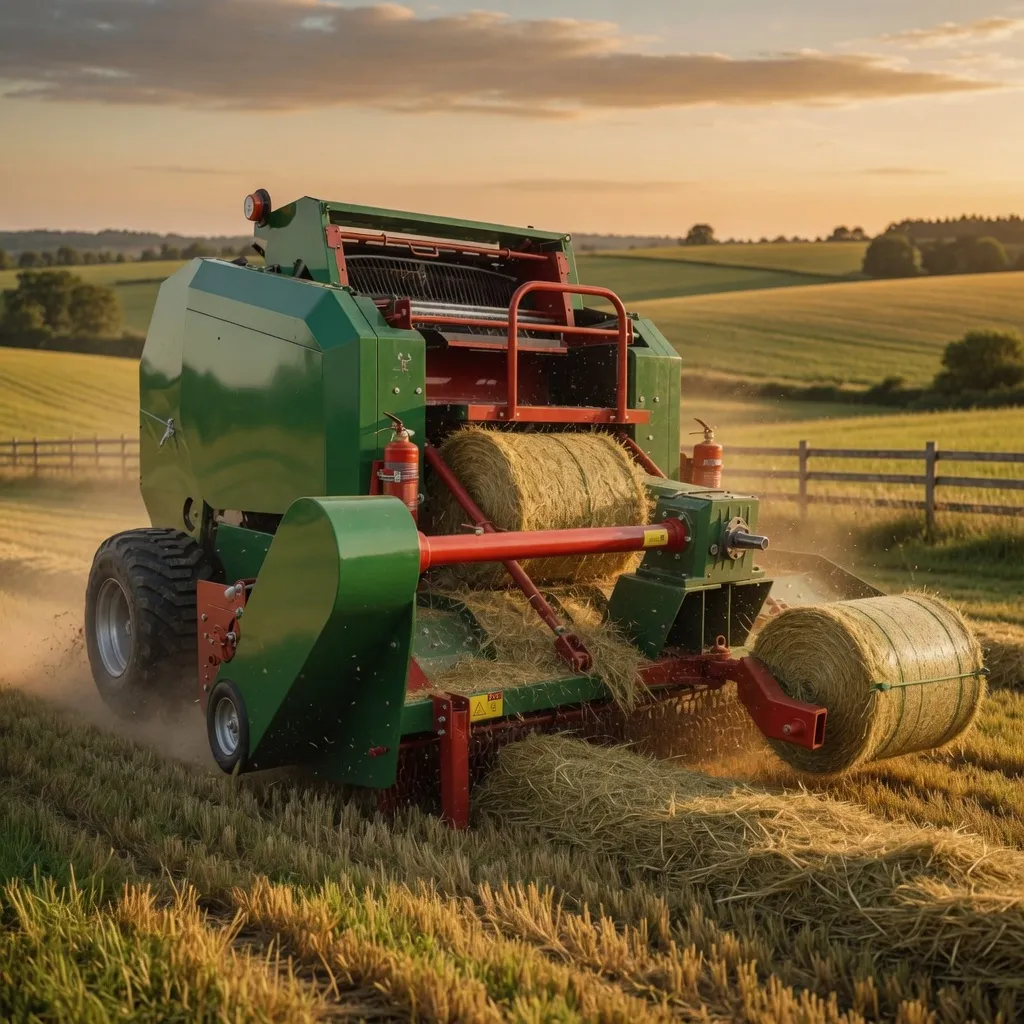
An SA sheep farmer who already owns a round baler needs one additional piece of equipment to make baleage: a silage film wrapper. For 100 to 400 head small-to-medium sheep and goat operations making 150 to 400 bales per season, a compact wrapper is the appropriate specification. The 9YG-1.0 round baler produces 1.0 m diameter bales at the size appropriate for small SA sheep and goat operations — a full 1.0 m bale at 45% DM haylage moisture weighs 250 to 350 kg, which is feedable directly on the ground for a mob of 80 to 150 sheep without wastage over 2 to 3 days, or can be split between two feed sites for larger mobs.
If a wrapper is not yet owned, the additional capital cost of entering baleage production is AUD $18,000 to $32,000 for a new compact wrapper, or AUD $8,000 to $16,000 for a well-maintained second-hand unit. At 250 bales per season and an AUD $11 per bale film cost, the film alone adds AUD $2,750 per season to operational costs. The net additional cost — equipment finance plus film, minus the value of avoided hay losses and reduced contractor or labour time in weather monitoring — typically produces a 3 to 5 year payback on the wrapper investment for Mid North producers with 2 to 3 unreliable hay seasons per decade.
Operational Changes When Baling at Higher Moisture
The critical operational adjustment for a farmer transitioning from dry hay to haylage is moisture targeting. Dry hay is baled at 14 to 16% moisture — most experienced hay producers can assess this by hand with reasonable accuracy. Haylage is baled at 45 to 60% moisture (40 to 55% DM), and this moisture range must be confirmed with a handheld moisture meter or a calibrated squeeze test before baling begins. Baling above 65% moisture (below 35% DM) in the absence of LAB inoculant produces clostridially spoiled silage; baling below 40% moisture (above 60% DM) produces incomplete fermentation and aerobic deterioration at feedout. The 5 to 10 minute investment in confirming moisture before each baling session prevents the batch failures that discourage new haylage producers from continuing.
Feeding Sheep and Goats on Baleage: What Changes at the Trough
The Adjustment Period and Palatability
Sheep and goats transitioning from dry hay to baleage typically show a 5 to 10 day adjustment period where daily intake is lower than the theoretical target. This is a normal response to the novel smell (fermentation acids and LAB metabolites), texture (softer and wetter than hay), and colour (olive-green rather than golden) of good-quality haylage. The adjustment period can be shortened by: introducing haylage gradually alongside familiar dry hay in a 50:50 ratio for the first week, ensuring the haylage is genuinely well-fermented (pH 4.2 to 4.8 at opening, clean acidic smell, no ammonia odour) rather than poorly made, and ensuring fresh water is available at all times — baleage has significantly higher moisture content than hay and sheep will drink slightly less water per day but need access.
Feed-Out Management for Small SA Flocks
The primary management consideration for small SA sheep and goat operations feeding baleage is feed-out rate relative to bale size. A 1.0 m bale of haylage at 45% DM contains approximately 90 to 120 kg DM — enough for 100 ewes at 1.0 kg DM per head per day for approximately 1 day. Opening a new bale daily fits the feed management rhythm of most SA small flock operations. The risk is leaving a partially opened bale exposed to air for more than 48 hours in warm conditions — above 20°C ambient, aerobic deterioration of the exposed face begins within 24 to 36 hours. Plan feed-out to ensure each opened bale is consumed completely within 2 days maximum.
Common Mistakes When SA Sheep Farmers First Try Baleage
The most common first-year mistake from farmers who own a hay baler and add a wrapper. Wrapping material at 14 to 16% moisture (dry hay DM) with silage film produces a sealed bale that does not ferment — there is insufficient moisture for LAB activity — but does develop mould from residual moisture under the film. The result is mouldy ‘silage’ that is neither hay nor fermented baleage. Always target 40 to 55% DM (45 to 60% moisture) when baling for film wrapping.
At AUD $8 to $14 per bale for 6 layers of film, the temptation to use 4 layers and save AUD $3 to $5 per bale is understandable. The consequence — a 30 to 40% reduction in oxygen barrier performance — means that minor film damage from UV, birds, or farm equipment penetrates to the bale interior 2 to 3 times faster. In SA’s intense summer UV environment, 4-layer film on outdoor-stored bales shows cracking and brittleness within 6 to 8 months; 6-layer film routinely lasts 14 to 18 months intact. Always use 6 layers minimum for SA storage conditions.
Well-fermented good-quality baleage supports late pregnancy and lactation well. Poorly fermented baleage with elevated ammonia nitrogen (above 10% of total nitrogen) causes subclinical metabolic stress in high-pregnancy ewes that manifests as reduced lamb birth weights and elevated pregnancy toxaemia risk. Test at least one representative bale from each cutting event before feeding to high-value pregnant ewes. This is a 10-minute forage test from a rural testing laboratory — budget AUD $40 to $60 per sample.
Pasture legumes (medic, subclover, vetch) common in SA’s mid-north have lower water-soluble carbohydrate (WSC) content than ryegrass or cereal crops — making them harder to ferment reliably without inoculant support. Apply a homofermentative LAB inoculant to all baleage made from legume-dominant swards. The cost is AUD $1.50 to $3.00 per bale — trivial relative to the insurance value against a batch failure on material that took a full paddock rotation to produce.
Frequently Asked Questions From SA Sheep and Goat Producers
Discuss Your SA Sheep or Goat Farm Baleage Transition
Tell us your flock size, existing baling equipment, and the specific hay quality problems you’re trying to solve — we’ll advise whether baleage makes sense for your operation and what additional equipment you’d need.