Net Wrap vs Twine: Choosing the Right Bale Binding
The cost-per-bale comparison, shape retention differences, storage duration implications, and the crop and market conditions that make each binding type the right choice.
A Decision Most Baler Buyers Make by Default — and Shouldn’t
When farmers buy a new round baler, the binding type question — net wrap or twine — is usually settled by the dealer’s standard configuration or by what the previous machine used. It is rarely made as a deliberate comparison of the two options’ relative advantages across the buyer’s specific crop types, storage requirements, and market. This matters because the net wrap versus twine decision has real cost and quality implications that vary significantly by application.
Net wrap adds AUD $1.20 to $2.80 per bale to consumable costs compared to twine at AUD $0.25 to $0.70 per bale — a material difference across a 600-bale season (AUD $570 to $1,260 additional for net wrap). In return, net wrap provides better bale shape retention, 30 to 60 seconds faster bale cycle time, and meaningfully better performance in high-moisture silage and long-duration outdoor storage. Whether those benefits justify the cost premium depends entirely on the operation’s specific circumstances.
This article covers the complete net wrap versus twine comparison — mechanism, cost, shape retention, storage performance, and the specific crop and market conditions that tilt the decision toward each. For context on how binding choice integrates with the baler specification decision, our article on best round baler for small to mid-size sheep farms covers the broader equipment specification context where binding type is one component.
Mechanism and Speed: How Each Type Works
Net Wrap: The Peripheral Pressure System
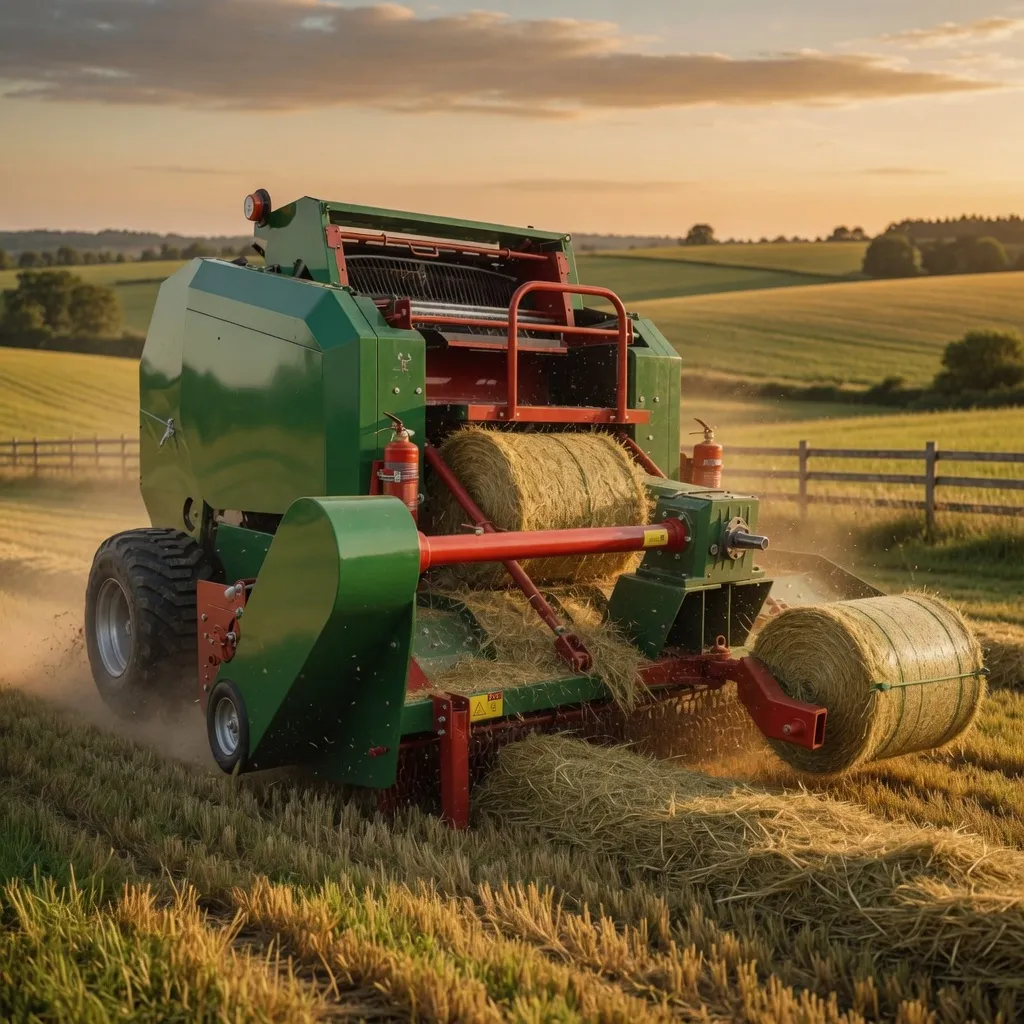
Net wrap is a knitted or woven polypropylene mesh that is fed across the full bale width during the final bale-forming rotations. The net adheres to the bale surface through friction from the rotating bale, wrapping 1.5 to 2.0 times around the circumference before the knife cuts and the net end is tucked. The result is a net that provides continuous circumferential pressure on the bale surface — maintaining cylindrical shape as the bale is ejected and through the handling and storage period.
Net wrap application takes 7 to 12 seconds per bale in most machines and requires the bale to stop forming while the net feeds — this ‘dwell time’ reduces baler throughput slightly compared to twine in continuous-flow operations. However, net wrap eliminates the ‘tailgating’ problem of twine — the need to wait for twine to fully tie and cut before ejection — and produces a bale that is ejected in a single clean action, maintaining momentum in high-volume operations.
Twine: The Spiral Wrap System
Twine binding uses two or three polypropylene or sisal twine strands applied to the bale in a spiral pattern as the bale rotates, with the twine tied at the bale surface and cut. Twine provides point-contact binding at the tied locations rather than the continuous circumferential pressure of net wrap — adequate for hay bales that are relatively stable in shape, less adequate for high-moisture silage bales that tend to bulge and deform between the twine contact points after ejection.
Twine application is faster per revolution cycle (no dwell time) but requires a longer total cycle per bale to achieve adequate binding security across the bale width. Net modern commercial round balers take approximately equivalent total cycle times to finish a bale in twine versus net wrap formats — the speed advantage of twine is smaller in practice than in theory.
| Factor | Net Wrap | Twine | Advantage |
|---|---|---|---|
| Consumable cost per bale | $1.20–$2.80 | $0.25–$0.70 | Twine — $1–$2 per bale cheaper |
| Bale cycle time (practical) | 7–12 sec application | Similar total cycle | Similar |
| Shape retention (silage) | Excellent — cylindrical | Poor-Moderate — deforms | Net wrap |
| Shape retention (hay 14-16%) | Good | Good — adequate | Similar |
| Outdoor storage weathering | Good — mesh protects | Moderate — twine degrades | Net wrap |
| Biodegradability | Low — plastic mesh | Higher — sisal twine option | Twine (sisal) |
| Removal at feedout | Fast — one pull | Faster — cut 2-3 twines | Twine slightly |
| Livestock ingestion risk | Low — mesh visible | Moderate — twine fragments | Net wrap |
When Net Wrap Is the Correct Choice
Silage Baleage — Net Wrap Is Non-Negotiable
For silage baleage at 40 to 65% moisture, net wrap is not a preference — it is the correct technical specification. The reasoning: a silage bale at 55% moisture is an asymmetric load — the bottom half of the bale is denser and wetter than the top half due to settling under the bale’s own weight. Twine binding at 3 to 4 contact points cannot provide the continuous circumferential resistance needed to prevent the bale from flattening at the base and bulging at the equator within 24 to 48 hours of ejection. A deformed silage bale has internal structural gaps where anaerobic conditions are not maintained — aerobic pockets form in the deformed zones, initiating fermentation failures that spread inward over the storage period.
Net wrap’s continuous circumferential pressure maintains the cylindrical bale geometry through the active fermentation phase (the first 21 days when deformation risk is highest) and through the entire storage period. For the silage baling workflow on the 9YG-1.25A variable-chamber round baler, net wrap is the standard configured binding — the baler’s ejection system and bale collection geometry are optimised for the shape-stable net-wrapped bale format.
Outdoor Storage Beyond 6 Months — Net Wrap Holds Better
Polypropylene net wrap, despite its reputation as a plastic waste problem, is significantly more UV-stable than polypropylene twine at equivalent thickness. For hay bales stored outdoors beyond 6 months — including export hay stacks and remote property reserves that must last through a full year before use — net wrap maintains structural integrity through the UV, temperature cycling, and rain/dew events that degrade twine binding. A twine-tied hay bale stored outdoors for 12 months in SA or WA shows measurable twine degradation (cracking, reduced tensile strength) from UV exposure; equivalent net wrap maintains full binding strength.
When Twine Is the Correct Choice
Low-Moisture Hay for Immediate Sale or Barn Storage
Dry hay baled at 13 to 16% moisture with immediate barn storage or within-season sale does not require the shape retention and extended outdoor durability of net wrap. The lower consumable cost of twine (AUD $0.25 to $0.70 per bale versus $1.20 to $2.80 for net wrap) is a genuine saving across a 400 to 600-bale hay season without meaningful quality trade-off when the storage conditions are appropriate. Well-baled dry hay at 14% moisture holds its cylindrical shape under twine binding in barn storage — the low moisture means the bale is mechanically stable and does not settle or deform the way moist silage does.
Bedding Straw — Twine Reduces Feed-Site Cleanup
For wheat straw bedding bales fed in horse or pig facilities, the net wrap removal step creates a cleanup task — net wrap fragments that are not fully removed from the bale face before feeding contaminate the bedding area with plastic mesh. Twine-tied straw bales are faster to open at the feed site (cut 2 to 3 twines, pull the bale apart) and leave no plastic mesh contamination. For commercial straw bedding supply where animal welfare and stable cleanliness are priority concerns, the twine format is the more practical choice despite its lower shape retention.
Biodegradability and Environmental Considerations
Polypropylene net wrap is the primary source of agricultural plastic contamination in Australian farm soils and waterways — UV degradation produces microplastic fragments that persist in the environment for decades. Sisal twine, produced from the natural fibre of the agave plant, degrades completely within 12 to 24 months in field conditions and presents no microplastic contamination risk. Polypropylene twine degrades similarly to net wrap but in smaller initial fragment sizes that are less visible and less likely to be collected during paddock cleanup.
Some Australian local governments and farming regions have implemented plastic bale wrap collection schemes — most apply to silage film rather than net wrap, but the regulatory trend toward reduced agricultural plastic use is clear. Sisal twine or the newer biodegradable plastic twine alternatives (PLA-based products entering the Australian market from 2023 onwards) allow hay producers to achieve full biodegradability while retaining the cost advantage of twine over net wrap.
Frequently Asked Questions
Discuss Your Baler Binding Specification
Tell us your crop mix, storage duration, and market — we’ll advise on the right binding configuration for your operation and confirm compatibility with your baler model.