
Hay Bale Transport: Moving Bales Without Damaging Them
From paddock ejection to storage stack to feed site — the handling equipment, techniques, and common damage points that determine how much of your silage quality survives the journey between the baler and the trough.
Bale Handling: The Last 10% of Silage Quality That Most Farms Ignore
Considerable thought goes into making silage well: moisture targeting, inoculant application, film layers, wrapping timing. Considerably less thought goes into what happens to the bale after it leaves the wrapper. But the bale handling chain — ejection, paddock movement, loading, transport, unloading, stacking, and feedout movement — contains multiple opportunities for quality-destroying damage that negates a portion of everything that was done correctly in the field.
Film punctures from bale spikes driven at the wrong angle. Film tearing from bales dropped rather than lowered. Bale deformation from excessive stacking height during active fermentation. Film shredding from bales transported on rough tracks without a protective transporter. Each of these failures is preventable with correct equipment and handling technique. For a silage programme producing 800 bales per season at AUD $120 per bale value, a 5% handling-damage rate represents AUD $4,800 in silage quality loss per season — recovered entirely by correct handling practice and appropriate transport equipment.
This article covers the full bale handling chain: the right equipment for each stage, the specific damage mechanisms to avoid, and the EverPower transporter and conveyor products designed for efficient, damage-free bale movement. For context on how throughput speed during the baling day affects the total handling load, our article on how hay and silage contractors increase daily bale output covers the production-side throughput management that handling logistics must keep pace with.
Stage 1: Paddock Ejection to Storage — The First and Most Damaging Phase
Why Most Film Damage Happens in the First 200 Metres
The bale’s first journey — from the point of ejection behind the wrapper to the storage pad — is statistically where most handling damage occurs. Reasons: the bale has just been wrapped and is still in the active fermentation phase (most vulnerable to pressure deformation from stacking before gas stabilisation), the paddock surface is uneven and potentially wet or soft, and the tractor driver is often fatigued from a long baling day and less careful in slow-speed bale placement than earlier in the session.
Three specific paddock-phase damage mechanisms account for the majority of handling losses: (1) spike puncture — the bale spike enters the bale body rather than the end-face when the tractor approaches at an angle rather than square to the bale end; (2) ground dragging — bales with insufficient clearance under the loader slide on rough paddock surfaces, stripping film from the underside; and (3) placement impact — bales ‘dropped’ from loader height rather than lowered contact the ground with enough impact to crack the film at the base.
Bale Transporters: The Purpose-Built Solution
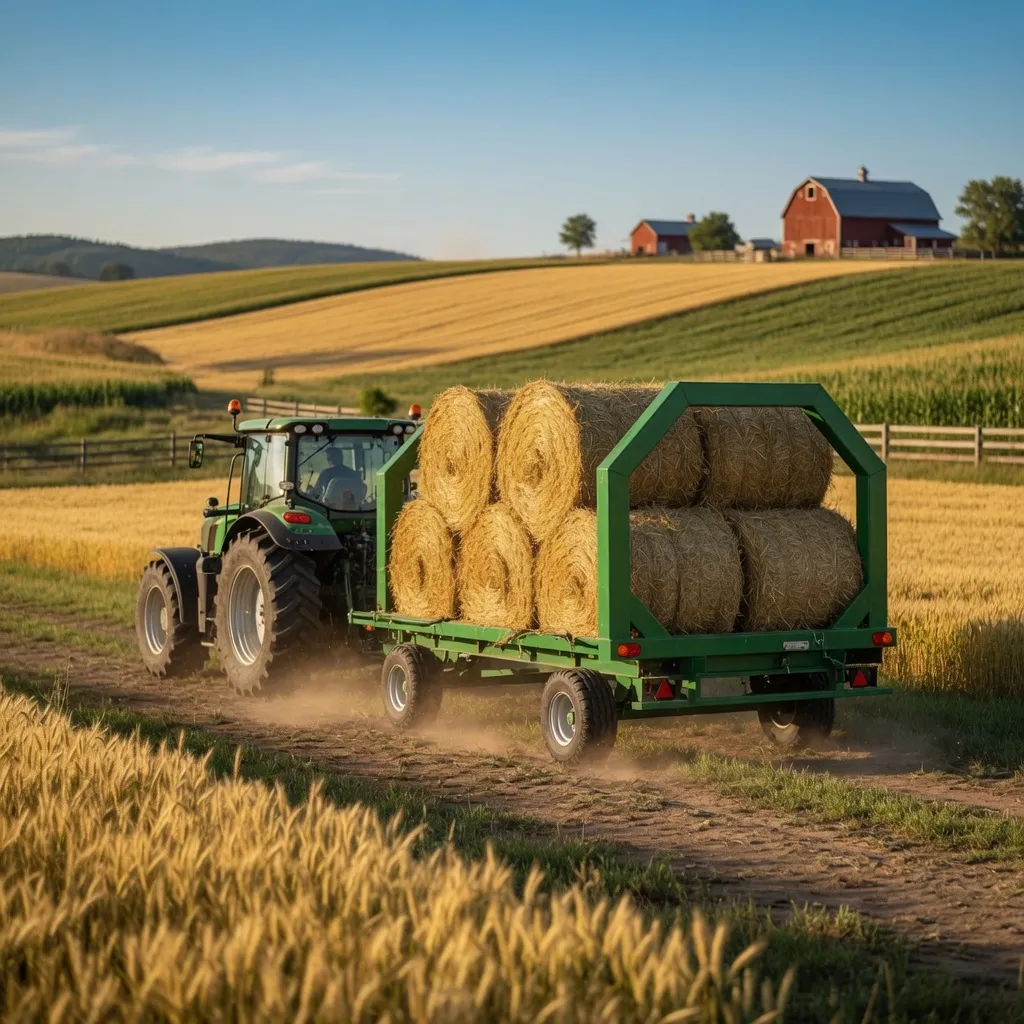
The most effective single upgrade for farms moving more than 200 silage bales per season from paddock to storage is a dedicated round bale transporter. The 9JYYD-2.5 round bale transporter carries bales on a cradle-type bed that contacts the bale at multiple support points rather than a single spike — distributing the bale weight without the puncture risk of spike handling. The transporter carries 2 to 3 bales per load, reducing the number of tractor trips required to clear a paddock after baling and allowing the baler to keep pace with the transporter in a two-tractor production chain.
| Handling Method | Film Damage Rate | Trips per 100 Bales | Suitable For |
|---|---|---|---|
| Bale spike on loader | 3–8% | 100 | Small volumes, careful operators |
| Bale squeeze attachment | 1–3% | 100 | Better than spike — no puncture |
| 9JYYD-2.5 bale transporter | <1% | 33–50 | 50+ bales/day operations |
| 9JYYD-4.5 bale conveyor | <0.5% | N/A (inline) | High-volume contractor ops |
Stage 2: Loading and Transport on Farm Tracks
Road and Track Damage — What the Transporter Prevents
Silage bales moved on rough farm tracks by loader spike at road speed (above 8 km/h) experience repetitive impact vibration that fatigues the film at the bale equator — the area of highest film tension. Farm tracks in the Riverina and Wimmera are often corrugated or potholed from heavy vehicle use, and a loaded bale spike traversing 500 to 1,000 m of rough track can fatigue the film to the point where UV degradation accelerates and the first minor heat or cold cycle causes cracking in the equatorial zone.
The 9JYYD-2.5 transporter’s cradle mounting eliminates the single-point spike stress entirely — the bale sits in a cradle that absorbs the track vibration through the transporter chassis rather than through the bale film. At transport speeds of 10 to 15 km/h on rough tracks, the film stress on a transporter-carried bale is 70 to 80% lower than on a spike-carried bale at the same speed.
Road Transport in Bulk: Bale Loading on Flat-Beds
For operations moving silage bales more than 1 to 2 km from field to storage, or for contractors delivering bales to client properties, flat-bed semi-trailer or B-double transport requires bales to be palletised or stacked two layers high on the trailer bed. The primary film damage risk in this context is bale-to-bale contact during cornering and braking — adjacent bales in a load rub against each other, abrading the film surface. Separate adjacent bales with foam padding strips or recycled conveyor belt sections if using road transport for more than 5 km. Strap every bale individually to the trailer rather than relying on side-to-side load pressure to prevent bale movement.
Stage 3: Storage Stacking — Height, Timing, and Surface
Stack Height and Fermentation Timing
The most consistent handling mistake in Australian silage storage is triple-stacking bales (three layers high) before fermentation is complete. During the first 14 to 21 days post-wrapping, bales are building internal gas pressure from active fermentation — CO₂ production is at its highest, and the bale film is under more stress than at any other point in the storage period. Stacking a third bale on top of two gas-pressurised bales compresses the bottom bale seal zones, creates film-to-film friction points at the bale ends, and can split the film at the equatorial overlap seam.
Single-layer storage for the first 21 days is ideal; double-layer is acceptable with careful placement. Triple-stack only after day 21 when fermentation has stabilised and internal pressure has normalised. The additional ground space required for single-layer fermentation storage is worth the 3 to 5% film damage reduction that conservative stacking height provides.
Storage Surface: What Goes Under the Bale Matters
Round silage bales stored on bare soil sit in contact with a moisture source for the entire storage period. The film overlap at the bale base — the lowest film coverage zone — absorbs ground moisture through capillary action, initiating anaerobic spoilage in the bottom 10 to 15 cm of the bale over a 3 to 6 month storage period. A compacted gravel or crushed rock pad (10 to 15 cm depth) eliminates base moisture contact at a cost of AUD $3,500 to $8,000 for a 300-bale pad — recovered in 2 to 3 seasons through reduced base spoilage.
Stage 4: Feedout Movement — The Daily Handling Risk
Silage Bale Movement to Feed Sites
The highest-frequency handling event in a silage programme is the daily or twice-daily movement of bales from storage to feed sites. For a 200-cow dairy moving 4 to 6 bales per day, this represents 1,200 to 1,800 individual bale handling events per season — each one a potential film damage opportunity. The bale spike is the standard tool for this task on most Australian dairy and beef farms, and the spike puncture rate from daily feedout operations is the largest source of unintended film damage across the season.
Two practices that reduce feedout spike damage: approach every bale square to the end face (not at an angle — angled approach causes the spike to enter the side of the bale rather than the end face), and lower the bale to feeding height slowly rather than dropping it. A 450 kg silage bale dropped from 60 cm height onto a concrete feed pad generates a brief but very high impact force at the base that cracks the film at the equatorial overlap. Lower, don’t drop, every time.
Common Bale Handling Mistakes
The single most common cause of preventable film puncture in Australian silage operations. A spike approaching at 15 to 20 degrees from square to the bale end enters the side film rather than the end face — immediately penetrating the seal zone. Every tractor driver handling silage bales should be briefed on square approach protocol. A damaged spike — bent, blunt, or with a rough surface from ground contact — causes more punctures than a well-maintained spike on correct approach.
Film splitting at the equatorial overlap seam from early triple-stacking is visible as a horizontal crack running around the bale circumference at the midpoint. By the time it is noticed during a storage inspection, the crack has typically been present for 2 to 6 weeks and aerobic deterioration in the bale may have extended 20 to 40 cm inward from the split. Resist the urge to maximise storage density during the active fermentation phase.
A worn spike with a rough or corroded surface generates film abrasion at every penetration point. A bent spike causes the bale to hang off-centre on the loader, increasing the likelihood of angled approach to the next bale. Maintain bale spikes with an annual inspection — replace any spike with visible corrosion, bending above 3 degrees from the axis, or with the tip dulled to below the original profile. A replacement spike costs AUD $35 to $90; a damaged silage bale costs AUD $60 to $180 in lost DM.
The 30-second repair tape application is only possible if the tape is within reach at the moment the damage is noticed. Operators who must drive back to the shed to get repair tape routinely decide the damage is ‘small enough to watch’ rather than making the extra trip — and the ‘small’ puncture becomes a 5 kg DM loss per day for the next 4 weeks. Keep a roll of silage repair tape in every tractor and loader that handles silage bales during the storage and feedout period.
Frequently Asked Questions

Discuss Your Bale Handling and Transport Setup
Tell us your annual bale volume, storage distance, and current handling equipment — we’ll specify the right transporter or conveyor configuration for your operation.