Equine buyers reject bales that livestock farmers wouldn’t think twice about — the specific standards for dust, mould, weeds, and presentation that separate horse-market hay from commodity roughage.
Why Equine Hay Is a Different Product to Livestock Roughage
Horse property owners and agistment managers in NSW’s Hunter Valley and Camden region, Victoria’s Mornington Peninsula and Yarra Valley, and SA’s Adelaide Hills pay AUD $14 to $26 per bale for premium equine hay at farm gate — a price point 60 to 120% above the commodity roughage rate for equivalent oaten or meadow hay. This premium reflects a fundamentally different product specification, not simply marketing. Horses are more sensitive to dust, mould, and respiratory irritants than any common livestock species, and the relationship between hay quality and equine respiratory health is well-established enough that premium horse property managers test hay lots before accepting delivery.
The equine hay market penalises quality failures more severely than the livestock market. A cattle producer fed a slightly dusty or mildly mouldy bale of hay will reduce intake but continue eating. A competition horse or sensitive Thoroughbred offered hay with visible mould or elevated dust will experience a measurable spike in tracheal mucus and inflammatory cell count within 24 to 48 hours — directly affecting performance and triggering veterinary intervention. For the agistment property that buys 2,000 to 5,000 bales per season, a reputation for consistent quality is the basis of long-term supply contracts; a single sub-standard delivery generates social media posts in the tight-knit equine community that outlast the relationship with the client.
This article covers what equine hay buyers actually require from a baling perspective — the production decisions that determine whether a bale meets premium horse hay specification or falls into the lower-value livestock market. For the broader equipment selection context across hay, silage, and straw in the same operation, our article on which silage baler works best for ryegrass, lucerne, and oats covers how the same baler handles different crops across a mixed hay programme.
The Equine Hay Specification: What Buyers Actually Test For
Dust: The Primary Respiratory Health Determinant
Dust in horse hay — primarily from broken stem fragments, fungal spores, actinomycetes, and soil particles — is the primary environmental trigger for equine asthma (formerly called heaves or recurrent airway obstruction, RAO). The condition affects an estimated 14 to 17% of horses in temperate regions and manifests as chronic coughing, nasal discharge, and reduced exercise tolerance. Dust from hay is the most consistent and controllable environmental trigger in stabled horses.
The production decisions that determine dust level in a bale are made in the field, not at the storage shed. The three highest-impact factors are: baling moisture (bales made above 18% moisture are dustier at feedout than bales made at 14 to 16% because internal moisture promotes microscopic mould growth that desiccates into spore dust during storage), cutting height (low cutting below 8 cm picks up soil particles and stover fragments that become dust in the bale), and tedding and raking aggression (excessive mechanical handling shatters stems into fragments that settle as fine dust in the bale centre).
| Production Factor | Low-Dust Outcome | High-Dust Outcome |
|---|---|---|
| Baling moisture | 14–16% — hay is supple, minimal fragmentation | Below 12% — brittle stems shatter into dust |
| Cutting height | 10–15 cm — avoids soil and stover pickup | Below 6 cm — significant soil and debris |
| Tedding speed | 6–8 km/h — gentle inversion | 10+ km/h — stem fragmentation and leaf loss |
| Rake aggressiveness | Single gentle pass at 6–7 km/h | Multiple passes or tight windrow compression |
| Storage duration | Below 6 months — minimal mould sporulation | 12+ months — increasing spore load in stored bale |
Mould: Zero Tolerance in the Equine Market
Hay with any visible surface mould is rejected by virtually all professional equine buyers — not because mould causes immediate toxicosis (though some mycotoxin-producing species do), but because visible mould indicates sufficient internal moisture and microbial activity that the full bale interior is nutritionally compromised and the respiratory spore load from the moulded bale is clinically significant. The production solution is simple but absolute: never bale above 18% moisture for horse hay. A bale made at 20% moisture may look acceptable at baling but will show surface mould colonies within 4 to 8 weeks of storage in Australian summer conditions.
Weed Control: The Market-Access Requirement
The Weed Species That Kill Horse Hay Contracts
Several weed species that livestock will eat without harm are toxic to horses or physically injurious and are grounds for immediate contract termination in the equine hay market. The most commercially significant in Australian hay-producing regions:
| Weed | Risk to Horses | Distribution | Management |
|---|---|---|---|
| Capeweed (Arctotheca calendula) | Reduced palatability, photosensitisation | SA, WA, Vic hay country | Spray before seed set — not at flowering |
| Paterson’s Curse (Echium plantagineum) | Liver damage (pyrrolizidine alkaloids) | NSW, SA | Zero tolerance — paddock exclusion |
| Skeleton Weed (Chondrilla juncea) | Latex residue, palatability loss | SA, WA, inland NSW | Certified weed-free paddocks for horse hay |
| Spear Thistle (Cirsium vulgare) | Physical mouth/gut injury from spines | Vic, Tas, NSW | Pre-cut slashing or spray in rosette stage |
| Serrated Tussock (Nassella trichotoma) | Near-zero nutritive value — displacement | Tablelands, Vic Alps | Exclusion from horse hay paddocks |
Weed-Free Paddock Selection — The Foundation of the Product
Premium equine hay producers in the Hunter Valley and Camden region maintain a paddock inventory segregated by weed status — paddocks with clean weed history dedicated to horse hay production, lower-status paddocks used for livestock roughage. This segregation is the operational foundation of a sustainable equine hay business: it removes the risk of spot-treatment failure or late-season weed emergence from the equation, and it allows the producer to document weed-free status for buyers who require paddock history.
Bale Presentation and Weight: What Equine Buyers See First
The Visual Assessment That Happens Before Any Test
An experienced equine property manager assessing an incoming hay delivery makes the initial quality judgement within the first 30 seconds of opening the gate — before any moisture meter or laboratory test. They are looking at: bale colour (golden-yellow to light olive-green for oaten, bright golden for wheaten, mid-green for meadow or lucerne), surface condition (no visible mould, no excessive dust cloud on handling, tight net wrap with no loose tails), bale shape (cylindrical and consistent, not bulging or pinched at one end), and smell (fresh, grassy, sweet — never musty, fermented, or ammonia-tinged).
Each of these visual indicators is a proxy for a production decision. Golden colour reflects baling within 4 to 5 days of cut and dry storage with minimal UV exposure. Tight net wrap indicates a baler with correct net wrap tension and a full-length wrap cycle. Consistent cylindrical shape indicates a variable-chamber baler running at appropriate windrow weight — irregular shapes come from fixed-chamber machines running on windrows too light or too heavy for their set point. Clean, grassy smell indicates baling below 16% moisture with no fermentation initiation in storage.
Bale Weight Consistency — The Contract Compliance Requirement
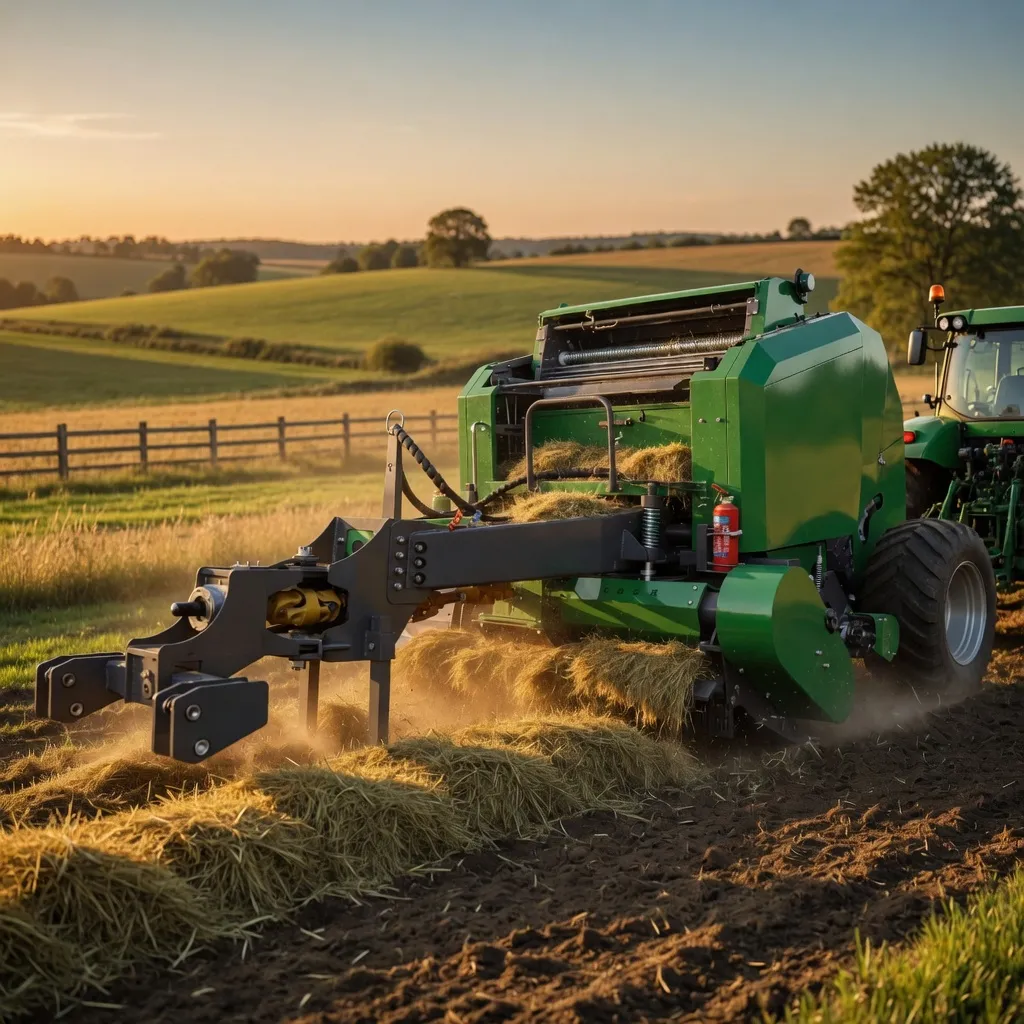
Equine agistment properties and commercial horse facilities purchase hay on a per-bale price rather than a per-tonne price in most Australian market arrangements. A contracted bale weight of 320 kg that delivers 270 kg bales means the buyer receives 16% less hay per bale than they are paying for — a shortfall that is discovered at the feedout rack and reported to every property manager in their network within a week. The 9YG-1.25A variable-chamber round baler’s chamber pressure control maintains consistent bale weight across variable windrow densities — weigh every 20th bale during production and adjust chamber pressure if weight drift exceeds ±4% from the target.
Species Selection for Premium Equine Hay Markets
| Species | Premium Market | Standard Market | Key Quality Characteristic | Typical Farm-Gate Price |
|---|---|---|---|---|
| Oaten hay (Avena sativa) | Hunter Valley equine | General livestock | Golden, palatable, low dust | $16–$24/bale |
| Wheaten hay (T. aestivum) | Competition horses | Breeding stock | Golden, consistent quality | $14–$22/bale |
| Lucerne/alfalfa (M. sativa) | Performance horses, breeding | Dairy supplement | High protein — 20%+ CP | $20–$32/bale |
| Meadow hay (mixed grass) | Leisure horses, ponies | Sheep/cattle | Variety, palatability | $12–$18/bale |
| Timothy (P. pratense) | Premium competition, export | Not primary in Aus market | Low NSC — metabolic horses | $24–$40/bale |
Timothy hay for metabolic horses (those with insulin resistance, laminitis history, or Cushing’s disease) commands the highest per-bale prices in the Australian premium equine market because of its naturally low non-structural carbohydrate (NSC) content — typically 8 to 12% versus 14 to 22% for oaten hay. Timothy production requires cool-season growing conditions (Tasmania, high-country Victoria, southern SA) and careful heading-stage management; it is the most demanding crop for equine hay production but the most rewarding per-bale.
Common Mistakes That Lose Equine Hay Contracts
The decision that most often produces a rejected or discounted hay delivery: baling at 22 to 25% moisture because rain is coming and the paddock must be cleared. A bale made under these conditions will develop internal mould within 4 to 8 weeks and arrive at an equine property smelling musty and showing grey-white colonies on the interior layers. One bad delivery in the horse hay market is rarely forgiven. If the weather turns, leave the hay in the windrow and chalk it up to a livestock-quality product rather than risking your premium market reputation.
Livestock paddocks managed with high nitrogen inputs, wetter irrigation schedules, and without weed exclusion protocols produce hay with higher dust potential, less reliable weed-free status, and greater variability in species composition. Segregate paddocks used for horse hay production and manage them to horse hay standards: lower nitrogen (reduces grass maturity speed and lodging risk), strict weed monitoring and treatment, cutting height maintained at 10 to 12 cm.
Premium equine buyers increasingly ask for paddock history documentation — pesticide applications in the 12 months prior to cut, weed treatment records, and irrigation water source where applicable. Producers who cannot provide this information lose contracts to those who can. Maintain a simple paddock diary (a spreadsheet with dates, inputs, and observations) for any paddock used for equine hay production. This takes 15 minutes per year to maintain and is the difference between a documented premium product and an undifferentiated commodity.
Net wrap tails — the loose end of net wrap left hanging from the bale when the wrap cycle ends — are a significant liability in the equine hay market. Horses at hay racks or on self-feeders ingest net wrap fragments if loose tails hang near the feeding area. A horse that ingests net wrap requires veterinary intervention; the liability exposure to the hay producer under contract law is material. Set the baler’s net wrap cycle to produce a fully tucked tail, and inspect every bale during stacking for loose wrap ends.
Frequently Asked Questions
Discuss Your Equine Hay Baling Programme
Tell us your target species, buyer requirements, and annual bale volume — we’ll specify the right baler and rake configuration for horse-market hay production.