
Large pastoral stations operating at scale — 2,000 to 20,000 head of breeding cattle or sheep across hundreds of thousands of hectares — face a silage baling problem that is categorically different from the one confronting a 300-cow dairy farm or a mixed cropping operation. The difference is not just in the number of bales required. It is in the operating environment: vast paddock distances, extended machinery deployment away from workshop facilities, variable and sometimes extreme weather during the baling window, and a workforce model that places premium value on machines that are straightforward to operate, maintain in the field, and keep running without specialist technician support. This article examines what heavy-duty silage baling looks like at pastoral station scale, and why the equipment and operational model that works at smaller farm scale requires meaningful adaptation.
Scale Changes Everything: The Pastoral Station Baling Context
On a 500-cow dairy farm, the silage baler operates within a few kilometres of the farm workshop, the operator is typically the farmer or a trained employee who uses the machine regularly, and a breakdown can usually be addressed with local resources within hours. On a large pastoral station in the Central Tablelands of NSW or the Queensland downs country, the same machine might be operating 80 kilometres from the nearest town, staffed by a ringers’ crew that uses it intensively for 6 weeks and then parks it, and any breakdown that requires a specialist part initiates a logistics chain that can take 3–5 days to resolve.
The volume requirements at pastoral station scale compound this operational complexity. A large beef breeding station running 5,000 breeders with a target of 12 weeks’ drought reserve needs approximately 5,000–6,000 bales of 1.25m silage, or 1,500–2,000 large-diameter bales, depending on bale size. Building this reserve in a single favourable season requires sustained daily bale output over an extended period — not a few intensive days but weeks of consistent operation. The machine is in the field continuously for that period, and any lost day represents a significant portion of the programme’s total output.
The weather risk at pastoral station scale is also disproportionately large. A 300mm rain event that wets a prepared ryegrass windrow on a dairy farm delays baling by 48 hours and costs 150 bales. The same event across a seasonal native grass pasture flush on a large station that won’t repeat the growth opportunity for another two years costs not just those bales but potentially the entire season’s reserve-building window. The ability to move quickly during a suitable weather window — and to keep moving without breakdowns — is the operational premium that large station silage programs place on their equipment.
Heavy-Duty Machine Specifications for Station Operating Conditions
When station managers evaluate silage baling equipment, the specification priorities are different from those of a dairy farmer or contractor. Throughput per day matters — but the specification that matters before throughput is durability under extended high-intensity operation in conditions that provide no easy access to workshop support. A machine that produces 15% more bales per day but requires a mid-season workshop visit defeats its own purpose at station scale.
Bearing and Roller Specifications
Large pastoral stations running their silage baler at 300–500 annual PTO hours during a 6–8 week intensive programme are operating at the upper range of what most standard farm specifications anticipate. The bearings that limit chamber roller life under these conditions are typically the input shaft bearings and the pickup reel main bearings — both are under continuous load during operation and both accumulate the vast majority of their wear during intensive-season use rather than distributed across a longer, lower-intensity calendar.
The EverPower S9000 platform uses higher-load-rated bearings at these critical points specifically because of the operating profile that commercial-scale baling demands. The specification is not marketing copy — it reflects a genuine engineering decision to use bearings with a higher dynamic load rating at the cost of slightly higher initial component price, because the downstream cost of a bearing failure during a pastoral station’s harvest window vastly exceeds the cost premium on the bearing itself.
Pickup System Robustness for Variable Terrain
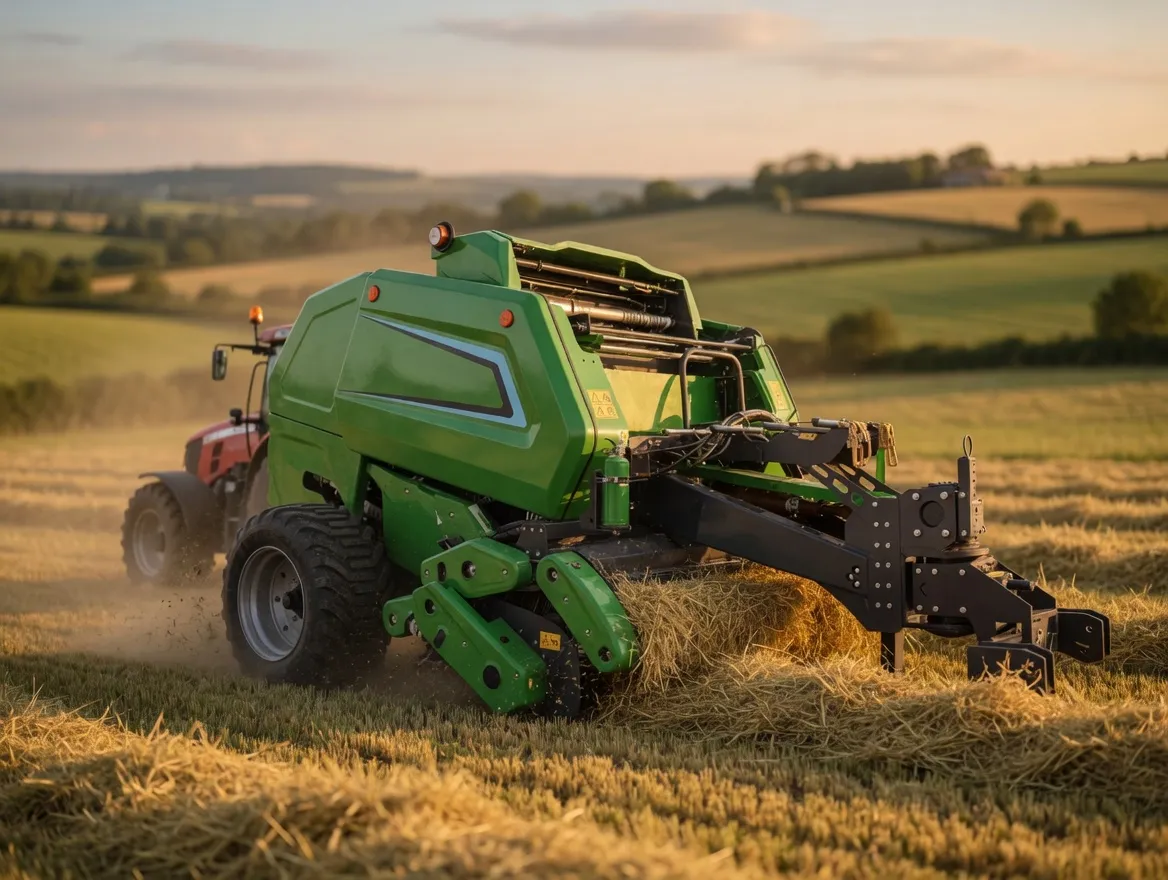
Pastoral station paddocks are not the flat, irrigated dairy farm pastures for which many balers’ pickup systems are implicitly optimised. Native grass paddocks in western NSW, Queensland channel country, and the NSW Northern Tablelands have irregular ground surfaces — gilgai formations, tree stumps, scattered rocks, and undulating terrain that cause the pickup reel to experience impacts that a dairy farm operator would never encounter. The pickup reel’s float system — which allows the pickup to follow the ground contour rather than riding rigidly — must have adequate travel range and return-spring strength to accommodate this terrain without either dragging on the ground (contaminating the bale with soil) or riding too high (leaving a windrow strip in the paddock).
Tractor Fleet Considerations for Remote Station Baling
Most large pastoral stations do not maintain a dedicated silage baling tractor in the way a contractor or intensive dairy farm would. The tractor that pulls the baler during the harvest window is typically a multi-purpose station tractor that also runs cultivation equipment, vehicles maintenance, and general property work across the year. This has several implications for the baler-tractor matching question.
First, the tractor’s PTO hour accumulation during the baling season will be a significant fraction of its total annual hours — which means the hydraulic system, PTO shaft, and driveline components will experience their most intensive loading during a period when the tractor cannot be easily serviced or swapped out. Confirming hydraulic flow compatibility between the station’s tractor fleet and the baler before the season — not on the first day of harvest — is essential. The EverPower technical team at Condell Park can verify compatibility for any specific tractor model and year, which takes the guesswork out of a pairing decision that needs to be right before the season starts.
Second, the tractor should have the fuel tank capacity to run a full baling day without mid-field refuelling. At large station paddock scales — paddocks of 200–400 hectares are common in pastoral country — the logistics of fuel delivery to the baling site across rough track conditions are a real operational overhead. Tractors with 300+ litre tanks, or tractors paired with a saddle tank arrangement, avoid the lost time that a mid-paddock fuel stop generates when the resupply vehicle has to cover 20+ kilometres of station track to reach the baling site.
Film and Consumables Logistics: The Supply Chain Problem
On a mixed farm or dairy, consumable restocking during the silage season is a manageable inconvenience — a run to the local agricultural supplier or a same-day delivery from a nearby depot. On a large remote pastoral station, consumable resupply is a logistics operation that requires planning from the start of the season rather than reactive ordering when stock runs low.
The pre-season consumables calculation for a pastoral station silage program is straightforward: target bale count × film rolls per 100 bales × 1.2 contingency buffer = pre-season film order. The same calculation applies to net wrap. For a station targeting 3,000 bales, this typically means 45–60 rolls of 750mm stretch film and 8–12 rolls of net wrap — enough volume to justify a single pre-season order that is delivered and stored at the homestead depot before any baling begins. Stations that have experienced the cost and frustration of halting a 5,000-bale programme because film stock ran out and the next delivery was 10 days away understand why this pre-season logistics discipline is not optional.
EverPower’s Condell Park depot can fulfil bulk pre-season orders for both stretch film and net wrap, with delivery coordination for remote stations that require freight forwarding rather than direct pickup. Establishing a pre-season supply arrangement with EverPower before the baling window opens — not during it — is the practice that eliminates the supply chain disruptions that can halt a pastoral station’s most important feed production programme of the year.
Field Service Capability: Maintaining the Machine in Remote Country
The pastoral station’s field service requirement for a silage baler is specific: the machine must be maintainable by a competent station hand with standard hand tools, without requiring specialist service equipment or a manufacturer’s technician for any foreseeable failure during the baling programme. This is not a premium requirement — it is the baseline for the machine to be commercially viable at pastoral station scale.
The field service kit that should accompany every large station baling programme includes: a full set of replacement pickup tines, two complete belt joint sets in the correct width, one net wrap knife assembly, a hydraulic hose repair kit, a set of standard PTO shaft grease points and grease gun, and a torque wrench for bearing-preload checks. This kit represents a relatively modest inventory cost against the programme value it protects — a single day of prevented downtime during a 6-week harvest window pays for the kit many times over.
EverPower machines are specifically designed with this field service requirement in mind. Belt joints are accessible without major disassembly; pickup tine replacement requires no special tools; the net wrap knife assembly is a simple swap with a retention bolt that any workshop-competent station hand can complete. This design choice — prioritising field serviceability over minimising manufacturing cost at the wear-item interface — reflects an understanding that the machine’s commercial value to a pastoral station depends on its ability to be maintained in the field, not in a workshop.
Bale Transport and Storage at Station Scale
Moving 3,000–6,000 silage bales from paddocks spread across a large station to strategically located storage sites is a logistics programme in its own right. The paddock-to-storage movement typically occurs in two stages: the baler produces and wraps bales across the paddock, then a telehandler or front-end loader collects and stacks them at the nearest accessible location, and a separate truck-and-trailer operation transports them to the permanent depot sites that serve each grazing zone.
The EverPower 9jyy series bale transporters can streamline the first stage of this movement — collecting and transporting bales from the baling site to an intermediate stack location without requiring the telehandler to operate alongside the baling machine in the paddock. For stations where the telehandler is also involved in other operations during the baling programme (bore maintenance, fencing, infrastructure work), the 9jyy transport reduces competition for the loader and allows the baling operation to proceed continuously without waiting for the telehandler to become available.
Storage site selection at pastoral scale follows the same principles as smaller operations but at larger spatial distribution. Zone depots — storage sites serving specific grazing paddock clusters — minimise the truck transport distance for feedout, which at station scale can represent a significant annual fuel and labour overhead. Each zone depot site should have firm, free-draining ground, adequate access for the transport vehicle, and enough width for a single-file row of bales with inspection access on both sides. On stations with black soil paddocks, purpose-built gravel pads at each depot site are a worthwhile capital investment that prevents the base spoilage and vehicle bogging that otherwise occur during wet periods.
Staffing the Pastoral Station Silage Programme
Large pastoral station silage programmes are typically staffed by a combination of permanent station employees and seasonal or casual operators brought on specifically for the baling period. The staffing model reflects the concentrated seasonal nature of the work — six weeks of intensive baling that requires additional hands that cannot be economically retained year-round.
The machine’s operator learning curve is a real cost in this staffing model. An experienced baler operator who knows the machine produces significantly more bales per day than a competent tractor driver who is learning the specific machine for the first time. EverPower’s commissioning support — which covers initial setup, density setting calibration, and the machine-specific operating procedures that make the difference between first-week and fifth-week performance — compresses this learning curve significantly. A pastoral station that provides its seasonal baling operators with structured machine familiarisation at the start of each season, rather than leaving them to develop their own operating habits, consistently achieves better seasonal bale totals.
The wrapping operation is the most logistically complex component of the pastoral station programme when running standalone baler and wrapper configurations. Coordinating two operators across large paddock areas — ensuring the wrapper stays within 3–4 hours of the baler and that neither machine is waiting for the other — requires communication and scheduling discipline that is easier to achieve on smaller, more visible paddocks. Combined baler-wrapper machines eliminate this coordination requirement entirely, which is why large stations that have made the transition consistently report that the operational simplification is as valuable as the quality improvement.
The Opportunistic Baling Model: Acting When Conditions Align
The most important operational characteristic of a large pastoral station silage programme is speed of deployment when conditions are right. Unlike a dairy farm with a scheduled silage calendar, large pastoral stations often operate in an opportunistic baling model — the decision to bale is triggered by the coincidence of a pasture flush with an acceptable weather window, and the entire programme may need to be executed within 3–4 weeks of that window appearing.
Being ready to deploy immediately means the machine must be fully serviced, the consumable inventory must be in place, the tractor must be confirmed-compatible, the staff must be available and briefed, and the paddock plan must be developed before the window opens — not after. Stations that do this preparatory work in the inter-season period can begin baling the day conditions become suitable. Stations that begin this preparation when the pasture flush appears lose the first week to logistics, which on a narrow weather window can represent a significant proportion of the total available time.
EverPower’s pre-season support for pastoral station customers covers machine servicing confirmation, consumable inventory calculation, tractor compatibility check, and operator briefing materials — all available before the season opens. This preparation infrastructure is available to all EverPower customers through direct contact with the NSW team, and for stations that have experienced the cost of a delayed or disrupted baling programme, it represents a service investment that is worth making before each season rather than assuming last season’s preparation is still current.
EverPower for Large Pastoral Stations
EverPower Baling Machinery Australia Pty Ltd supplies the S9000-platform commercial machines and the supporting equipment range suited to large pastoral station silage programmes. The NSW-based team understands the remote operating conditions, extended deployment model, and field serviceability requirements of pastoral scale operations. Local parts stock, pre-season supply arrangements, and direct technical support are available to pastoral station customers through the Condell Park depot.
EverPower Baling Machinery Australia Pty Ltd
27 Harley Crescent, Condell Park NSW 2200
+61 2 9708 3322
[email protected]
Frequently Asked Questions
27 Harley Crescent, Condell Park NSW 2200 | +61 2 9708 3322 | [email protected]
About Us | Contact Us