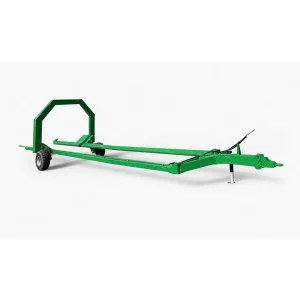
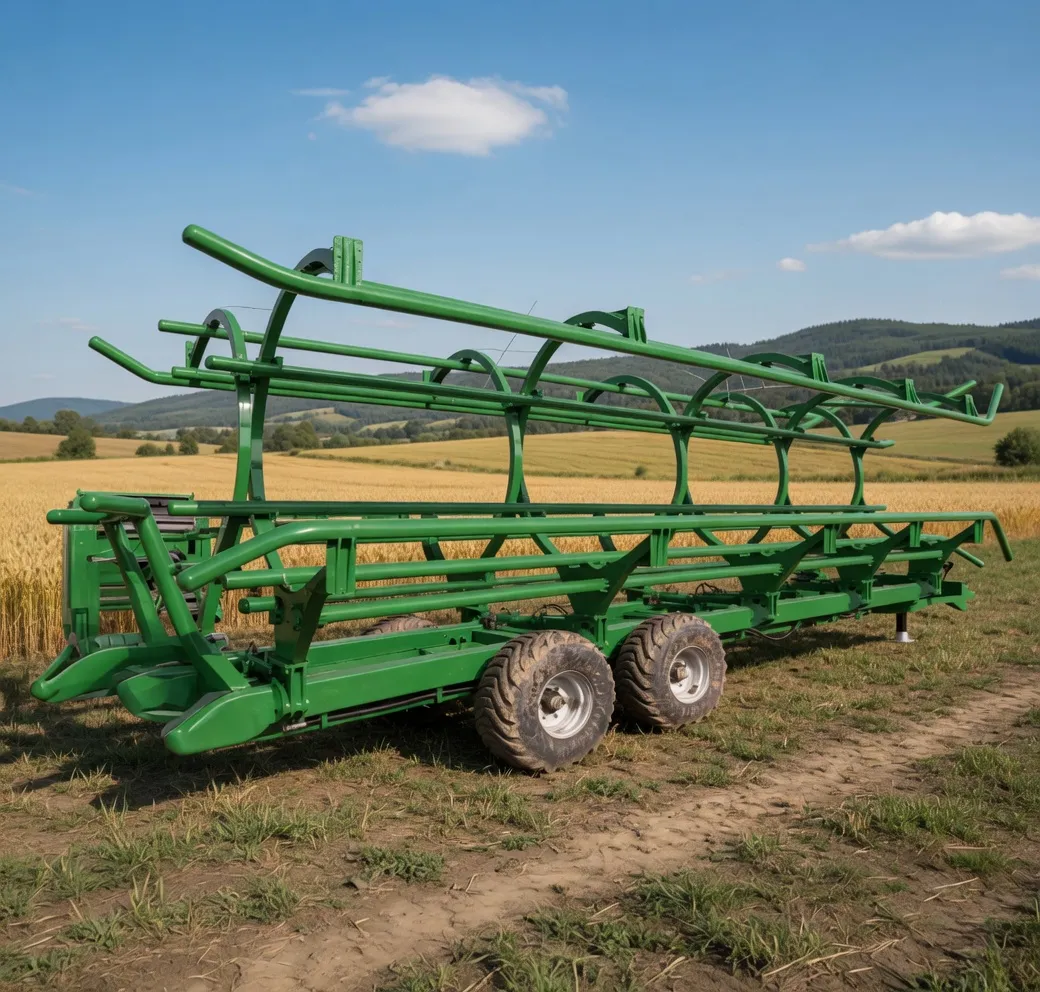
Description
Product Specifications
| No. | Parameter | Unit | Specification |
|---|---|---|---|
| 1 | Product Name | — | Hay Baler Conveyor |
| 2 | Product Model | — | 9JYY-4.5 |
| 3 | Hitching Method | — | Tow-Behind Type |
| 4 | Loading / Unloading | — | Hydraulic |
| 5 | Maximum Load Capacity | kg | 4,500 |
| 6 | Matching Power | kW | ≥ 50 |
| 7 | Working Hydraulic Pressure | MPa | ≥ 16 |
| 8 | Transport Speed | km/h | ≤ 40 |
| 9 | Tyre Model | — | 400/60-15.5 Dual Axle, 4 Wheels |
| 10 | Bale Size (Dia. × Length) | mm | Dia. 1,000–1,400, Length 1,000–1,500 |
| 11 | Overall Dimensions — Working | mm | 9400 × 6750 × 1,750 |
| 12 | Overall Dimensions — Transport | mm | 9400 × 2900 × 3,300 |
| 13 | Overall Machine Weight | kg | 3,240 |
Product Overview
Moving round bales from the paddock to the storage site is the part of the baling operation that rarely appears in machine brochures but consumes a significant portion of the total baling cost and — on silage operations — introduces the greatest risk of film damage and dry-matter loss. Every extra handling step a bale receives after wrapping is a puncture risk; every hour a bale sits on the paddock before collection is time for soil moisture and UV to begin degrading the outer film layers. The 9JYY-4.5 Hay Baler Conveyor addresses the collection step by picking up, transporting, and depositing bales using fully hydraulic arm loading — no manual rolling, no chains, no bale-rolling risk that damages film on silage bales.
The machine’s 4,500 kg load capacity carries three to four standard large round bales per trip, depending on bale weight. It tows behind any tractor above 50 kW at transport speeds up to 40 km/h, converting what is typically a slow, labour-intensive tractor-and-spike operation into a single-pass collect-and-go run across the paddock. The hydraulic arm collects bales directly from the ground without the tractor needing to reverse up to each one — the operator drives forward along the bale row and the arm swings out, picks up, and loads without stopping.
Bale compatibility covers diameters from 1,000 to 1,400 mm and lengths from 1,000 to 1,500 mm — matching the output of the full EverPower round baler range as well as bales from John Deere, New Holland, Claas, Krone, and other major brands. The dual-axle four-wheel configuration provides stable transport on both sealed and dirt roads at the rated 40 km/h transport speed, and the 3,240 kg machine weight is manageable behind tractors that are also used for other tasks.
Technical Features — Built for Paddock Reality
Fully Hydraulic Loading — No Manual Effort, No Film Damage
The hydraulic arm system is the central design decision in the 9JYY-4.5. On machines that rely on drive-over loading or chain-winch collection, the bale is rolled or dragged across the platform — a process that abrades the bottom film layers on silage bales and can introduce punctures that start the aerobic deterioration process long before the bale is fed out. The 9JYY-4.5’s arm lifts bales from the ground and places them onto the platform with a controlled, gentle arc that maintains film integrity. Multiple handling trials comparing arm-loaded versus drive-over-loaded silage bales consistently show lower visible film damage on arm-loaded bales and correspondingly better silage condition at feed-out.
4,500 kg Load Capacity — Three to Four Bales Per Trip
The 4,500 kg rated capacity comfortably carries three 1.3 m oaten hay bales at 900–1,050 kg each, or four lighter silage bales at 700–900 kg each. Carrying multiple bales per trip is the key economic advantage over tractor-spike single-bale collection, which requires one tractor trip per bale. On a 200-bale paddock, single-bale collection runs 200 tractor trips; three-bale collection with the 9JYY-4.5 reduces that to approximately 67 trips — cutting tractor hours, fuel, and paddock compaction by roughly two-thirds for the collection task.
Compatible with Bales 1,000–1,400 mm Diameter
The adjustable arm and platform accommodate the full range of bale diameters produced by EverPower’s 9YG-1.0 (Φ1,100 mm), 9YG-1.25A and 1.25 (Φ1,300 mm), and S9000 Series (Φ1,300 mm), as well as competitive brands producing bales in the 1.0–1.4 m range. Length accommodation from 1,000 to 1,500 mm covers both 1,000 mm narrow-chamber and 1,400–1,500 mm wide-chamber bales. The machine does not require any reconfiguration to switch between bale sizes — the hydraulic arm self-adjusts within the specified range.
≥ 50 kW Tractor Requirement — Works with Mid-Size Tractors
The 50 kW (approximately 68 hp) minimum power requirement means the 9JYY-4.5 can be towed by the same mid-size tractor that many family farms run for general tasks. This is an important practical consideration: on smaller properties, dedicating a large tractor exclusively to bale collection leaves it unavailable for other pressing harvest-season tasks. The 9JYY-4.5’s modest tow requirement allows a 75–85 hp tractor to handle collection while the farm’s primary baling tractor stays on the baler.
Transport Speed to 40 km/h — Fast Road Transfer
The dual-axle four-wheel configuration on 400/60-15.5 tyres provides the lateral stability for 40 km/h loaded road travel. Moving between paddocks on gravel farm roads at 40 km/h with a full load completes in practical timeframes — a 2 km paddock-to-shed run takes three minutes rather than eight, which matters when working against weather windows. The working width of 6,750 mm folds to 2,900 mm transport width, within the standard road-legal limit without a permit for rural travel on most Australian state roads.
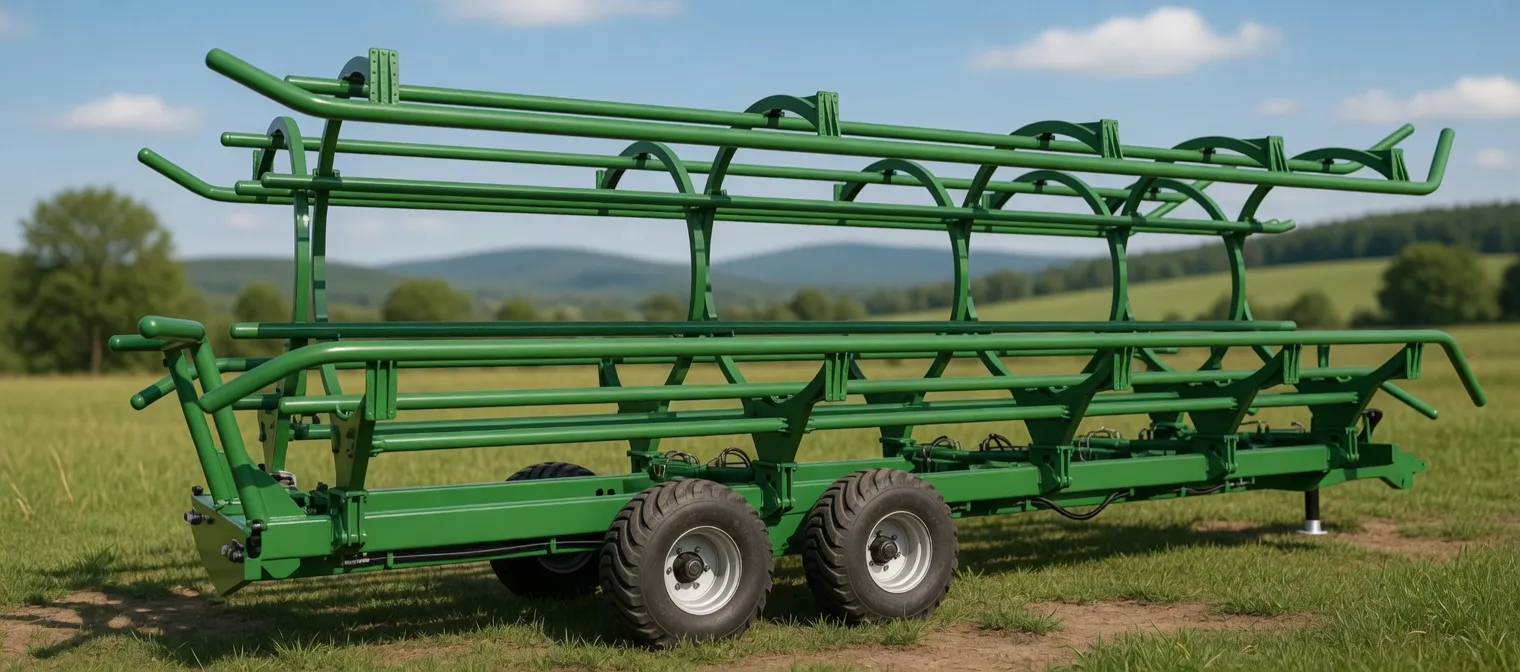
How the 9JYY-4.5 Works in the Field
Tractor and conveyor drive along the windrow of deposited bales. The hydraulic arm extends to the bale position — no reversing required, no precise alignment manoeuvres.
The arm swings down, grips the bale, and lifts it onto the platform with a controlled arc that keeps the bale stable and protects film integrity. Operator controls the arm from the tractor cab via the hydraulic levers.
Repeat the pickup sequence until the platform is at capacity (3–4 bales depending on weight). The platform distributes load across the dual axles to maintain stability during loading and transport.
Tow the loaded conveyor to the stack or storage site at up to 40 km/h. At the unload point, the hydraulic arm reverses the process — bales are placed precisely into position without dropping or rolling.
Operators running the 9JYY-4.5 on a 300-bale silage paddock typically complete collection in 4–6 hours with a single tractor, versus 10–14 hours for single-bale spike collection. The time saving is largest on long paddocks where each tractor trip covers significant distance between bale pickup and storage stack — exactly the paddock layout common on larger Australian farms.
Applications — Where Multi-Bale Collection Pays
Silage Operations — Protecting Film Integrity
The most financially significant application for arm-loaded collection is wrapped silage bale handling. Each film puncture on a silage bale creates an aerobic deterioration zone that spreads inward from the puncture point over weeks and months of storage. A single 5 cm puncture in the outer film layers can result in 15–25 kg of spoiled silage at feed-out on a 700 kg bale — a loss per bale that compounds across hundreds of bales in storage. The 9JYY-4.5’s arm loading keeps bales off the ground during transfer and avoids the abrasion that drive-over collection systems inflict on the bottom film layers.
Large Hay Operations — Reducing Tractor Hours per Bale
On dry hay operations producing 500–3,000 bales per season, the economics of multi-bale collection are straightforward. Single-bale spike collection requires one tractor return trip per bale; the 9JYY-4.5 delivers 3–4 bales per trip. At 200 bales per day and a 2 km paddock-to-shed distance, single-bale collection runs 400 km of tractor travel per day; multi-bale collection with the 9JYY-4.5 reduces that to approximately 135 km. The fuel and time saving in collection alone frequently recovers the machine cost within a season on operations of this scale.
Remote Properties — Simplicity & Maintainability
Remote stations and large outback properties particularly value the 9JYY-4.5’s robust simplicity. The fully hydraulic system uses standard agricultural hydraulic components available from any rural hydraulic supplier. There are no electronic systems, no calibrated sensors, no firmware to update — a hydraulic hose failure or cylinder seal replacement is within the capability of any station mechanic. This maintainability in locations 200+ km from specialist service agents is a genuine practical advantage over more electronically complex bale-collection systems.
Shared Machinery Groups — One Collector for Multiple Balers
Neighbour groups and machinery syndicates often own multiple balers operating simultaneously across different properties. A single 9JYY-4.5 can follow behind any of the balers in sequence — the broad bale-size compatibility means it collects from every machine without reconfiguration. The 40 km/h road speed makes it practical to move between properties within a day’s work without losing significant collection time to travel.
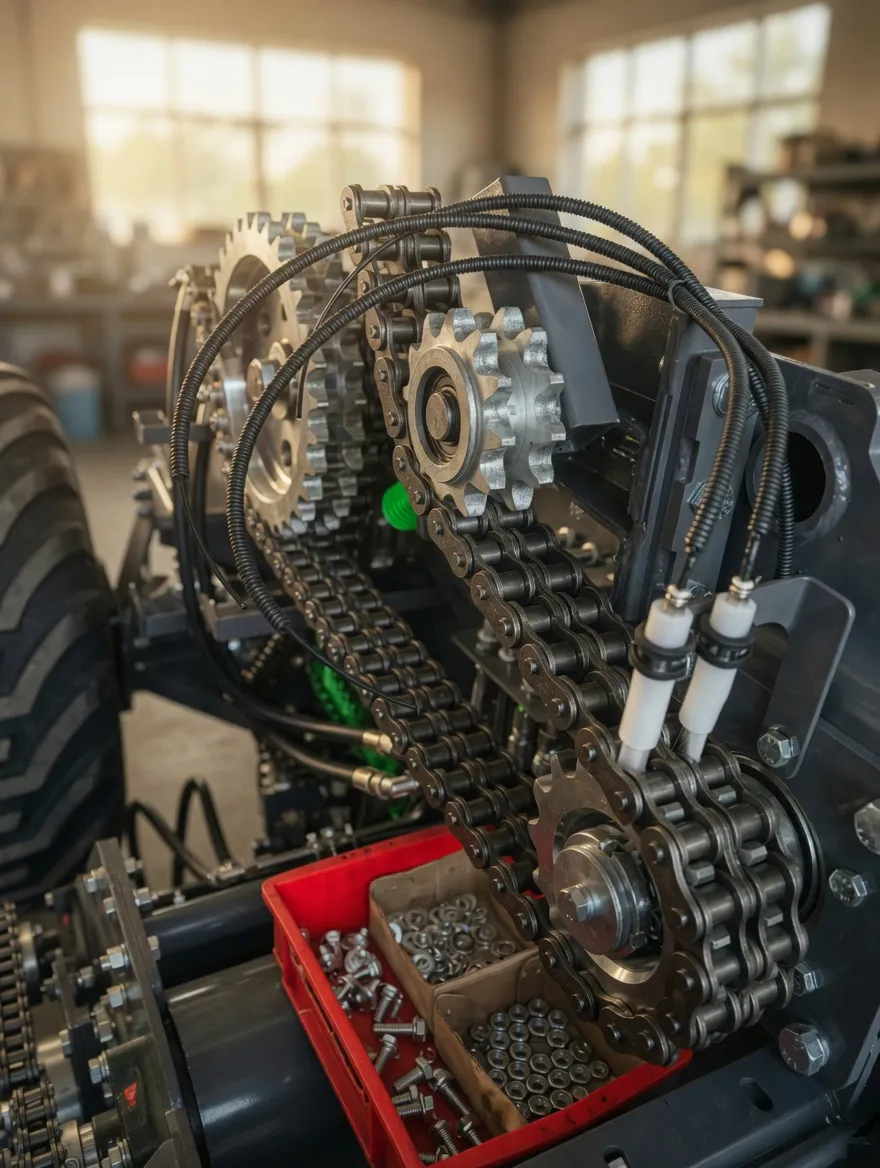
Maintenance — Straightforward Hydraulic System Service
Before Each Operating Season
Full hydraulic system inspection: check all hose connections for seepage or cracking, particularly at the arm pivot points where hoses flex repeatedly during loading cycles. Replace any hose showing cracking in the outer sleeve — hose failure under 16 MPa system pressure is a rapid and messy failure mode that stops the machine immediately. Inspect the arm pivot pins and bushings for wear; worn pins allow the arm to deflect laterally during the lift arc, reducing pickup precision and increasing the risk of bale drop.
Every 100 Operating Hours
Change the hydraulic fluid and filter in the circuit supplying the arm and platform systems. Hydraulic fluid in bale-handling equipment accumulates fine abrasive particles from field dust faster than most agricultural hydraulic circuits because the arm cylinders operate in the dust-rich environment close to the ground. Contaminated fluid is the primary cause of control-valve wear in hydraulic bale handlers — fluid changes at 100-hour intervals rather than seasonal intervals significantly extend valve service life.
Tyre and Axle Inspection
Inspect the four 400/60-15.5 tyres for wear, sidewall cracking, and bead seating before each season and after any extended transport runs on rough roads. The dual-axle configuration loads all four tyres more lightly than a single-axle design at the same capacity, which extends tyre service life but also means that a single underinflated tyre carries a disproportionate load without being immediately obvious to the operator. Set all four tyres to the specified inflation pressure with the machine unloaded and re-check with a full load.
Why the 9JYY-4.5 Changes the Collection Equation
Gentle controlled lift from ground to platform. Eliminates the film abrasion that drive-over and chain-winch collection systems inflict on silage bales.
Reduces tractor trips for a 200-bale paddock from 200 to approximately 67 — cutting collection fuel and time by two-thirds.
Standard agricultural hydraulic components throughout. Serviceable by any rural mechanic — critical for remote properties far from specialist agents.
Accepts bales from 1,000–1,400 mm diameter and 1,000–1,500 mm length — compatible with every major baler brand without reconfiguration.

About EverPower Baling Machinery Australia
EverPower Baling Machinery Australia Pty Ltd — 27 Harley Crescent, Condell Park NSW 2200 — is the direct Australian arm of an ISO 9001-certified manufacturer operating a 32,000 m² factory with 180 staff and a dedicated R&D centre. Every machine carries a genuine Australian warranty administered from our Sydney office, backed by locally stocked spare parts for 72-hour national delivery.
Call +61 2 9708 3322, email [email protected], or visit silage-baler.com/about-us.

Frequently Asked Questions
Cut Your Collection Time by Two-Thirds
Contact EverPower to confirm the 9JYY-4.5 suits your bale size and storage layout, or to compare it with our single-bale transporter options.