
Producing 1,000 silage bales in a season is a different kind of problem from producing 200. At 200 bales, the limiting factor is usually the weather window and the available crop. At 1,000 bales, the weather and the crop are still constraints — but the binding limit is almost always the system: how the mowing, raking, baling, wrapping, transport, and storage operations are coordinated across multiple people, multiple machines, and multiple paddocks over several weeks of intensive work. The farms that reach 1,000+ bales consistently are not the ones with the biggest machine; they are the ones with the tightest system.
Designing the Production System Before the Season Starts
A 1,000-bale programme across a 6-week season requires approximately 167 bales per week, or 28 bales per day at 6 operating days per week. At standard forward speed on a 1.25m baler in well-prepared ryegrass, 28 bales per day is a morning’s work for a single operator. The question is not whether the baler can produce 28 bales in a day — it almost certainly can. The question is whether those 28 bales can be mowed, wilted, raked, baled, wrapped, transported, and stored on every operating day across 6 consecutive weeks without any link in that chain becoming the bottleneck that stops everything else.
The system design begins with a capacity audit of each link in the chain. Starting from the mowing end: what area per day can the mowing equipment cover, and does that area yield enough wilted windrow material to supply the daily bale target 24–36 hours later? If the mower covers 12 hectares per day, and each hectare of ryegrass at 3.5 t DM/ha yields approximately 8–9 bales, then 12 hectares supplies approximately 100 bales’ worth of material per day — comfortably ahead of a 28-bale daily target. That capacity buffer is what keeps the baler from being material-supply limited.
Moving to the wrapping end: if 28 bales are being produced per day, the wrapping system must wrap 28 bales per day to maintain the 4-hour maximum bale-to-wrap standard on silage. A standalone wrapper at 4–6 minutes per bale can wrap 28 bales in 2–3 hours of uninterrupted operation — achievable with a dedicated wrapper operator. A combined baler-wrapper completes this step automatically, eliminating the coordination requirement entirely. The system design must explicitly assign wrapping responsibility and confirm the capacity is sufficient; leaving wrapping as a lower-priority task that happens “when there’s time” is the most common source of quality failures in high-volume programmes.
The Paddock Rotation Plan: Matching Crop Readiness to Machine Availability
At 1,000+ bales per season, the paddock rotation plan is a genuine management document rather than a rough mental schedule. The plan maps each paddock’s estimated baling date against the programme timeline, accounting for the 24–36 hour wilting requirement, the expected DM at cutting, and the weather probabilities for the region. This plan should be on paper before the first paddock is cut.
The plan works backwards from target baling dates: if paddock A needs to be baled on Day 5, it needs to be cut on Day 3 or 4. The mowing crew needs to execute this schedule consistently — not cut paddocks in the most convenient order, but in the order that keeps the baling crew continuously supplied without gaps. The people running the mower need the paddock rotation plan in the same format that the baling operator has it.
The plan also needs weather contingency built in. In a 6-week baling window, at least one rain event that delays the programme by 2–3 days should be assumed. Operations that plan for 7 productive days per week and discover they can only reliably achieve 5.5 days per week run out of ready windrow material repeatedly. Operations that plan for 5.5 days and occasionally achieve 7 run ahead of schedule.
Machine Capacity Matching Across the System
Every machine in the system needs capacity matched so no single machine is the bottleneck. The mowing operation should never limit the baler; the wrapping operation should always exceed baling output. This is the mechanical design of the system, as important as the staffing and scheduling components.
| System Link | EverPower Machine | Daily Capacity | Role in System |
|---|---|---|---|
| Mowing | 9GQY-3.2 Mower-Conditioner | 15–20 ha/day | Always ahead of baler; provides 24-hr windrow buffer |
| Raking | 9LH-12 Lateral Rake | 25–35 ha/day | Stays ahead of baler at all volume levels |
| Baling | 9YG-1.25A Round Baler | 80–120 bales/day | Sets the production ceiling for 1,000-bale programmes |
| Wrapping | 9YCM-850 Wrapper | 100–140 bales/day | Capacity margin above baler output is deliberate |
| Transport | 9jyy-4.5 Bale Conveyor | Continuous | Removes bale accumulation at the baling site daily |
Staffing and Role Clarity
A 1,000-bale programme requires at minimum: one baler operator, one wrapper operator (or a combined machine), one mower operator running the day-ahead cutting schedule, and one person managing bale transport and storage. The critical staffing discipline is role clarity — every person needs to know exactly what their responsibility is each day without needing to coordinate informally in real time.
Informal coordination works at 200 bales. At 1,000 bales, it introduces the communication failures that cause the wrapper to be in the wrong paddock when the baler is ready, or the transport tractor to be off-property when bales need moving. The daily 10-minute planning meeting — all staff present or on the radio, confirming today’s paddock assignments, bale count target, constraints, and fallback plan — adds 10 minutes to the day and removes hours of reactive problem-solving.
Consumable Management: Never Run Out Mid-Programme
Running out of stretch film or net wrap mid-season halts a 1,000-bale programme as effectively as a mechanical breakdown. At 100 bales per day, a half-day film shortfall costs 50 bales. The solution is a pre-season bulk order based on a complete consumption calculation with a 20% contingency buffer built in before any baling begins.
At 6-layer wrapping on 1.25m bales using 750mm film: approximately 65 bales per roll. For 1,000 bales: 1,000 ÷ 65 × 1.15 contingency = 17–18 rolls pre-season. Net wrap: at 300–350 bales per roll, 1,000 bales requires 3–4 rolls minimum. Order before the season opens; never order reactively during the programme. The same advance-ordering discipline applies to the spare parts kit — pickup tines, belt joints, net wrap knife, and hydraulic fluid are all predictable 1,000-bale season consumables that can be staged at the operating depot in 30 minutes of pre-season effort.
Bale Transport: The System Step That Gets Overlooked
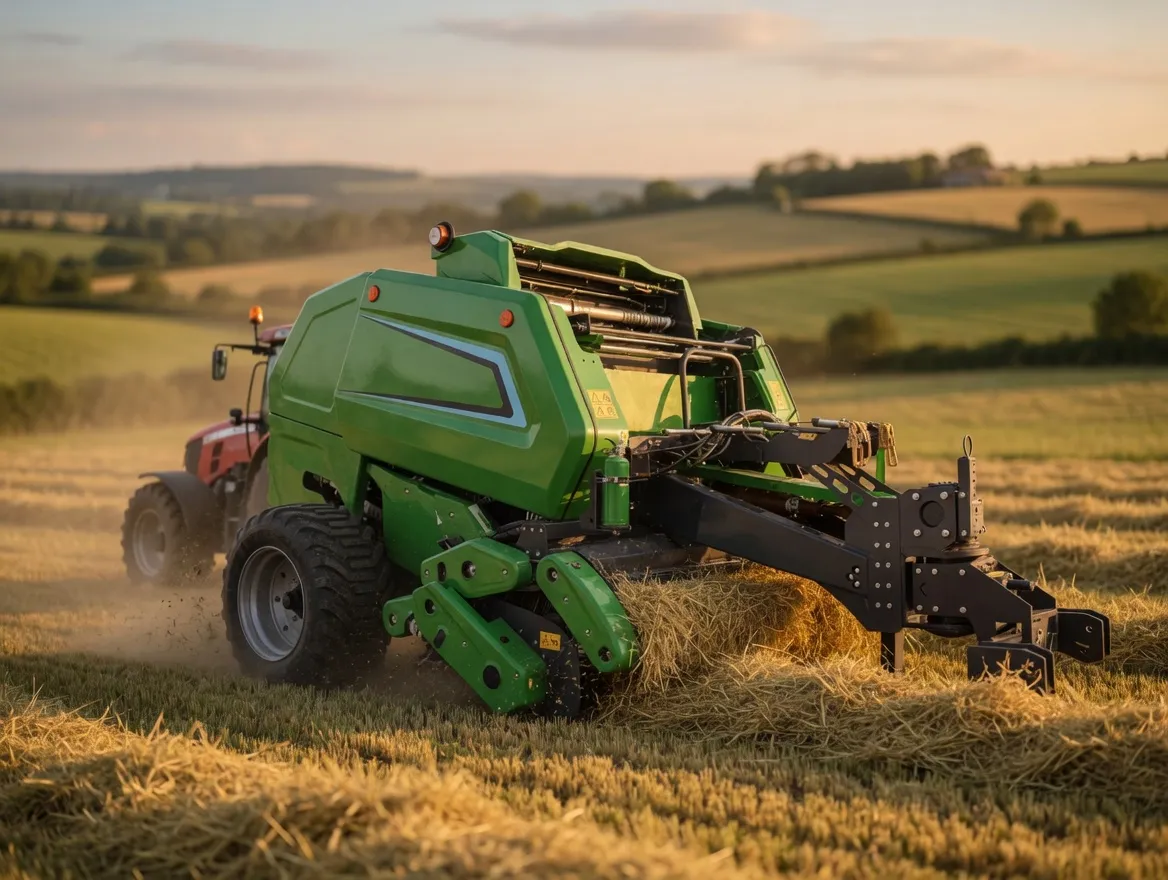
In most systems analyses of high-volume silage programmes, bale transport receives the least attention and causes the most problems. The baling and wrapping operations are visible and well understood; moving 1,000 wrapped bales from paddocks to storage sites — while keeping the baling site clear for the next day — is a logistics problem that needs to be explicitly designed, not assumed to solve itself.
At 28 bales per day, the baling site accumulates 28 bales that need to be transported to storage before the next day’s run. If storage is 500 metres away, a telehandler makes 6–7 trips to clear 28 bales. If storage is 3 kilometres away, each trip takes four times as long — transport becomes a half-day operation that requires dedicated equipment. The system design must calculate daily transport cycle time explicitly and confirm the transport equipment can clear daily production. The EverPower 9jyy-4.5 Bale Conveyor reduces the loader dependency by moving bales from the paddock to an intermediate staging point as part of the baling operation, reducing the number of loader trips required and freeing the telehandler for paddock-to-storage transport.
Storage Infrastructure for 1,000+ Bales
Storing 1,000 bales in a single end-to-end row occupies 1.25 kilometres — clearly impractical. In practice, 1,000 bales are stored in multiple parallel rows of 50–100 bales with 3-metre lanes between rows for telehandler access. The required footprint is approximately 80 × 30 metres of firm, well-drained ground. Gravel surfacing or concrete pads at bale base positions extend storage life and prevent the base moisture damage that silage film cannot protect against from below.
FIFO rotation in a 1,000-bale storage site requires a labelling system — row tags indicating baling date, or a site map. Without this, the feedout operator inevitably takes bales from the most accessible position rather than the oldest row. The first bales made — which have the longest storage time and the closest approach to the end of reliable storage life — end up consumed last. At 1,000 bale scale, the FIFO discipline protects the entire reserve investment; without it, quality heterogeneity becomes a livestock management problem at feedout.
Quality Monitoring Across a 1,000-Bale Programme
A 1,000-bale programme produces bales across multiple paddocks, cut dates, and possibly crop types — all with different quality characteristics. Treating the entire 1,000-bale reserve as a uniform product leads to poor ration management at feedout: the operator doesn’t know whether the bale being opened is from the high-quality early-spring cut or a later, lower-ME batch.
The quality monitoring approach for a large programme is batch testing: one representative sample per identifiable batch at 6–8 weeks post-baling. For a 1,000-bale programme involving 5–6 distinct paddock batches, this means 5–6 laboratory tests at $50–$80 each — a total investment of $300–$500 that enables precise ration management across the full feedout period. Farms implementing this testing consistently produce better livestock performance from the same silage — not because the silage is better, but because the ration is calibrated to what’s actually in the bales.
Post-Season Review: Building the System for Next Year
The operational intelligence gathered during a 1,000-bale season — which paddocks performed best, where bottlenecks developed, actual machine hours versus the plan, how consumable quantities compared with estimates — is only valuable if captured and used. The 2-hour post-season review, conducted within 2 weeks of the programme’s end while details are fresh, turns a good first season into a better second one. Farms running 1,000+ bale programmes for five or more years consistently describe the same pattern: the programme that produces 850 bales in year one often produces 1,100 bales in year three from the same equipment, because the system around the machines improved season by season.
EverPower Support for High-Volume Programmes
EverPower Baling Machinery Australia Pty Ltd supports high-volume silage programmes with matched equipment from the full harvest chain, supplied from the NSW base with local technical support and pre-season supply arrangements. For operations planning their first 1,000-bale season or scaling up from a smaller programme, EverPower’s team can walk through the system design and capacity matching based on the specific property, crop types, and tractor fleet. The conversation before the season starts produces better outcomes than the troubleshooting conversation during it.
EverPower Baling Machinery Australia Pty Ltd
27 Harley Crescent, Condell Park NSW 2200
+61 2 9708 3322
[email protected]
Frequently Asked Questions
27 Harley Crescent, Condell Park NSW 2200 | +61 2 9708 3322 | [email protected]
About Us | Contact Us