Description
Product Specifications
| No. | Parameter | Unit | Specification |
|---|---|---|---|
| 1 | Model Name | — | 9LH-12 Towed Lateral Rake |
| 2 | Structure Type | — | Tractor-Drawn Lateral Type |
| 3 | Connection Method | — | Towed Type |
| 4 | Matched Power | kW | 25–44 |
| 5 | Raking Width | m | 12 |
| 6 | Operating Speed | km/h | 5–10 |
| 7 | Productivity | hm²/h | 6–12 |
| 8 | Number of Raking Teeth | pcs | 168 |
| 9 | Operators | person | 1 |
| 10 | Structural Weight | kg | 1,510 |
| 11 | Miss-Raking Rate | — | ≤ 3% |
| 12 | Working Dimensions (L×W×H) | mm | 5500 × 12000 × 1350 |
| 13 | Transport Dimensions (L×W×H) | mm | 9400 × 3400 × 1750 |
Product Overview
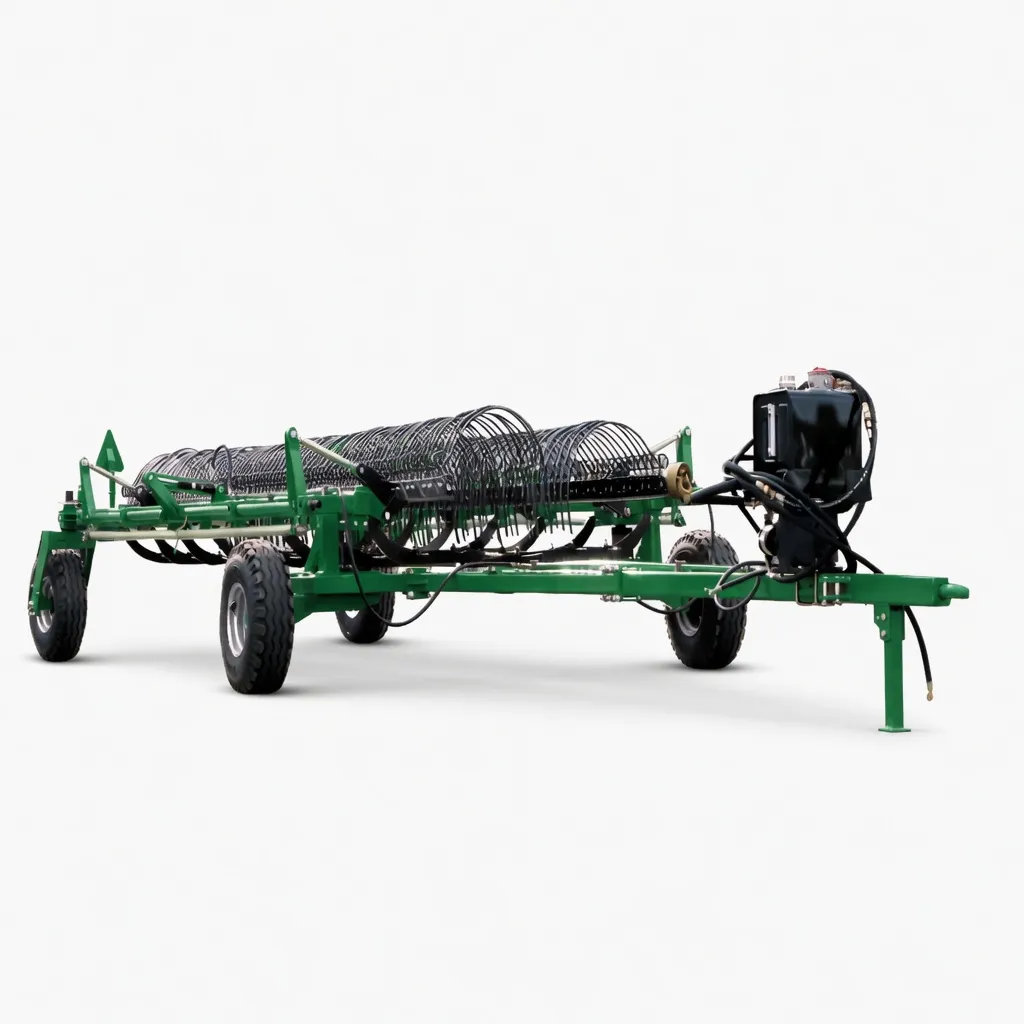
At 12 m working width with 168 raking teeth and a productivity range of 6–12 hm²/h, the 9LH-12 Towed Lateral Rake is the machine that arrives when a standard 9 m finger wheel rake is no longer wide enough. It covers ground at a rate that, at the upper end of the 10–12 hm²/h range with a fast tractor and open paddock conditions, exceeds the mowing rate of most single-mower operations. For large-scale hay and silage production where the rake is historically the bottleneck, the 9LH-12 removes that constraint completely.
The lateral rake design works differently from a finger wheel rake. Where finger wheels roll passively on ground contact and sweep material sideways, a lateral rake uses a tined rotating mechanism to gather cut material from a wide swath and deliver it laterally into a windrow at one side of the machine’s path. This delivery method handles heavier crop densities and wetter material better than passive finger wheel designs — making the 9LH-12 applicable across a wider range of crop types and conditions than a finger wheel rake of similar working width.
Power requirement is 25–44 kW — modest for a 12 m working-width machine. The lateral mechanism is PTO-driven but the design is torque-efficient: the rake operates at low rotational speed with high tooth count rather than at high speed with fewer teeth, which keeps the power demand within mid-tractor territory. Compatible tractors across John Deere 5E/6E/5M/6M, New Holland T4/T5/T6, Case IH Farmall/Maxxum, Kubota M5000/M6000, and Massey Ferguson 5700/6700 Series cover the working tractor fleet on Australian farms making large hay and silage programmes.
Technical Features — Engineering the 12 m Width
168 Raking Teeth Across 12 m
The 168 teeth are distributed across the full 12 m working width in a pattern designed to maintain ≤ 3% miss-raking rate across the entire range of operating speeds from 5 to 10 km/h. At the high-speed end — 9–10 km/h on flat, open paddocks with thin-to-moderate crop density — the tooth count provides sufficient sweep frequency to collect material before the machine’s forward motion carries the next pass over any uncollected crop. At slow speed — 5–6 km/h on heavy dense windrows — the same tooth count delivers a thorough collection sweep without overloading individual teeth.
Lateral Delivery Mechanism — Handles Heavy Crops
The lateral delivery mechanism actively moves material sideways across the machine’s width rather than relying on the passive rolling sweep of finger wheel designs. This active lateral motion is more effective on crop types that mat or resist passive rolling: wet grass at 55–70% moisture, thick-stemmed crops like sorghum or mature ryegrass, and lodged or tangled material that lies in a compressed mat rather than a loose swath. The 9LH-12 handles these conditions at productive operating speeds where a finger wheel rake would require speed reduction and repeated passes to fully collect the swath.
6–12 hm²/h — Matching Mowing Rate at Scale
The upper end of the 9LH-12’s 12 hm²/h productivity is reached at 10 km/h on flat open paddocks with clean, thin-to-moderate crop density. At this rate, the 9LH-12 rakes as fast as a 9GQY-3.2 mower-conditioner mows — the two machines can operate concurrently on a large paddock, with the rake following the mower on the first swath while the mower is still working the far end of the paddock. This concurrent-operation potential collapses the total mow-to-bale timeline by eliminating the raking wait between mowing completion and baling commencement.
25–44 kW Power for 12 m Width — The Efficiency Advantage
A 12 m working-width machine requiring only 25–44 kW is the direct result of the lateral rake’s torque-efficient design philosophy: low rotational speed, high tooth count, active but slow lateral delivery. The power demand from 168 slowly-moving teeth is far lower than from high-speed rotary tines at equivalent coverage rate. This means the 9LH-12 runs behind the mid-range tractors already on most Australian farms — no tractor upgrade required despite the machine’s large working width.
Transport Width 3,400 mm — Road Legal with Care
The 9LH-12 folds from its 12,000 mm working width to 3,400 mm for transport. At 3,400 mm, the machine is within agricultural road-width exemptions for farm-to-farm travel on rural roads in most Australian states, though operators should confirm local requirements before road travel. The transport configuration at 9,400 × 3,400 × 1,750 mm is manageable on standard farm float equipment for longer-distance inter-property movement.
How the 9LH-12 Works
Tractor and rake enter the paddock at 5–10 km/h depending on crop density. The 12 m working width allows the operator to cover 1.2 ha per km of forward travel — impressive coverage rate on long paddocks.
The 168 raking teeth engage the cut swath across the full 12 m width. The lateral delivery mechanism moves material sideways toward the windrow side, gathering from the full working width in a single continuous flow.
Consolidated windrow exits at one side of the machine’s path at a width suitable for baler pickup. For large balers with 2+ m pickups, the windrow can be left at full delivery width. For narrower pickups, a wheel rake pass concentrates further if needed.
At 8–10 km/h the machine covers 64–80 ha in an 8-hour shift — enough to rake the day’s mowing in a single pass and keep the chain moving to baling without an overnight delay.
The 9LH-12 integrates directly with transport wagons for combined rake-and-collect operations — the windrow delivered by the rake can be collected immediately by a following wagon rather than being left in the paddock for a separate baling pass. For green-feed collection, ensiling, or chaff cart operations, this direct integration removes a handling step entirely.
Applications — Large-Scale Hay and Silage Production
Large Cereal Straw Operations — Post-Harvest Efficiency
After grain harvest, the straw across hundreds of hectares needs to be consolidated into windrows for baling within a tight post-harvest window — often just a few days before the next crop preparation operations need to begin on the same paddock. The 9LH-12’s 6–12 hm²/h productivity allows a single tractor-and-rake combination to cover 60–100+ ha per day, completing the straw raking phase across a large property’s entire harvest area before the preparation timeline begins to compress. Properties in WA’s wheatbelt and NSW’s Riverina with 200–500+ ha of straw to rake per season find the 9LH-12 transformative for their post-harvest logistics.
High-Output Hay — Eliminating the Raking Bottleneck
Large hay operations running two or three mowers simultaneously often find the rake is the rate-limiting step: the mowers produce cut area faster than a standard rake can process it, and the hay sits exposed waiting for the rake. The 9LH-12’s 12 hm²/h upper rate exceeds the combined mowing output of two 9GD-2.5 mowers running simultaneously, meaning a single 9LH-12 can stay ahead of a two-mower fleet. The productivity arithmetic changes the scheduling entirely: instead of the rake trailing the mowers by a day, the rake finishes with time to spare.
Lucerne — Multiple Cuts, Consistent Quality
Lucerne operations making three to five cuts per season need a rake that works quickly across the full cut area without the quality penalty of leaf shatter. The 9LH-12’s low-speed lateral mechanism is gentler on dried lucerne leaf than high-speed rotary alternatives, and the 12 m coverage rate allows the full cut area to be raked in a single day — minimising the time dried lucerne is on the ground before baling and reducing the re-wetting exposure that can occur when cut material is raked on the second or third day after mowing in variable weather.
Silage — Concurrent Mow-Rake-Bale Programmes
The 9LH-12’s productivity allows a silage programme to run the mower, rake, and baler in concurrent operation on a large paddock rather than in sequential single-day operations. With a mower-conditioner ahead, the 9LH-12 raking the first swaths, and the baler following, the entire mow-to-wrapped-bale chain runs in a single operation rather than across three days. This concurrent approach minimises the total time from cutting to film application — directly improving silage fermentation quality through the same zero-exposure logic as combined baler-wrapper machines.
Maintenance — Keeping 168 Teeth Working at Full Rate
Daily Tooth and Drive Inspection
Before each shift, inspect a representative sample of 20–25 teeth from different positions across the 12 m width for bending, cracking, or tip wear. On a 168-tooth machine, individual tooth inspection of every tooth daily is impractical — sampling 15% of the total across the full width gives a statistically reliable picture of overall tooth condition. Any tooth sampled that shows significant bend or wear indicates the entire local tooth group should be inspected and likely replaced. Grease the PTO input and the lateral drive gearbox according to the manufacturer’s schedule.
Every 40–60 Operating Hours
Check the lateral drive chain tension — the mechanism that delivers material sideways from the full 12 m width to the windrow side uses a drive chain that elongates gradually under the load of heavy crop. A slack chain produces uneven lateral delivery speed, which creates windrow non-uniformity. Adjust tension per the manufacturer’s specification. Inspect the tooth-carrier bars for any wear at the tooth-mounting welds — the lateral mechanism loads the carrier bar differently from a simple forward-raking mechanism and carrier welds are a wear focus point.
End of Season
Replace all teeth showing wear below the minimum tip-length specification as a complete set — on a 168-tooth machine, operating with a subset of worn teeth creates coverage gaps that inflate the miss-raking rate above the ≤ 3% specification. EverPower holds complete tooth replacement sets for the 9LH-12 at Condell Park NSW for next-day delivery. Inspect the fold-transport hydraulic cylinder seals for any weeping — the transport fold on a 12 m machine exerts significant cylinder force and seal condition directly affects safe fold operation.
The 9LH-12: When Scale Is the Constraint
Single-pass coverage across widths that no other machine in the EverPower rake range can match.
Matches or exceeds the mowing rate of multiple mowers — eliminates the raking bottleneck from large-scale operations.
High tooth density across the full width maintains collection quality at all speeds within the 5–10 km/h range.
Mid-tractor power for a 12 m working width — the lateral design’s efficiency keeps power demand within working-farm tractor capability.
About EverPower Baling Machinery Australia
EverPower Baling Machinery Australia Pty Ltd — 27 Harley Crescent, Condell Park NSW 2200 — is the direct Australian arm of an ISO 9001-certified manufacturer with a 32,000 m² factory, 180 staff, and a dedicated R&D centre. Every machine carries a genuine Australian warranty administered locally, backed by spare parts stocked for 72-hour national delivery.
📞 +61 2 9708 3322 | ✉️ [email protected] | silage-baler.com/about-us
Frequently Asked Questions
Twelve Metres. One Pass. Done.
Contact EverPower to confirm the 9LH-12 fits your paddock scale and tractor, or to compare it with the 9LZY-9.0 finger wheel rake for your crop type.