Pre-Stretch Ratio Is the Most Misunderstood Setting on a Bale Wrapper
Most bale wrapper operators set the pre-stretch ratio once when the machine is first commissioned and never revisit it. This is understandable — the machine works, the bales look wrapped, and there is no obvious indication that the setting is sub-optimal. But pre-stretch ratio is the setting that determines film economy (how much surface area each roll covers), film barrier quality (how tightly the film conforms to the bale surface and seals at the overlaps), and film durability in storage (how much the film contracts to self-seal and resist external stress). A pre-stretch setting that is too low wastes film and produces loose coverage; one that is too high tears film or produces a brittle wrap that cracks under UV in storage. The correct setting is specific to your film specification, ambient temperature, and bale shape — and it is worth spending 30 minutes getting right rather than accepting whatever the previous operator left on the machine.

Pre-stretch ratio on the 9YCM-850 is adjusted via the dispenser roller differential — the ratio between the exit roller speed and the entry roller speed determines how much the film elongates before contacting the bale surface.
What Pre-Stretch Ratio Means Physically
Pre-stretch ratio is the percentage by which the film is elongated before it contacts the bale surface. A 55% pre-stretch means the film exits the dispenser at 155% of its original length — 1,000 mm of film stored on the roll becomes 1,550 mm of film applied to the bale. A 70% pre-stretch means 1,000 mm becomes 1,700 mm.
This elongation is achieved by the pre-stretch roller mechanism in the film dispenser arm. Two rollers — entry and exit — run at different speeds, controlled by a fixed gear ratio. The film passes between them; the differential speed causes the film to elongate between the two roller contact points. Adjusting the gear ratio (on machines with adjustable pre-stretch) changes the elongation percentage. On the 9YCM-850, the design pre-stretch range is 55–70%, adjusted by changing the position of a gear or chain on the dispenser drive.
The elongated film has two important properties. First, it covers more bale surface per metre of film — the 55–70% pre-stretch reduces film consumption per bale by 35–41% compared to unstretched application. Second, the stretched film has elastic memory — it wants to return to its shorter original length. Once applied to the bale, the contracting film pulls tight against the surface, conforming to the bale contour and self-sealing the overlap zones as adjacent stretched layers press against each other.
Finding the Correct Pre-Stretch for Your Film and Conditions
The correct pre-stretch ratio is the highest ratio that does not cause film tearing under the full range of operating conditions you will encounter in the season. This is determined by three factors: film elongation-at-break specification, ambient temperature, and bale surface profile.
Film elongation-at-break: Quality silage film at 25 microns has an elongation-at-break of 500–700% — far above the 55–70% pre-stretch applied by the machine. However, elongation-at-break reduces significantly as UV degradation progresses and as temperature decreases. Aged film or cold film has much lower effective elongation, and the safety margin between the applied pre-stretch and the break point narrows. Use 55% pre-stretch as a starting point and test; increase toward 70% only if film tearing does not occur.
Ambient temperature: Polyethylene film becomes less elastic in cold conditions (below 10°C). At 5°C, the film’s elongation-at-break may be 30–40% below its ambient-temperature specification. In cold early-morning Australian conditions, start at 55% pre-stretch and allow the film roll to warm to above 10°C before wrapping. As the day warms, the pre-stretch can be increased toward the design specification if desired. Never attempt to wrap at ambient temperatures below 5°C without reducing pre-stretch — film breakage rates will be high.
Bale surface profile: A dense, round bale presents a consistent surface distance from the film arm — the pre-stretch tension remains relatively consistent throughout each pass. An oval or uneven bale creates variable distances, causing the pre-stretched film to alternately over-tension (at the wider point) and go slack (at the narrower point). If bale shape is irregular, a slightly lower pre-stretch (55–60%) provides more tolerance for surface variation without tearing at the wide points.
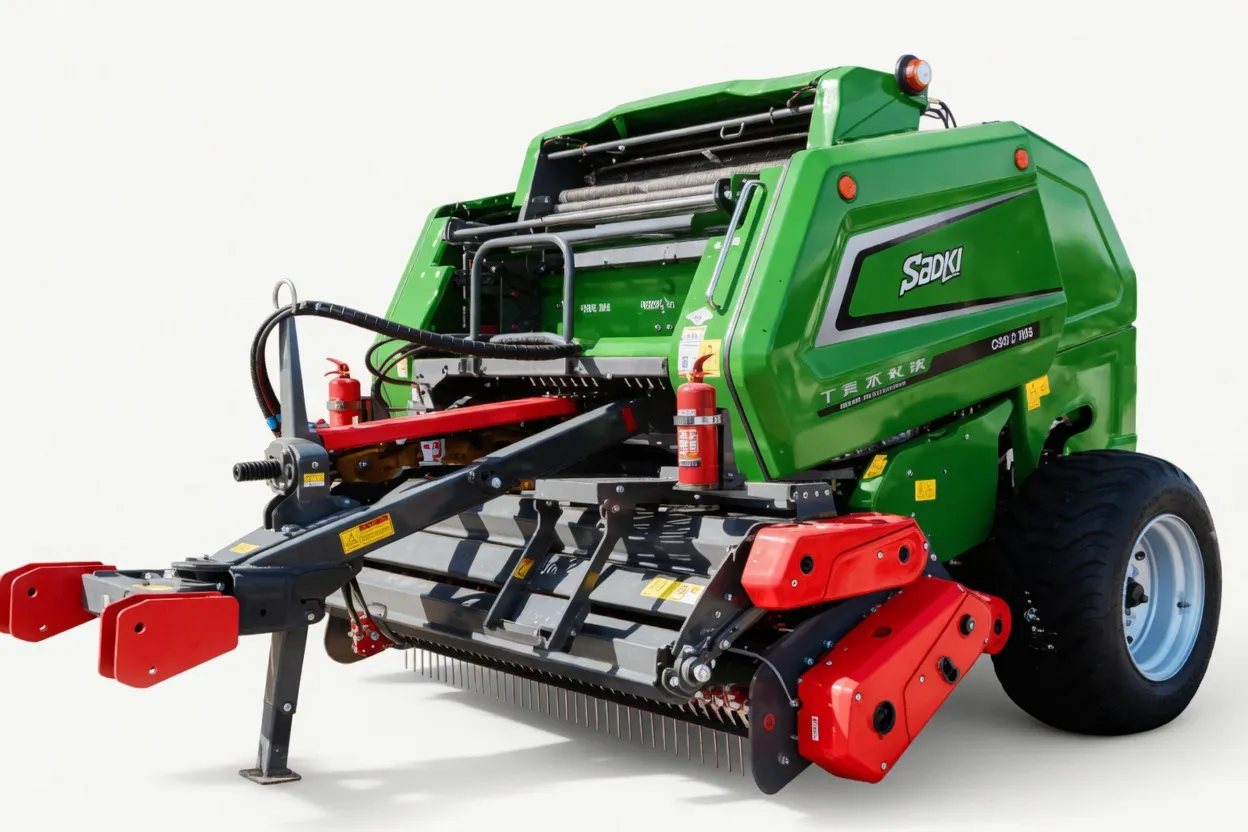
Bale shape directly affects how pre-stretch works — a dense, uniformly round bale allows the pre-stretch ratio to be set at the design specification, while an oval or uneven bale requires a lower setting to prevent tearing at the wider bale dimension.
Step-by-Step Procedure for Setting Pre-Stretch on the 9YCM-850
Set the dispenser to 55% pre-stretch
Locate the pre-stretch adjustment on the dispenser arm — on the 9YCM-850 this is typically a chain or gear position adjustment accessible from the side of the dispenser housing. Set to the lowest ratio (55%) for initial testing. Confirm the adjustment is secured before loading a film roll.
Wrap a test bale and assess coverage
Wrap one complete bale at the 55% setting. After ejection, examine the film surface: it should be taut and smooth, with no wrinkles or loose sag zones visible. If the film appears wrinkled or loose, increase pre-stretch by 5% and test again.
Increase to 60–65% and test for film tearing
Wrap 3 consecutive bales at 60–65%. If no film tears occur and the coverage is tight, this is a suitable operating range. Check the film tail after cutting — at correct pre-stretch, the tail contracts back against the bale surface and adheres within 2–3 seconds of the cut.
Set the operating pre-stretch at the highest tear-free level
The operating pre-stretch for the season is the highest level at which no film tears occurred across the test sequence. Record this setting on the machine’s information plate or in the maintenance log. Check and reset at the start of the next wrapping session if ambient temperature has changed significantly overnight.
Pre-Stretch and Film Consumption: The Economics
Higher pre-stretch = more surface coverage per roll = lower film cost per bale. Moving from 55% to 70% pre-stretch increases effective film length by approximately 10% per roll — from 1,500 m of film producing 1,550 mm per original metre (at 55%) to 1,700 mm per original metre (at 70%). On a 1,500 m roll at 4 layers wrapping 22 bales at 55%, the same roll at 70% wraps approximately 24–25 bales — saving approximately 1 roll per 175 bales wrapped, or approximately AUD $130–$155 per 175 bales at current film prices. The economics of maximising pre-stretch (within the tear-free limit) are clear — but never compromise film coverage quality for cost saving by pushing pre-stretch above the safe limit for your conditions.
Recommended Product: 9YCM-850 Bundling Film Wrapping Machine
55–70% adjustable pre-stretch via dispenser roller gear adjustment. Correct pre-stretch setting balances film economy (coverage per roll) with barrier quality (tight, self-sealing overlap zones). Pre-stretch roller inspection and adjustment guidance provided by EverPower at setup. Available from EverPower’s Condell Park NSW warehouse with Australia-wide delivery.
Frequently Asked Questions
Set It Right Once. Cover Every Bale Perfectly All Season.
EverPower can guide you through pre-stretch setup for the 9YCM-850 for your specific film specification and climate conditions.
EverPower Baling Machinery Australia Pty Ltd | 27 Harley Crescent, Condell Park NSW 2200
📞 +61 2 9708 3322 | ✉️ [email protected]