
A round baler is a significant investment, and the way you set it up on day one shapes how it performs for years. Rushing through the initial hookup leads to misaligned PTO shafts, incorrect belt tension, and bales that come out lopsided or under-dense. This beginner’s checklist walks you through every step — from matching the baler to your tractor, to making your first test bale, to the adjustments you should make after the first ten bales are on the ground. Follow it methodically and you will avoid the mistakes that cost new operators time and money in their first season.
Step 1 — Verify Tractor Compatibility Before You Hitch
Before you connect anything, confirm that your tractor meets the baler’s requirements. The operator’s manual specifies minimum PTO horsepower, hydraulic flow rate, and hitch category. Most compact and mid-size round balers require a minimum of 25 to 50 PTO horsepower, while full-size variable-chamber models may need 70 to 100 PTO horsepower. If your tractor falls below the minimum, the baler will struggle to form dense bales and the PTO driveline will overheat under continuous load. Check the manual for hydraulic requirements as well — most round balers need at least one double-acting remote valve, and combined baler-wrappers may need two or three.
Hitch category matters more than many beginners realise. A Category 1 baler hitched to a Category 2 tractor with wrong-size pins will sit at the incorrect angle, which affects pickup height and PTO shaft alignment. Use the correct hitch pins and, if necessary, the bushings or spacers that adapt between categories. Measure the distance from the tractor’s PTO stub to the hitch point and compare it to the baler’s specified drawbar length. If the gap is outside the recommended range, the PTO driveline will operate at an excessive angle, which accelerates universal joint wear and can cause vibration that damages both the tractor and the baler.
Step 2 — Connect and Adjust the PTO Driveline
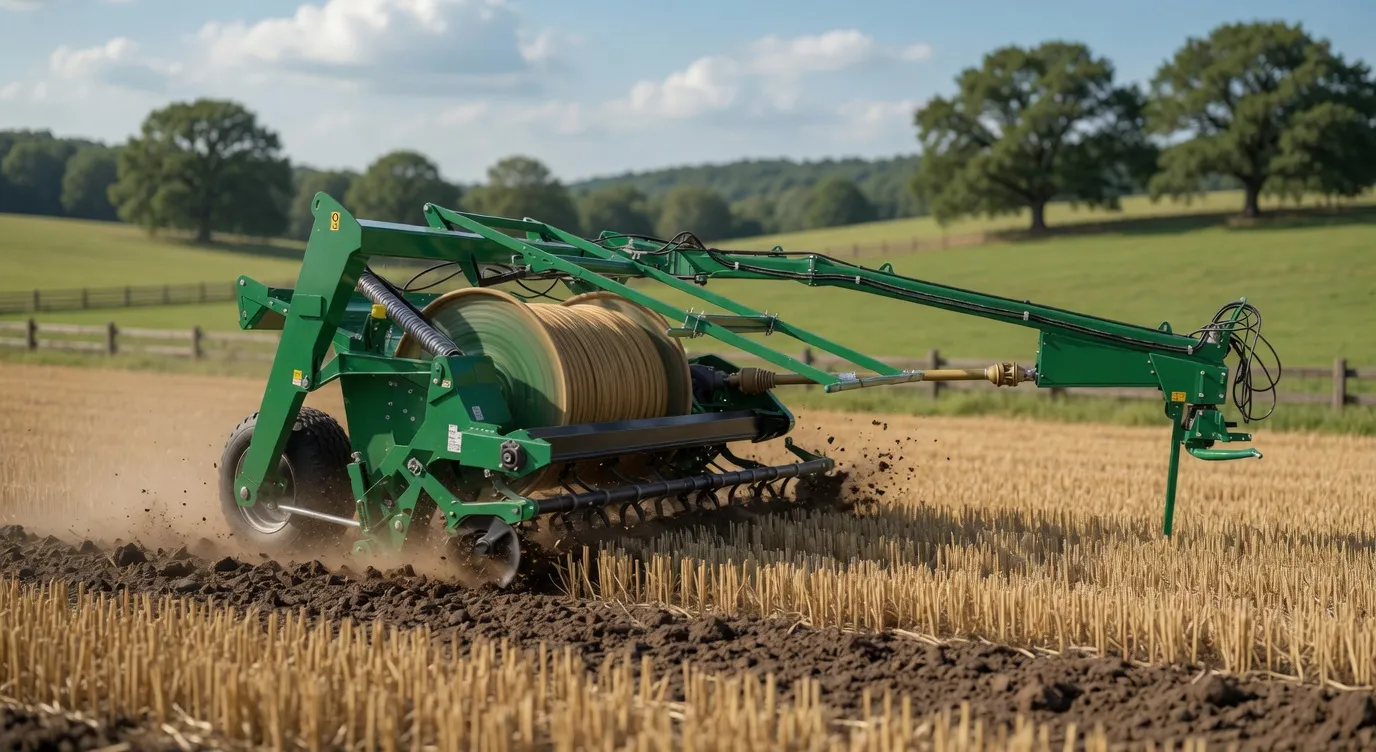
The PTO driveline transfers power from the tractor engine to every moving part inside the baler. Connecting it incorrectly is the single most common setup mistake and the one with the most expensive consequences. Start by sliding the driveline halves apart and checking their total collapsed and extended lengths against the manual. If the driveline is too long when the baler is at its closest point to the tractor, the two halves will bottom out and the resulting force will damage the gearbox seals. If it is too short at full extension during a tight turn, the halves will separate entirely and the exposed shaft can catch on anything nearby.
Most new balers ship with the PTO shaft pre-cut to a standard length, but you may need to shorten it to match your specific tractor. The manual provides a measurement procedure: park the tractor on level ground, hitch the baler, turn the steering to full lock in both directions, and measure the minimum and maximum distances between the tractor PTO stub and the baler input shaft. Cut the driveline so that at minimum distance, at least 150 millimetres of overlap remains between the two halves, and at maximum distance, the halves do not separate. Always cut equal amounts from both the inner and outer tubes to maintain balance. After cutting, deburr the ends, apply fresh grease, and reassemble. Confirm that the shield rotates freely around the shaft and is not cracked or missing — a spinning, unshielded PTO shaft is one of the most dangerous hazards on any farm.
Step 3 — Hook Up Hydraulic Lines and Electrics
Round balers use hydraulic pressure to control the tailgate, the net or twine wrapping mechanism, and (on variable-chamber models) the bale density. Each hydraulic line is colour-coded or tagged with a label at the factory. Match these labels to the functions described in the operator’s manual and connect them to the correct tractor remote valves. Connecting a pressure line where a return line should go will cause the function to operate in reverse or not at all, and in some cases can damage hydraulic cylinders. After connecting, start the tractor engine at low idle and cycle each hydraulic function slowly through its full range while watching for leaks at every fitting.
Most modern round balers also have an electrical connection for the bale monitor, net wrap trigger, or electronic control unit. This is typically a seven-pin or twelve-pin connector that plugs into the tractor’s implement harness. If your tractor does not have the matching socket, you will need an adapter or a direct-wire installation to your battery with an appropriate fuse. Power up the monitor and confirm that it reads correctly — the bale diameter indicator should show zero or near-zero with an empty chamber, and the twine or net wrap counter should match the physical position of the wrapping arm. Set the target bale diameter according to your preference, typically 1.0 to 1.2 metres for standard round bales, and set the number of net wrap revolutions, usually two to two-and-a-half for hay and three to four for silage that will be subsequently film-wrapped.
Step 4 — Set Pickup Height and Crop Guard Clearance
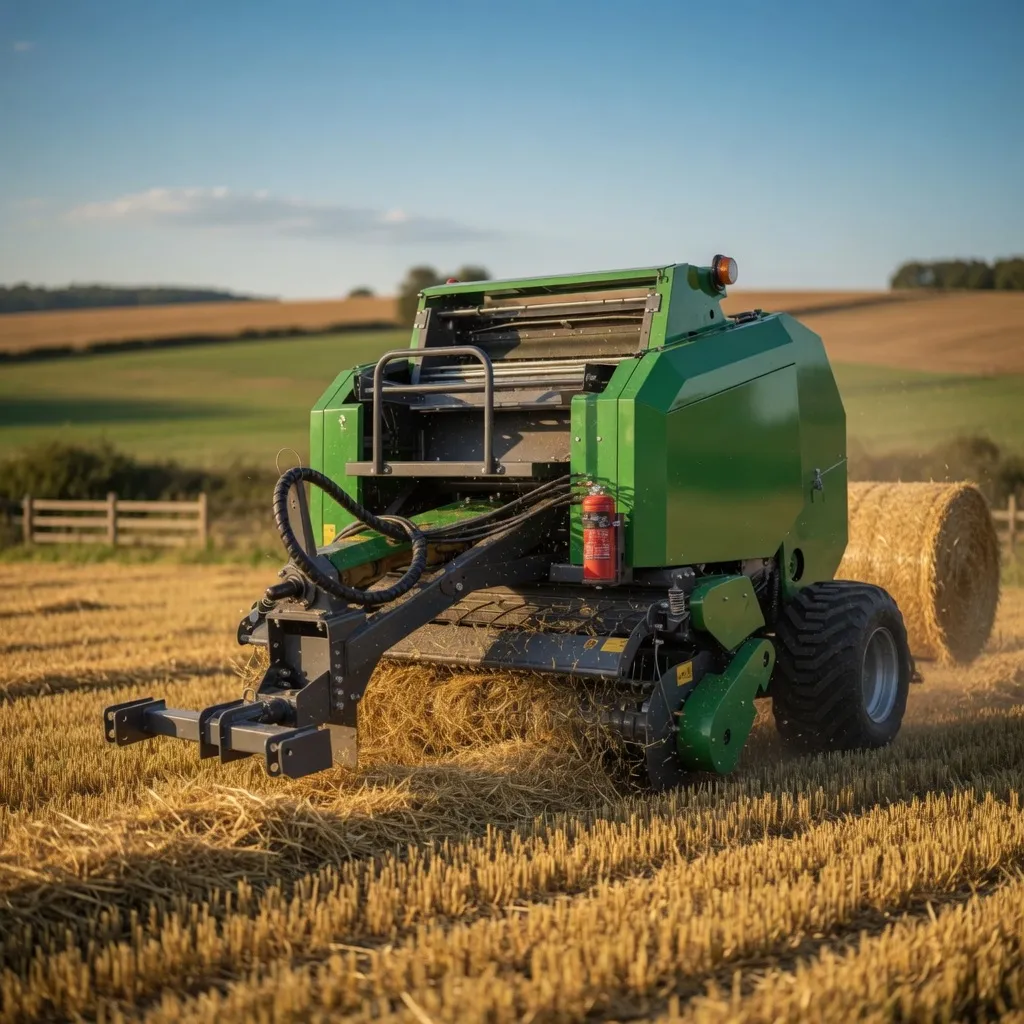
The pickup mechanism is the baler’s intake. It sweeps forage off the ground and feeds it into the bale chamber, and its height determines how cleanly it collects the windrow. Set the pickup gauge wheels so that the tine tips run approximately 25 to 40 millimetres above the ground surface on a level paddock. Too low and the tines will dig into the soil, collecting dirt that contaminates the bale and accelerates tine wear. Too high and the tines will ride over short or compressed windrows, leaving material behind and producing underweight bales.
The crop guard sits above the pickup tines and controls the thickness of the mat that passes through to the feed mechanism. For your first baling session, set it to the middle position recommended in the manual. After your first few bales, assess whether material is flowing smoothly. If the pickup is struggling to pass heavy crop through, open the guard by one notch. If light, dry material is falling off the tines before it reaches the chamber, close the guard by one notch. These small adjustments have an outsized impact on bale quality and pickup reliability, so take the time to get them right rather than leaving the setting on the factory default indefinitely.
Step 5 — Calibrate Bale Density and Chamber Pressure
Bale density is how tightly the machine compresses the forage. Too loose and the bale falls apart when you move it; too tight and you overload the belts, waste fuel, and produce bales that are too heavy for your loader to handle safely. On a belt-type variable-chamber baler, density is controlled by hydraulic pressure applied to the tension arms that pull the belts tight around the forming bale. The operator’s manual provides a recommended pressure range for different forage types — typically lower for dry, light hay and higher for dense, wet silage crop.
On a fixed-chamber baler with roller systems, density is influenced by the number of rollers engaged and the pre-set spring tension on the chamber. Consult the manual for the correct initial setting and plan to fine-tune after your first few bales. A good test is to lift a finished bale with your loader and push your thumb firmly into the outer layer. On a well-formed hay bale, your thumb should indent approximately 20 to 30 millimetres before meeting firm resistance. If you can push much further, increase density. If the surface feels rock-hard with almost no give, reduce density to avoid unnecessary stress on the machine and netting.
| Forage Type | Moisture | Density Setting | Approx. Bale Weight |
|---|---|---|---|
| Dry grass hay | 10 – 15% | Low – Medium | 280 – 380 kg |
| Oaten hay / straw | 12 – 18% | Medium | 300 – 400 kg |
| Wilted silage crop | 40 – 55% | Medium – High | 450 – 600 kg |
| High-moisture baleage | 55 – 70% | Medium (reduce to avoid plug) | 500 – 700 kg |
Step 6 — Thread the Net Wrap or Twine
Net wrap and twine are what hold the bale together once it leaves the chamber. Threading the wrapping system incorrectly is one of the most frustrating problems for first-time operators because a failed wrap means the bale unravels as it exits, wasting the forage and requiring manual clean-up before the next bale can start. For net wrap, feed the leading edge of the net roll through the guide rollers and brake mechanism exactly as shown in the manual diagram. The net must pass under the tension bar, over the spreading rollers, and into the cutting mechanism in the correct sequence. Pull approximately one metre of net through the system and check that it hangs evenly across the full width of the chamber opening.
For twine-tied balers, thread each ball of twine through its respective guide tube, tensioner, and needle. Most balers use two to four twine balls simultaneously to distribute the wraps evenly across the bale face. Tie the loose ends together temporarily so they do not retract through the guides during transport. Before making your first bale, run the wrapping cycle manually using the tractor hydraulics or the baler’s test mode to confirm that the net or twine feeds, wraps, and cuts correctly. This dry run catches threading errors before they ruin a bale in the field. If the wrap does not cut cleanly, check the knife blade for sharpness and adjust the knife-to-anvil gap per the manual.
Step 7 — Grease, Lubricate, and Pre-Flight Check
A new baler arrives with factory lubrication, but not all grease points are filled to operating level. Walk around the machine with a grease gun and pump fresh grease into every fitting until clean grease appears at the seal. Count the fittings as you go and compare your count to the number listed in the lubrication chart in the manual. Most round balers have between 15 and 30 grease points, including the pickup bearings, the roller bearings, the PTO input shaft bearing, the tailgate hinge pins, and the net wrap mechanism pivots. Missing even one fitting will lead to premature bearing failure within the first season.
Check chain tensions on any chain-driven components. New chains stretch during the first few hours of operation, so you will need to re-tension them after your initial baling session. Inspect all belts for correct tracking — on a belt-type baler, the belts should sit centred on the rollers with equal spacing on each side. If a belt is tracking to one side, adjust the tracking mechanism before operating. Confirm that all safety shields and guards are in place and fastened securely. Finally, check tyre pressures on the baler’s road wheels. Under-inflated tyres cause the baler to sit at an uneven angle, which affects pickup height and bale shape.
Step 8 — Make Your First Test Bale
Choose a section of paddock with a consistent, moderately dense windrow for your first pass. Avoid the heaviest or wettest part of the field until you are comfortable with the machine. Engage the PTO at the manufacturer’s rated speed — 540 rpm for most round balers — and begin driving forward at four to five kilometres per hour. Watch the bale formation monitor closely. The diameter indicator should climb steadily as material enters the chamber. If it stalls or jumps erratically, slow down to reduce the crop flow rate. Listen to the machine: a smooth, rhythmic sound indicates healthy operation, while grinding, banging, or squealing suggests a mechanical problem that should be investigated immediately.
When the monitor indicates the bale has reached target diameter, stop forward travel and initiate the wrapping cycle. Watch the net or twine apply and confirm it wraps the correct number of revolutions before cutting. Open the tailgate and allow the bale to roll out onto the ground. Walk back and inspect it. A well-formed bale is cylindrical, uniform in diameter from end to end, and firm to the touch across its entire surface. Measure the diameter and compare it to the monitor reading — if they differ by more than five per cent, recalibrate the monitor sensor. Check the wrap coverage: the net should extend across the full barrel of the bale with at least 50 millimetres of overlap on each flat face. Your first bale will probably not be perfect, and that is entirely normal. The point of the test bale is to identify which settings need fine-tuning before you commit to a full day of baling.
Choosing the Right Baler for a First-Time Owner
If you have not yet purchased your first baler, the setup process is much smoother when the machine is correctly sized to your operation. A compact, fixed-chamber round baler producing 1.0-metre bales is ideal for small to mid-size properties running fewer than 500 head of sheep or 100 head of cattle. These machines require less tractor horsepower, have fewer hydraulic requirements, and are mechanically simpler, which means fewer adjustment points and a shorter learning curve for the operator. They also produce lighter bales that are easier to handle with a standard front-end loader rather than requiring a dedicated bale handler.
The EverPower 9YG-1.0 Round Baler is purpose-built for operators entering the baling market. It produces consistent 1.0-metre round bales from as little as 25 PTO horsepower, connects to standard Category 1 or 2 hitches, and uses a straightforward mechanical control system that minimises the number of settings you need to learn on day one. Its fixed-chamber design means the bale diameter is the same every time, which simplifies stacking and storage. For contractors and larger operations, see our detailed guide to how hay and silage contractors increase daily bale output with a combined machine.
After Your First Ten Bales — What to Re-Check
New chains stretch during break-in. Check all drive chains and re-tension to the manual’s specification. Expect to do this again after the next 20 bales.
Open the tailgate and visually inspect belt alignment. If any belt has migrated to one side, adjust the tracking rollers before continuing.
Vibration during initial operation can loosen bolts. Re-torque all critical fasteners including wheel lug nuts, pickup mounting bolts, and roller bearing caps.
Re-grease all fittings after the first session. During break-in, bearings seat and consume grease faster than during normal operation.
Inspect the universal joints for heat discolouration. If a joint ran hot, the PTO angle is likely too steep and the drawbar length needs adjustment.
Line up your first ten bales and compare them. If diameter varies by more than 5 cm between bales, recalibrate the bale monitor sensor and check belt tension consistency.
Common First-Timer Mistakes and How to Avoid Them
The most common mistake beginners make is driving too fast. A new operator eager to get the job done often pushes to eight or nine kilometres per hour before they have developed the feel for how the baler responds to crop density changes. The result is a plug or an uneven bale. Start at four kilometres per hour and only increase speed after you are confident that the pickup is handling the windrow cleanly and the bale monitor is showing steady, even growth. The second mistake is ignoring the PTO speed. If the tractor engine is lugging, the PTO drops below 540 rpm, and the baler’s internal mechanisms slow down. This causes uneven feeding and poor bale density. Reduce ground speed to unload the engine rather than increasing throttle, which just pushes more crop into an already struggling machine.
The third mistake is neglecting to read the operator’s manual. Every baler model has specific adjustment procedures, torque specifications, and safety warnings that differ from other models, even within the same brand. The manual is not generic advice; it is the engineering document for your specific machine. Keep it in the tractor cab, and reference it every time you encounter a situation you have not dealt with before. The hour you spend reading the manual before your first baling day will save many hours of troubleshooting over the course of the season.
Frequently Asked Questions
27 Harley Crescent, Condell Park NSW 2200
Phone: +61 2 9708 3322 | Email: [email protected]
About Us | Contact Us