
Most agricultural equipment articles describe how machines work in theory. This one is about what farmers actually see — bale after bale, paddock after paddock, across a full year’s worth of different crop types and conditions. The mixed cropping farm that runs its round baler over spring ryegrass silage, autumn oaten hay, and cereal straw after harvest is asking more of that machine than most specifications anticipate. Not because the machine can’t handle it, but because each crop reveals a different aspect of the machine’s performance — and experienced operators who’ve been through the full cycle a few times have a very clear picture of what to watch for, what to adjust, and what to expect.
Spring Ryegrass Silage: What the Machine Tells You
The first silage day of a new season has a rhythm that experienced operators know before the first bale is finished. The chamber fills quickly in heavy spring ryegrass — often faster than the operator expects if the sward is dense and the windrow was raked while still slightly pliable. The sound changes as the bale builds: a lower, fuller pitch as the chamber reaches capacity, then the net wrap system engaging, then the clean ejection sound as the completed bale drops to the paddock. On a well-set machine in good spring ryegrass at 58% DM, this cycle runs smoothly. When it doesn’t — when there’s slippage at the belt, or the net wrap drags rather than cutting cleanly — the operator feels it before the instrumentation confirms it.
The things farmers consistently notice on the first spring ryegrass day are usually the same across different operations. If the pickup tines are slightly out of adjustment from winter storage, the high-moisture ryegrass will show it immediately — material bunching at the pickup rather than feeding cleanly into the rotor. If the belt tension hasn’t been checked before the first run, the first heavy bale will tell the story. If the net wrap knife is even slightly dull from the previous season’s use, it will struggle to cut cleanly through the compressed, moist grass wrap. Spring silage is the machine’s first test of the year, and the operator who paid attention to the pre-season service gets a smooth first day. The operator who didn’t gets a diagnostic lesson instead.
What spring ryegrass silage does well is reveal the machine’s base performance. The crop’s high WSC content and moderate density don’t stress the chamber aggressively, so performance on this crop represents close to the machine’s designed operating point. Operators who establish their forward speed and density settings on spring ryegrass — and record those settings — have a reference point for adjusting when subsequent crops behave differently.
Autumn Oaten Hay: Where the Feel Changes
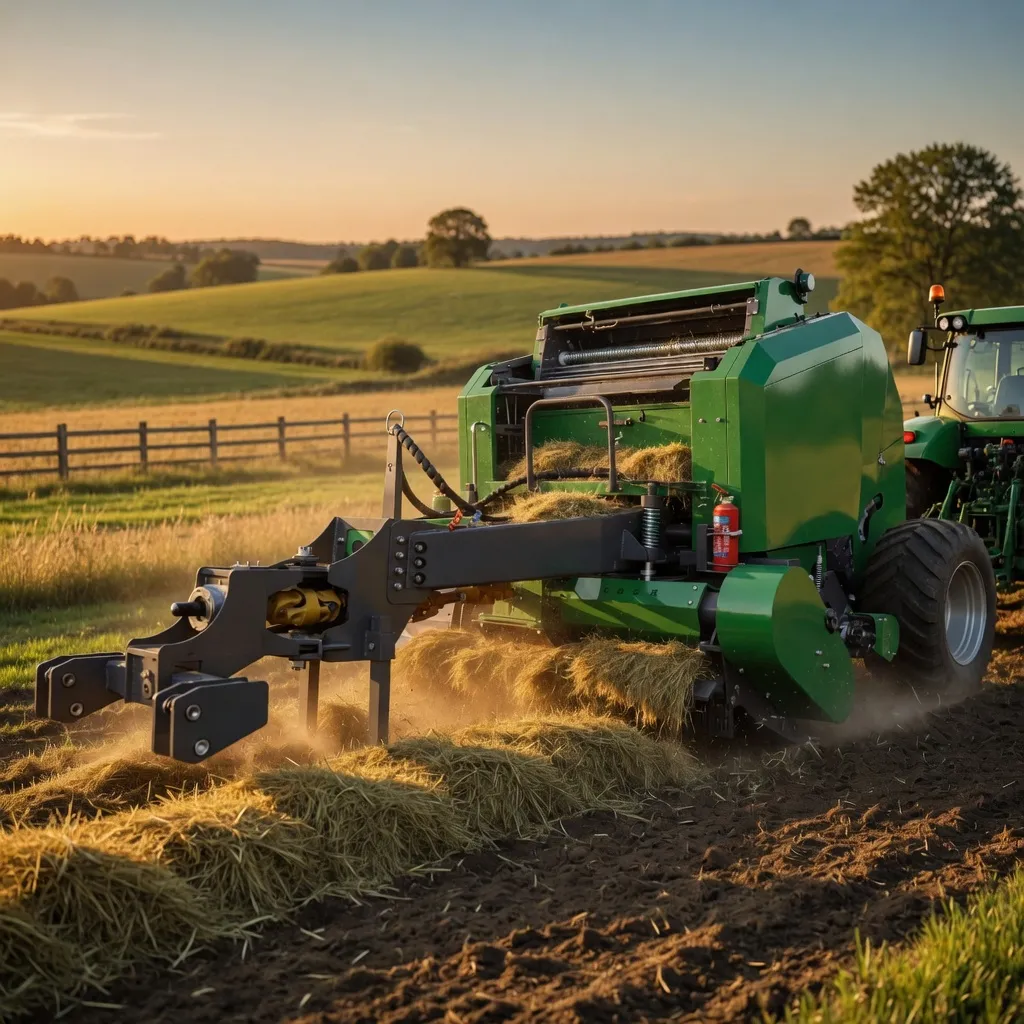
Move the same machine from spring ryegrass to autumn oaten hay and the operator notices a different quality to the baling immediately. Oat stems are stiffer and coarser than ryegrass, and when the crop is properly dry for hay — above 80% DM — the material packs differently in the chamber. Ryegrass silage compresses under hydraulic pressure with a smooth, consistent resistance. Dry oat stems resist and then yield in sections, which produces more variation in bale density across a paddock if the windrow is uneven.
What most farmers learn in their first season running oaten hay after silage is that the forward speed needs to come down in lodged sections of the paddock. A paddock of oats that has had a heavy flush and partially lodged creates windrows of inconsistent density — tight in the lodged areas, lighter in the upright sections. The instinct to drive at a consistent speed produces a mix of tight and loose bales that is obvious at stacking time. The experienced operator reads the windrow ahead and adjusts — slowing in the dense sections to let the chamber fill properly, maintaining speed in the lighter sections. After a couple of seasons, this becomes second nature.
The net wrap system behaves differently on dry hay than on silage. Dry material doesn’t compress with the same hydraulic firmness as silage, so the bale shape is slightly less consistent — slightly squarer at the shoulders than on silage. The net wrap application still works cleanly, but the cut needs a sharp knife more obviously than on the silage crop. Farmers who were getting away with a slightly dull knife on ryegrass silage will find it trailing wrap tails on dry oat hay. The autumn baling season is typically when net wrap knives get replaced — not because something went wrong, but because the dry crop makes the wear visible.
One thing oaten hay consistently reveals is the pickup tine adjustment quality. Oat stems lying across a windrow — especially when there’s a slight crosswind that has shifted the windrow — will lift and settle into the tine fingers in ways that show any unevenness in tine height or spacing. Tines that are at slightly different heights will pick up material inconsistently and occasionally miss sections of a shifted windrow. Farmers who check tine height uniformity before the hay season avoid the 2–3% pickup loss that adds up across a full day’s baling.
December Cereal Straw: The Machine’s Least Forgiving Application
Cereal straw after harvest is the most abrasive, most foreign-object-prone, and least nutritionally forgiving application in the annual cycle. If the machine was going to reveal a hidden problem — a bearing running slightly warm, a belt tensioner that was marginally loose, a pickup tine that was bent slightly inward — straw will find it faster than either silage or hay. Straw is harsh on belts because the dry, brittle stems contain silica that acts as a mild abrasive on belt surfaces over time. It is hard on pickup tines because stubble fields contain all the wire, bolts, and stones that the combine harvester’s straw spreader has redistributed across the paddock surface.
The paddock walk that experienced operators do before baling any field is most important on cereal straw paddocks — not just because of what the combine’s straw spreader might have deposited, but because of what the harvest machinery itself may have shed. Harvest machinery leaves behind all manner of ferrous hardware — bolts, teeth, knife sections — that land in the straw windrow and sit invisibly until the pickup tines drive them into the rotor. The five minutes spent walking the headland area and the area around the chaser bins is the most cost-effective five minutes in straw baling.
What straw does differently in the chamber is fill faster per unit of forward travel than either silage or hay, because straw is bulky relative to its weight. Operators who maintain silage forward speed on straw often overfill the chamber and find the bale density lower than expected — and the net wrap system struggling to compress the bale sufficiently before application. Reducing forward speed by 20–30% on straw relative to hay, and resetting the density control to account for the lower material weight per volume, typically brings straw bale density back to a satisfying, stackable result.
The end-of-day inspection after a straw baling session is the one farmers consistently say they should do more carefully than they sometimes do. Straw dust is the primary contamination source for pickup bearings, and a brief blowdown of the pickup and rotor area before parking the machine significantly extends bearing life across a full straw season. Farms that do multiple straw paddocks per year — as is common on mixed cropping operations — find that the 20-minute evening cleanout pays back in reduced bearing replacements over the machine’s working life.
What the Annual Cycle Teaches You About Your Machine
Farmers who have run the same baler across all three applications for several years develop a kind of operational intuition about the machine that is difficult to describe but very real in practice. They know the sound of the belt at the right tension on ryegrass silage versus the slightly different sound on dry straw. They recognise when the chamber is filling evenly versus when there’s a slight imbalance that will produce a bale that rolls asymmetrically at ejection. They feel the difference between the net wrap cutting cleanly and dragging — before they need to stop and look.
This operational familiarity is one of the strongest arguments for keeping the same machine across multiple seasons and multiple crop types, rather than trading frequently. The operator who has been through the full annual cycle three or four times on a given machine knows its specific quirks — which tine position is the first to show wear, which belt needs slightly more tension in cold morning conditions, when the net wrap knife is at the 70% life point where it starts to be inconsistent. That knowledge is genuine production value that disappears when the machine changes.
It’s also the reason why machine reliability matters more than peak performance for mixed cropping farmers. A machine that produces 85% of the theoretical maximum output every day across all crop types, reliably, all season, is worth more than a machine that produces 105% in ideal conditions but requires more attention across variable conditions. The EverPower 9YG-1.25A is designed with this operating profile in mind — consistent, robust performance across the full spectrum of mixed cropping applications, rather than a machine optimised for a single use case at the expense of versatility.
Silage Quality Across Crop Types: Managing Expectations
One of the most useful things a mixed cropping farmer can do for their livestock program is test silage quality from each crop type at 6–8 weeks post-baling and track the results over several seasons. The patterns that emerge from even three or four seasons of testing are revealing. Ryegrass silage quality is closely correlated with cutting stage — operations that are disciplined about cutting before heading consistently test 0.8–1.2 MJ/kg DM higher ME than those who cut a week later. Oaten hay silage quality is more influenced by DM at baling than cutting stage, within a reasonable range. Straw, of course, is not a silage application — but high-moisture grain sorghum or forage sorghum straw baled under drought conditions occasionally appears in mixed farming systems and needs to be understood on its own fermentation terms.
The testing investment — $50–80 per sample, sent to an accredited forage laboratory — is one of the highest-return investments available to a mixed livestock-cropping operation. The results directly inform the following season’s harvest decisions and allow the farmer to calibrate supplementary feeding requirements against actual silage energy density rather than estimated values. Operations that have been testing for five or more years consistently report that their silage quality has improved — not because the machine changed, but because the testing results changed the management decisions around harvest timing, DM targets, and wrapping protocols.
Machine Settings to Adjust Between Crop Types
The practical adjustments that experienced mixed cropping operators make when moving between crop types are few and specific. They are not complicated adjustments — they are the result of accumulated observation translated into simple settings changes.
Forward Speed
Establish a baseline forward speed on spring ryegrass silage — typically 6–8 km/h in a standard sward. Move to oaten hay at 5–7 km/h in uniform windrows, lower in lodged sections. Move to straw at 4–6 km/h to control chamber filling rate on bulky material. These are starting points, not fixed settings — the operator adjusts continuously based on windrow density and chamber fill rate feedback.
Bale Density Setting
Maximum density for silage, where the high-moisture material compresses efficiently and high density reduces residual oxygen in the fermentation environment. Medium-high density for dry hay, where over-compression can cause the bale to heat during storage. Medium density for straw, where the bulky material requires the chamber to fill fully before compression rather than being forced at high pressure into an underfilled chamber.
Net Wrap and Knife Inspection Timing
Check net wrap knife sharpness before the first hay baling run — dry hay shows knife wear that silage tolerates. Inspect and re-sharpen or replace before the first straw run. Straw leaves a distinctive dust contamination on the knife edge that accelerates wear; a post-straw-season knife check before storing the machine for the inter-season period protects the knife for the next silage season without requiring an additional blade replacement.
The Year-Round Baling Machine: What It Requires of the Farmer
Running a round baler across three or four different crop types in a single year asks more of the operator’s engagement than running it on a single application. Not more physical effort — the machine does the same work — but more attentiveness. The operator who knows their machine across multiple crop types is more observant: more likely to notice the subtle change in chamber sound that signals a belt adjustment is needed, more likely to recognise when the bale shape indicates a density setting should be revised.
This engagement is not a burden — experienced operators consistently describe it as one of the more satisfying aspects of mixed farming. The annual cycle of different crops and different machine responses keeps the work varied and keeps the operator’s skills actively engaged rather than becoming routine. The farmer who has been through fifteen silage seasons on the same machine type has a level of operational competence that produces visibly better silage than the farmer who is approaching their second or third season. Experience with diverse crop types accelerates that competence faster than a single application ever could.
EverPower for Mixed Cropping Operations
EverPower Baling Machinery Australia Pty Ltd supplies the round baler range that suits the Australian mixed cropping calendar — from compact 1.0m units for smaller farms through to the mid-scale 9YG-1.25A that handles the full silage-hay-straw cycle at commercial farm volumes. The machines are specified for the operating demands of year-round multi-crop use: robust pickup systems, accessible wear items, and density control systems that give the operator real feedback across different crop conditions. Local parts availability from the Condell Park NSW depot means that the wear items the annual cycle consumes — tines, belt joints, net wrap knives — are accessible without extended lead times.
EverPower Baling Machinery Australia Pty Ltd
27 Harley Crescent, Condell Park NSW 2200
+61 2 9708 3322
[email protected]
Frequently Asked Questions