Most equipment purchasing mistakes made by silage contractors are not visible at the point of sale. They reveal themselves six months later — as mid-season failures that stop work at the worst possible time, as per-bale costs that are higher than they should be because the machine is running at its limits rather than within them, or as quality complaints from clients whose silage didn’t ferment as expected. Working backwards from those failure modes, the selection criteria that actually matter for contractor equipment look quite different from what most machinery brochures emphasise. This guide examines what a contractor should be asking — and what the answers reveal — before committing to any baler purchase.
The First Question Most Contractors Forget to Ask
Before evaluating any machine specification, a contractor should ask: what annual PTO hours is this machine designed to sustain? Not peak hours in an exceptional season — sustained hours, every season, across the machine’s rated working life. This question separates contractor-grade equipment from farm equipment that has been marketed toward contractors because the margins are attractive to the seller.
A farmer running 150 annual PTO hours on a baler accumulates the same wear in roughly two and a half years that a contractor running 400 annual hours accumulates in one. A machine specified for farm intensity operated at contractor intensity will fail at a rate that is not a bad-luck story — it is an engineering certainty. The bearing ratings, belt grades, chamber geometry, and pickup system specification that are adequate for a farm use case are genuinely inadequate for commercial contracting. The distinction matters enough that asking it directly — “is this machine rated for 350+ annual PTO hours at silage moisture levels?” — should be the first question to any salesperson before any other specification is discussed.
The EverPower S9000 platform is designed to the contractor-grade standard that this question demands. The answer to “is it rated for commercial operating hours?” is yes, with the specific engineering decisions — heavier bearing ratings, contractor-grade belt systems, reinforced chamber geometry — that make the answer mean something rather than being a marketing claim.
Diagnosing the Bale Diameter Question
Contractors often approach bale diameter selection as a technical preference when it is actually a commercial decision that should be driven by client base analysis. The question is not “what diameter do I prefer?” but “what diameter does my client base’s feedout infrastructure support, and what does my revenue-per-machine-hour look like at each format?”
A 2.24m bale contains three to four times the dry matter of a 1.25m bale, but the cycle time is only 1.6–1.8 times longer. This means DM preserved per machine-hour is significantly higher on the larger format — which translates to more revenue per operating day if the client base has the feedout equipment to handle it. For contractors serving large dairy and beef operations, the 2.24m format is the economically superior choice. For contractors serving sheep farms, smaller mixed operations, or clients without large bale handling equipment, forcing the 2.24m format creates a client problem that undoes the economic argument entirely.
The diagnostic question here is: map your current and target client base, identify what bale diameter their feedout logistics actually accommodate, and select machine format accordingly. If the answer is genuinely mixed — some large clients who want big bales, some smaller clients who can’t handle them — the right solution may be two machines at different formats rather than one machine trying to serve both markets at a compromise.
What the Pickup System Reveals About the Machine’s Real-World Performance
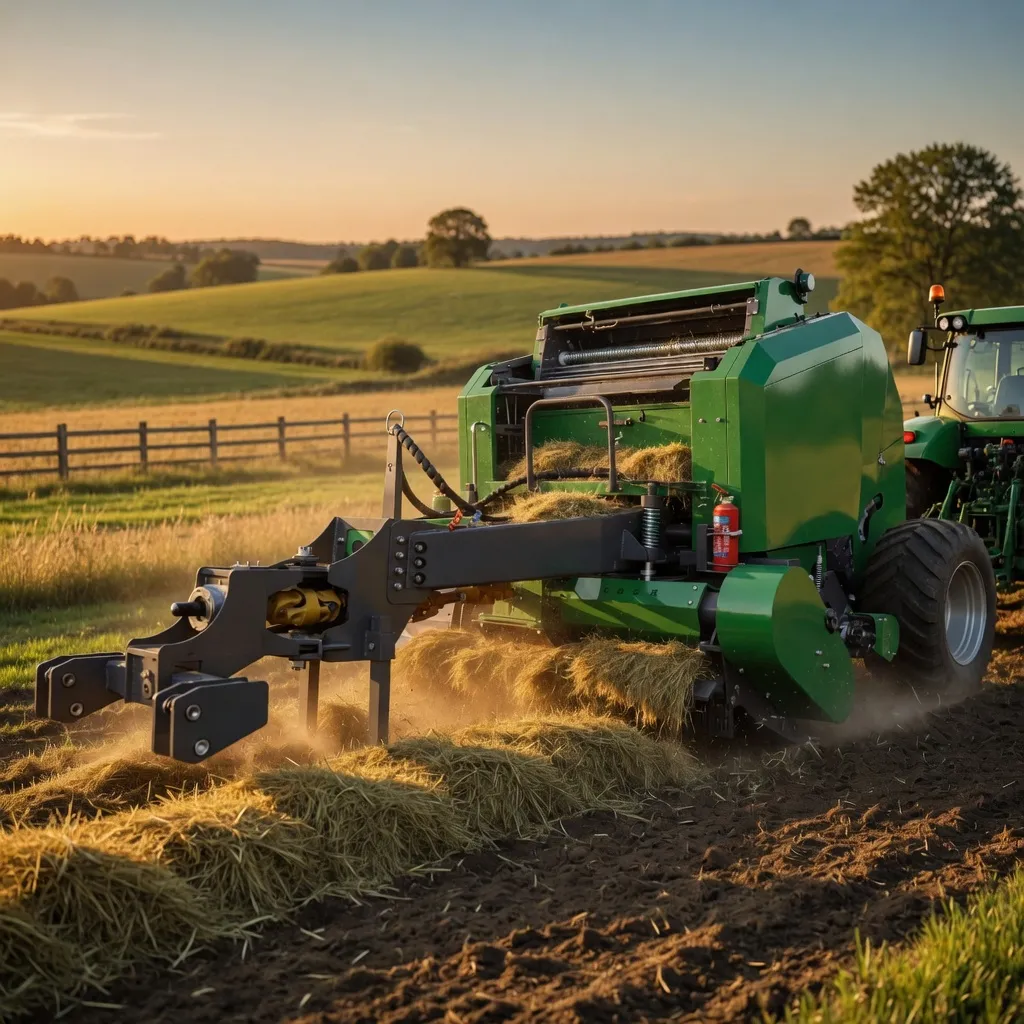
In a demonstration at a dealer’s premises, every pickup system looks adequate. The diagnostic question is: how does this pickup system perform on the fifth different client property of the week, when the windrow width is inconsistent, the rake operator over-consolidated in patches, and there are two sections of the paddock where the sward is half the density of the rest?
A contractor’s pickup reel encounters diversity that a farm’s baler never does — different crop species, different raking standards, different ground conditions, different operator habits at each client site. A wide pickup that tolerates windrow variation without the operator needing to adjust between farms is a genuine productivity asset. A narrow pickup that requires the operator to re-rake half the windrows it encounters to avoid leaving material in the paddock is a hidden cost that never appears as a line item but shows up in the day’s bale count.
The related question is tine material and foreign object tolerance. A contractor working across a dozen different paddocks per week will encounter rocks, wire, and irrigation hardware at a rate that a single-farm baler will never see. Pickup tines made from higher-grade spring steel with better fatigue resistance than the cheapest available replacement grade are worth the modest premium specifically because of how they behave in the 50th FOD encounter of the season — where an economy tine fractures and the replacement cost and downtime eats the saving from the initial price difference several times over.
The Paddock Walk Protocol That Pays for Itself
The single most cost-effective maintenance practice for a contractor’s pickup system is the 10-minute paddock walk before starting any new client site — identifying and marking visible rocks, wire, irrigation risers, and debris before the pickup encounters them at speed. This is not a procedure that experienced contractors debate. It is an absolute standard that every hour of hard experience confirms. The alternative — discovering a pickup obstruction at baling speed — costs four to ten times as long in repair time as the walk would have taken.
Net Wrap System Reliability: The Specification Nobody Measures Until It Fails
The net wrap cut-and-tuck cycle happens on every bale, invisibly, while the operator is already thinking about the next windrow section. When it works perfectly, it is invisible. When it produces a trailing wrap strand that catches on the bale as it ejects, the operator must stop, climb down, manually clear the wrap, and re-engage — adding 30–45 seconds to a cycle that should have been 90 seconds total. Across 80 bales per day, unreliable net wrap cuts add 40–60 minutes of dead time that never shows up as a diagnosed problem but consistently drags the day’s bale count below target.
The diagnostic questions for net wrap systems are: does the knife maintain its cut quality across the full range of net wrap brands the contractor may use in a season? Does it perform consistently across varying bale density and moisture levels — including the high-moisture silage bales that stress the cut mechanism differently from dry hay? And how accessible is the knife assembly for replacement in the field without workshop equipment? A net wrap system that answers all three satisfactorily is a production asset; one that doesn’t answers the first three is an operational liability that accumulates its cost invisibly across an entire season.
Evaluating Film Wrapping Performance on Combined Machines
For contractors running combined baler-wrappers, the film wrapping system is not a secondary consideration — it is half the machine’s commercial function. Pre-stretch consistency across the full wrapping cycle and across varying bale geometries determines whether the contractor can actually guarantee uniform film coverage to clients, which is the quality commitment that supports a premium per-bale rate.
The diagnostic question for film systems is whether pre-stretch ratio is maintained throughout the full turntable cycle — including at the bale shoulder transitions where lower-quality systems produce inconsistent tension that creates loose film and potential air entry points. A system that delivers consistent pre-stretch from the first pass to the last, regardless of bale diameter variation or moisture variation within the bale, is engineering that has been thought through seriously. A system that delivers acceptable average pre-stretch with significant cycle-to-cycle variation is a system that will produce variable silage quality across the season in ways that are difficult to diagnose because the problem isn’t visible until fermentation analysis reveals it months after baling.
Field Serviceability: The Specification That Doesn’t Appear on Data Sheets
The question of field serviceability — can a single operator fix a typical failure in the paddock with standard tools, without a technician and without a workshop — is not listed in any manufacturer’s specifications. It is, however, among the most commercially important characteristics for a contractor whose cost of downtime runs to $2,000+ per day during harvest.
The diagnostic approach here is to ask the supplier specifically: “Walk me through how an operator replaces a pickup tine, a belt joint, and the net wrap knife on this machine — what tools are needed, how long should it take, and what access to the component is required?” A machine whose wear items are accessible with standard tools and replaceable by one person in 30–90 minutes is a field-serviceable machine. A machine whose belt system requires significant disassembly that benefits from two people and a workshop lift is not — regardless of how well-engineered it is in other respects.
EverPower machines are designed with practical field serviceability as a stated engineering objective — a choice that reflects the supplier’s understanding that most in-field failures in Australia happen far from any workshop, late in the day, with time pressure. The maintenance point locations, wear item accessibility, and diagnostic logic are designed for a single operator working alone, not for a factory service team.
The Supplier Relationship: The Purchase After the Purchase
The most common failure mode in contractor equipment purchasing is evaluating the machine thoroughly and evaluating the supplier barely at all. The machine’s performance across its working life depends as much on the supplier’s support capability as on the machine’s engineering quality. A well-engineered machine with a supplier who has a 3-week international parts lead time, no local technical support, and no experience with Australian operating conditions creates a risk profile that is not offset by the machine’s specification quality.
The diagnostic questions for supplier evaluation are direct: what parts do you hold in local stock, and what is your typical dispatch time from order to delivery for common wear items? What is your technical support availability during harvest season hours? Have you worked with commercial contractors in eastern Australia, and can you describe how those relationships have operated across multiple seasons? The answers reveal whether the supplier understands the commercial stakes of contractor equipment downtime or whether they are primarily a transaction-focused import business that will be difficult to deal with after the sale closes.
Hydraulic Compatibility: Confirm Before Purchase, Not After
A common mismatch that creates operational problems on combined machines is insufficient hydraulic flow from the tractor to support the wrapping system at the flow rate the mechanism demands during peak cycle. The symptom — erratic film tension and variable pre-stretch across the wrapping cycle — is difficult to diagnose without flow testing because it presents as inconsistent quality rather than a clear mechanical failure. The underlying cause is not a machine problem; it is a tractor-machine pairing problem that should have been identified before purchase.
The EverPower technical team can confirm hydraulic compatibility for any specific tractor model and specification before purchase. Providing the tractor make, model, and hydraulic pump specification takes five minutes. The alternative — discovering the incompatibility on the first day of the season — costs a season of variable silage quality and the frustration of diagnosing a problem that was avoidable before the machine was ever connected.
EverPower Baling Machinery Australia Pty Ltd
27 Harley Crescent, Condell Park NSW 2200
+61 2 9708 3322
[email protected]
Frequently Asked Questions
27 Harley Crescent, Condell Park NSW 2200 | +61 2 9708 3322 | [email protected]
About Us | Contact Us