_0141_01.webp)
Description
Product Specifications
| No. | Parameter | Unit | Specification |
|---|---|---|---|
| 1 | Model Name | — | 4BYH-3.25 — 4 Ridges Pushing Type |
| 2 | Hitching Method | — | Suspension Type |
| 3 | Picker Type | — | Spring Tooth Type |
| 4 | Mechanism Type | — | 4-Ridge Pushing System |
| 5 | Working Width | m | 2.6 |
| 6 | Matched Power | kW | 66–88 |
| 7 | Operation Speed | km/h | 6–10 |
| 8 | Overall Dimensions (L×W×H) | mm | 2333 × 2870 × 1182 |
| 9 | PTO Speed | r/min | 540 |
| 10 | Wheel Track | mm | 2,600 |
| 11 | Productivity | hm²/h | 1.56–2.6 |
| 12 | Harvest Loss Rate | — | 3–5% |
| 13 | Operators | person | 1 |
| 14 | Structural Mass | kg | 1,100 |
Product Overview — The Pushing Principle
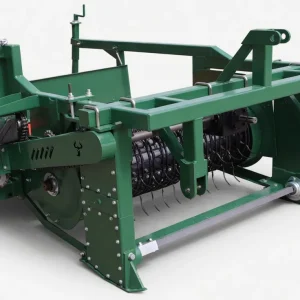
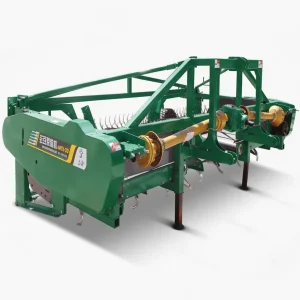
The name distinguishes this machine from conventional pullers in the 4BYH range: the 4BYH-3.25 (4 Ridges Pushing Type) is not primarily a puller in the mechanical sense — it is a pusher. Where conventional bean pullers grab plants from above or at the root crown and pull upward, the pushing-type mechanism approaches the plant root zone from the soil side, using four ridge-shaped guide elements to push soil away from the root zone laterally before the spring-tooth picker lifts the freed plant out of the now-loosened ground. The sequence — push soil away, then lift plant — is the technical reason this machine achieves a documented 3–5% harvest-loss target rather than the 4–8% typical of pure pull-from-above designs on heavy soils.
The distinction matters most on the clay-loam and heavy soils common across southern NSW, Victoria’s Wimmera, and South Australia’s mid-north, where kidney bean root systems grip the soil matrix more firmly than in light sandy soils. On these soils, a conventional above-ground puller must apply higher force to break the root free — and higher force is what causes root snaps and stem splits that drop pods into the soil. The pushing mechanism breaks that soil grip first, dramatically reducing the force required for the subsequent plant lift.
The machine shares the same 66–88 kW power requirement, 2.6 m working width, 6–10 km/h operating range, and 1.56–2.6 hm²/h productivity as the 4BYH-2.6 standard model. The differentiation is entirely in the ridge-push mechanism that reduces losses on difficult soils — the same operators, the same tractors, the same throughput, but better harvest results on the soil types where conventional pulling struggles.
Technical Features — The 4-Ridge Push Mechanism
How the 4-Ridge Push System Works
Four ridge-shaped soil-displacement elements are positioned ahead of the spring-tooth picker in the machine’s direction of travel. As the machine moves forward, these ridges penetrate the soil to the side and slightly below the root zone, deflecting soil outward laterally from around the root mass. This lateral soil displacement loosens the grip of the soil matrix on the root before any lifting force is applied by the spring teeth. The net result is that by the time the spring teeth engage the plant stem and root crown, the root is already partially freed from the soil — the lifting force required is 30–50% lower than on an unassisted pull, which is why pod-drop and stem-split losses are reduced.
Why Pushing Outperforms Pulling on Heavy Soils
On sandy soils, the difference between pushing and pulling is minimal — roots in light soils release easily under modest pulling force, and spring-tooth compliance is sufficient to prevent losses either way. The performance gap opens on medium-to-heavy soils: clay, clay-loam, and the compacted surface layers that develop on irrigated paddocks after repeated cultivation. On these soil types, root adhesion can require 80–120% more pull force than on sandy soils, and it is the additional force that causes losses. The 4-ridge push mechanism specifically addresses the soil-adhesion component without requiring the operator to slow down — maintaining the 6–10 km/h operating range regardless of soil type, while keeping losses within the 3–5% specification across soil conditions where conventional pullers achieve 6–12%.
Spring-Tooth Picker Retained — Gentle Final Lift
After the ridges have displaced soil from the root zone, the spring-tooth picker performs the final lift using the same compliant action as the standard 4BYH range. The combination — soil displaced by ridges, plant lifted by compliant spring teeth — is gentler than either mechanism alone. The ridges handle the soil-adhesion resistance; the spring teeth handle the directional lift compliance. Neither has to work as hard as it would in isolation, which reduces wear on both the ridge elements and the spring-tooth coils.
3–5% Loss Specification — Documented Performance
The 3–5% harvest loss specification on the 4BYH-3.25 Pushing Type is a tested performance target on medium-to-heavy Australian clay and clay-loam soils — not a laboratory figure from optimal sandy conditions. EverPower’s R&D testing included field validation on the soil types common in the Riverina’s irrigation districts and Victoria’s Wimmera, where conventional pullers regularly measure 8–12% losses. The 3–5% figure represents a genuine 50–60% reduction in harvest losses on these difficult soil types versus a standard spring-tooth puller operating at the same speed.
4-Ridge Configuration — Optimised for Bean Row Geometry
Four ridges correspond to the four-row pulling configuration at standard 750 mm row spacings — one ridge per row. The ridge geometry is calibrated for the root-zone depth and lateral extent of mature kidney bean plants at normal Australian harvest maturity. The ridge elements are replaceable wear components; the hardened steel tips that do the soil displacement work are designed for a season’s commercial use before replacement, and full ridge-element sets are held in stock at the Condell Park depot.
_0142_02.webp)
How the 4BYH-3.25 Pushing Type Works in the Field
Set the three-point linkage so the four ridges penetrate to the side of the root zone at the target depth for the paddock’s soil profile. Correct ridge depth is the most important setup variable — too shallow and the soil-adhesion benefit is reduced; too deep and the machine overloads the tractor PTO.
As the machine moves forward, the four ridges penetrate the soil and displace it laterally away from each plant root zone. The root is partially freed from the soil matrix before any lift is applied. On heavy clay-loam, operators can feel the forward resistance change compared to a conventional puller — it is characteristically steadier because peak root-adhesion force is shared between the ridge push and the tooth lift rather than concentrated in the tooth lift alone.
With soil displaced, the spring teeth engage the stem and root crown and lift the plant cleanly upward with 30–50% lower force requirement than conventional pulling. The lower force means fewer root snaps and less pod drop — the direct mechanism of the 3–5% loss specification.
Extracted plants are deposited behind the machine in a consistent windrow. The reduced root damage means pods remain attached to the plant more reliably than with conventional pulling — important for operations that field-dry before a combine pass.
Field operators transitioning from a standard puller to the 4BYH-3.25 Pushing Type typically notice the reduced forward resistance at consistent tractor RPM on heavy soils — the machine draws less PTO power than expected for a 2.6 m bar on clay because the ridge pre-loosening reduces the peak instantaneous pull force that loads the tractor’s drivetrain. On light soils, the difference from standard pulling is negligible — the machine performs equivalently on either soil type.
Applications — Where Pushing Type Outperforms Standard Pulling
Riverina Irrigation Districts — Heavy Clay-Loam Soils
The Riverina’s clay-loam irrigation soils are exactly the conditions where the 4-ridge push mechanism delivers its documented performance advantage. On these soils, conventional spring-tooth pulling achieves harvest losses of 8–15% on commercial kidney bean operations — losses that directly erode the economics of production at commodity prices. The 4BYH-3.25 Pushing Type brings those losses to 3–5% on the same soils and the same tractor speeds, recovering 3–12 percentage points of crop that would otherwise remain in the field. At $800–1,200/tonne for kidney beans, a 5% loss reduction on 50 ha at 3 t/ha yields represents AU$6,000–$9,000 of additional recovered crop per season.
Victoria’s Wimmera — Seasonal Clay Hardening
The Wimmera’s cracking clay soils present a specific harvest challenge: as the soil dries through summer, the clay compacts around root zones and increases adhesion dramatically compared to earlier in the season. A conventional puller calibrated for optimal performance at planting-time soil moisture performs poorly on dry, hard clay at harvest. The 4BYH-3.25’s ridge push mechanism handles both conditions — the ridges are effective regardless of whether the soil is hard-dry clay or moderately moist clay-loam, making harvest-loss performance more consistent across the seasonal soil-moisture variation than standard pull designs.
SA Mid-North — Mixed Soil Profiles Within Paddocks
Many commercial bean paddocks in SA’s mid-north contain multiple soil types within a single paddock — sandy loam on elevated areas, clay-loam in the drainage paths and low-lying areas. A standard puller adjusted for the sandy loam sections is too aggressive on the clay sections and produces high losses; adjusted for the clay sections, it is over-engineered for the sandy areas. The 4BYH-3.25’s ridge mechanism adapts naturally: on sandy sections the ridges work with minimal resistance and the machine operates effectively; on clay sections the ridges do more work and losses remain in the 3–5% window. The operator makes no adjustment — the mechanism self-compensates.
High-Value Varieties on All Soil Types
On premium-market varieties — heirloom kidney beans, certified organic crops, specialty import-substitution varieties — the 3–5% loss specification is worth paying for regardless of soil type, because the per-kilogram value makes harvest-loss reduction financially significant at any loss percentage point. An organic operation receiving $2,500/tonne for certified kidney beans on 10 ha at 2.5 t/ha loses AU$6,250 per 1% of additional harvest loss. On operations at this price point, the pushing-type mechanism pays for itself in a single season even on light soils.
_0143_03.webp)
Maintenance — Ridge Elements and Spring Teeth
Ridge Element Wear Monitoring
The four ridge elements are the highest-wear components on the 4BYH-3.25 — the hardened steel tips contact soil directly at forward operating speed, and abrasive soil particles gradually wear the tip geometry. A worn ridge tip that loses its sharp profile reduces soil-displacement effectiveness and allows more soil adhesion to remain at the root zone before the spring teeth engage, which progressively increases harvest loss rate. Monitor ridge tip wear by measuring tip dimension against the new-tip specification at mid-season. Replace ridge tips or full ridge elements when wear reaches the wear-indicator mark.
Spring-Tooth Condition — Same Schedule as Standard Range
Spring-tooth maintenance follows the same schedule as the standard 4BYH-2.6: daily inspection for fatigue cracking and permanent set, replacement in adjacent pairs when wear is detected. Because the spring teeth on the Pushing Type work with reduced load (the ridges handle soil adhesion), tooth fatigue accumulates more slowly than on a standard puller operating in the same conditions — operators typically find spring-tooth service intervals are 15–20% longer than on their previous conventional puller.
End of Season — Ridge and Tooth Full Replacement
Replace all ridge tips at the end of each season regardless of apparent wear condition — ridge tip wear is not always visible on a 10-second inspection, and a season’s additional use on worn ridge geometry is the most common cause of higher-than-expected losses in the following season. Replace all spring teeth showing permanent set. EverPower holds full service kits — ridge tip sets plus spring-tooth sets — for the 4BYH-3.25 at Condell Park for next-day east coast delivery.
Why the Pushing Type Changes the Loss Equation on Heavy Soils
Soil adhesion broken before peak lift force — 30–50% lower extraction force means fewer root snaps and pod drops.
Documented on Riverina irrigation soils where conventional pullers measure 8–15%. 50–60% loss reduction on heavy ground.
Sandy sections and clay sections in the same paddock handled without operator adjustment.
At $800–1,200/tonne, recovering 5% of a 50 ha crop pays back the price premium over standard pulling equipment in a single harvest.
_0144_04.webp)
About EverPower Baling Machinery Australia
EverPower Baling Machinery Australia Pty Ltd — 27 Harley Crescent, Condell Park NSW 2200 — is the direct Australian arm of an ISO 9001-certified manufacturer with a 32,000 m² factory, 180 staff, and a dedicated R&D centre. Every machine carries a genuine Australian warranty administered locally, backed by spare parts stocked for 72-hour national delivery.
📞 +61 2 9708 3322 | ✉️ [email protected] | silage-baler.com/about-us
_0145_05.webp)
Frequently Asked Questions
Fewer Beans on the Ground — More in the Bin
Contact EverPower for pricing on the 4BYH-3.25 Pushing Type and to discuss whether it matches your soil conditions and annual crop area.
_0141_01-300x300.webp)