Description
Product Specifications
| No. | Parameter | Unit | Specification |
|---|---|---|---|
| 1 | Model Name | — | 9GL-5.0/5.6 Traction Mower-Windrower |
| 2 | Hitching Method | — | Traction Type |
| 3 | Cutter Structure | — | Reciprocating Type |
| 4 | Cutting Width | m | 5.0 |
| 5 | Windrowing Width | m | 5.6 |
| 6 | Operation Speed | km/h | 6–7 |
| 7 | Productivity — Mowing | hm²/h | 2.4–2.8 |
| 8 | Productivity — Windrowing | hm²/h | 3.0–3.6 |
| 9 | Average Cutting Height | mm | 60–70 |
| 10 | Matching Power | kW | 30–60 |
| 11 | PTO Speed | r/min | 540 |
| 12 | Machine Weight | kg | 1,100 |
| 13 | Number of Rake Teeth | pcs | 78 |
| 14 | Rake Tooth Spacing | mm | 71 |
| 15 | Number of Moving Blades | pcs | 68 |
| 16 | Transport Dimensions (L×W×H) | mm | 3860 × 5600 × 3000 |
| 17 | Working Dimensions (L×W×H) | mm | 3860 × 7600 × 850 |
Product Overview
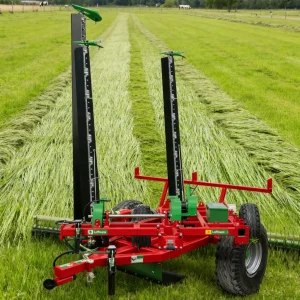
Scale the 9GL-2.5/2.9’s cut-and-windrow concept to 5.0 m and you have the 9GL-5.0/5.6: a machine that covers 2.4–2.8 ha/h in mowing mode and 3.0–3.6 ha/h in windrowing mode — matching the daily output of a standalone 5 m disc mower while simultaneously eliminating the need for a separate raking pass. On a 100 ha operation making two cuts per season, the avoided raking passes represent 110–140 tractor hours per year. Across a 10-year machine life, that is more than one full year of tractor time recovered.
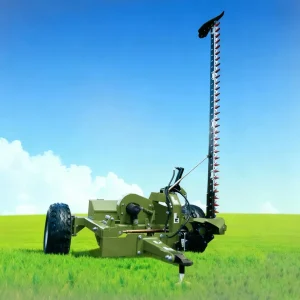
The 9GL-5.0/5.6 achieves this coverage rate behind a 30–60 kW tractor — a deliberately modest power requirement for a 5 m working-width machine. The reciprocating cutter mechanism, rather than the rotary disc design that dominates the high-speed commercial segment, makes the modest power requirement possible. Reciprocating systems require significantly less PTO power per metre of cutting width than rotary disc equivalents, which is why a 40 kW tractor can realistically run a 5 m reciprocating cutter while struggling with a 3 m rotary disc mower.
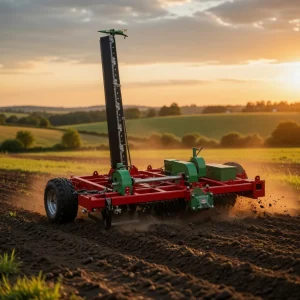
With 68 moving blades and 78 rake teeth, the machine carries the largest blade and tooth counts in the EverPower mower range. The 7,600 mm working width in operation mode makes this a large paddock tool — it suits properties with open paddock layouts rather than smaller, irregular blocks. The transport configuration folds to 5,600 mm width and 3,000 mm height for farm-road travel between paddocks, though the 5,600 mm transport width requires care on narrow farm laneways.
Technical Features — Why 5 m Reciprocating Beats 3 m Rotary
5.0 m Reciprocating Cutter — High Coverage, Low Power Draw
The reciprocating mechanism’s fundamental advantage is power efficiency: a 5 m reciprocating cutter requires approximately 25–35 kW of PTO power at working load, versus 35–50 kW for a 3 m rotary disc mower at the same cutting rate. This power efficiency is why the 9GL-5.0/5.6 can run behind a 30 kW tractor despite its large working width — the mechanical energy to move 68 blades back and forth is far less than the energy to spin rotary disc blades at 2,500+ rpm. The trade-off is forward speed: reciprocating systems are limited to 6–7 km/h versus 12–20 km/h for rotary. The 5 m width compensates for the lower speed in terms of area output — 2.4 ha/h at 7 km/h with a 5 m cutter matches the coverage of a 3.5 m rotary at 12 km/h.
78-Tooth Rake — 5.6 m Windrow from a 5.0 m Cut
Seventy-eight rake teeth at 71 mm spacing consolidate the 5.0 m cut swath into a 5.6 m windrow — a 12% wider consolidation than the cutting width. This outward sweep geometry gathers any material that falls at the cutting-width boundary into the windrow, preventing the thin edge strips that standalone mowers routinely leave which then get missed by the baler pickup on the first pass. The 5.6 m windrow is wide enough that a baler with a 2.0–2.4 m pickup needs two passes to collect it — a consideration operators account for in their paddock planning.
2.4–2.8 ha/h — Daily Coverage to Match Commercial Mowers
At 7 km/h and 90% field efficiency, the 9GL-5.0/5.6 covers 3.15 ha/h net. In a 9-hour working day with headland time, 24–27 ha of coverage is typical on a flat, open paddock. That daily coverage figure sits comfortably above what most farms with a 5 m mowing operation need to process in a working day, meaning the machine is rarely the bottleneck in the cut-to-bale sequence on operations up to approximately 120 ha of annual mowing area.
30–60 kW — Broader Tractor Compatibility Than Disc Mowers
A key practical advantage of the 9GL-5.0/5.6 versus rotary disc alternatives at similar coverage rates is tractor compatibility. A 5 m disc mower typically requires 70–100 kW to run reliably — putting it firmly in the large-tractor category. The 9GL-5.0/5.6 runs on tractors from 30 kW upward, meaning a farm with a 45 kW tractor as its primary unit can run a 5 m cut without upgrading the tractor. That saved tractor capital is a genuine economic benefit in the machine purchase comparison.
Stone Tolerance — Critical on Unimproved Pasture
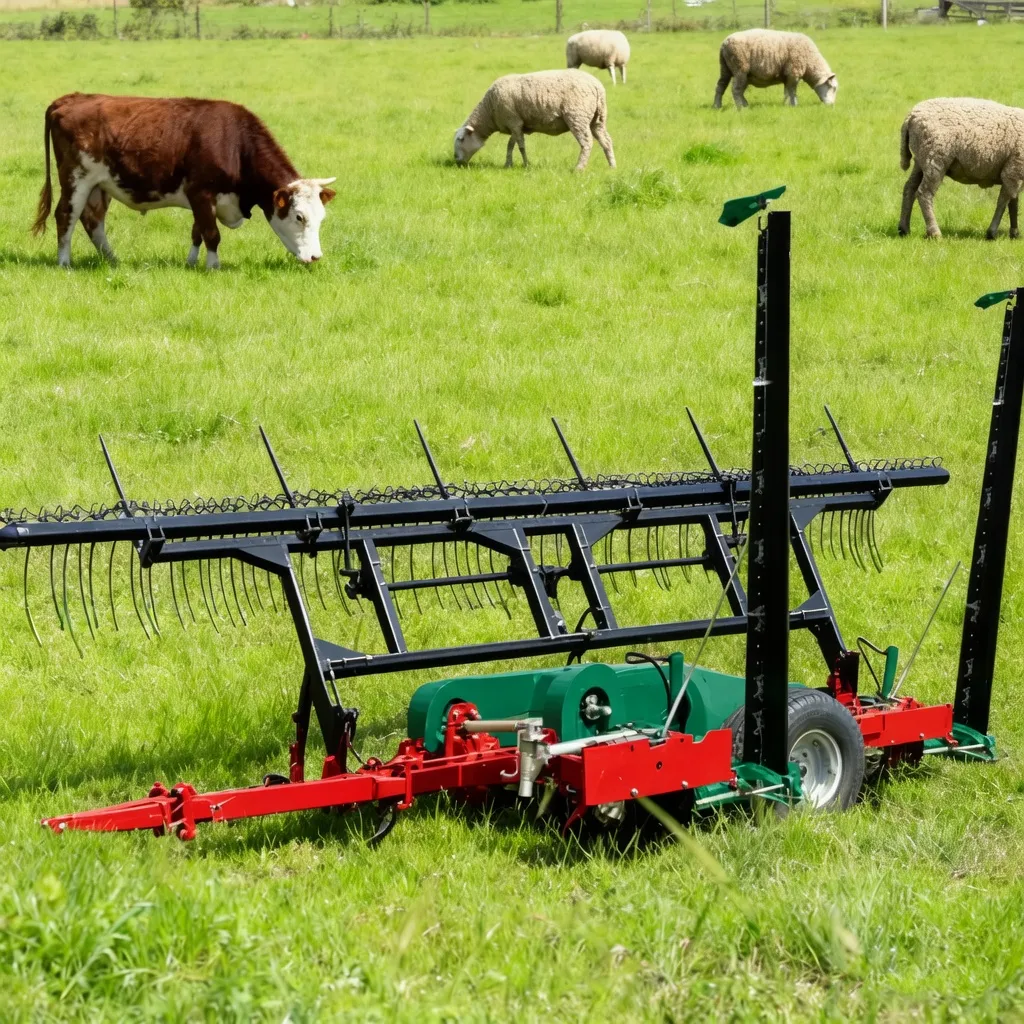
On large-area operations including unimproved or semi-improved pastures — common on the western slopes of NSW, in WA’s pastoral regions, and across northern Queensland’s beef country — occasional stone contact is an unavoidable field reality. A reciprocating blade that strikes a stone at most chips the blade edge and requires replacement; a rotary disc blade striking the same stone can shatter the disc, destroy the cutter housing, and create a dangerous projectile situation. The 9GL-5.0/5.6’s reciprocating design tolerates the stone-contact events that are statistically certain on large unimproved paddocks.
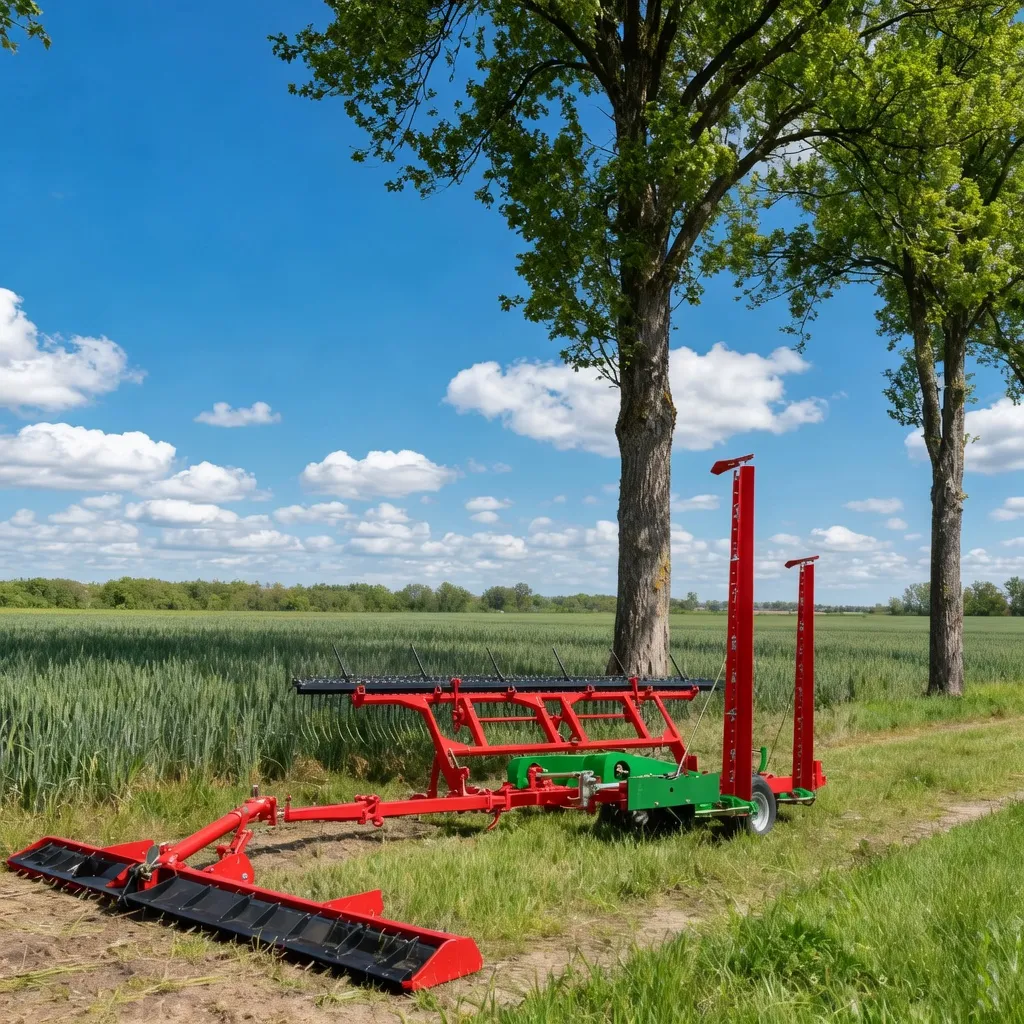
How the 9GL-5.0/5.6 Fits Into the Forage Programme
Tractor and machine enter the paddock at 6–7 km/h. The 7,600 mm working width covers 5.0 m cut width per pass; on a 200 m paddock, each pass covers 1,400 m² in under three minutes.
The 68-blade reciprocating cutter cuts at 60–70 mm height. Cut material passes immediately to the 78-tooth rake, which consolidates the 5.0 m swath into a 5.6 m windrow in the same forward motion.
The 5.6 m windrow lies behind the machine, cut surfaces exposed to sun and air. No return raking pass needed — the windrow is already in baler-ready condition.
Once target moisture is reached, the baler works through the 5.6 m windrow. At 2.0–2.4 m pickup width, the baler makes two passes per mowed strip, or the windrow is pre-raked to 1.8–2.0 m if a single-pass baler run is preferred.
The two-baler-pass requirement on the 5.6 m windrow is worth accounting for in field planning: on long, straight paddocks the baler typically works down one side of the windrow and returns on the other, maintaining forward efficiency. On irregular paddocks, pre-raking the 5.6 m windrow to 1.8 m with a wheel rake before baling is common practice — the one additional raking pass is still a net saving versus the two-pass (mow + rake) baseline.
Applications — Large-Scale Forage Operations
Large Beef & Sheep Stations — 50–300+ ha Annual Mowing
Beef and sheep stations in NSW, QLD, SA, and WA making annual hay or silage cuts from large, open paddocks find the 9GL-5.0/5.6 their most cost-effective cutting investment. The combination of a 5 m cut, avoided raking pass, and 30–60 kW power requirement means the station’s mid-range tractor handles the entire mowing operation without a dedicated mowing-tractor investment. On stations mowing 150+ ha per season, the machine’s daily coverage of 24–27 ha completes the cut in 6–7 days — a practical window for weather planning.
Hay Contractors — Wide Coverage, Single Machine
Hay contractors visiting multiple properties during the mowing season value the 9GL-5.0/5.6 for its ability to eliminate the raking schedule from the farm visit. A contractor who previously needed to mobilise both a mower and a rake for each property now completes the cutting phase in a single machine visit. The 5 m coverage rate allows a contractor to handle a larger daily area per client property, improving the economics of each site visit.
Dryland Cereal Hay — Wide Paddocks, One Pass
Dryland cereal-hay operations in WA’s wheatbelt and NSW’s Riverina work large, flat, open paddocks where coverage rate is the primary operational variable. At 2.4–2.8 ha/h, the 9GL-5.0/5.6 covers 200+ ha of annual cutting area within practical timeframes using a mid-range tractor. The reciprocating blade’s stone tolerance is particularly relevant in these regions, where paddock preparation is variable and stone contact cannot be entirely avoided.
Irrigation District Pasture — Multiple Annual Cuts
Irrigated pasture operations making three to five cuts per season per paddock benefit from the 9GL-5.0/5.6’s time-saving compounding effect. Five cuts avoided of a raking pass represents five complete raking operations eliminated per paddock per season — a figure that multiplies quickly across a 50 ha irrigated block. The 540 rpm PTO standard also accommodates the older tractors that are common on established irrigation-district farms where fleet upgrading happens gradually.
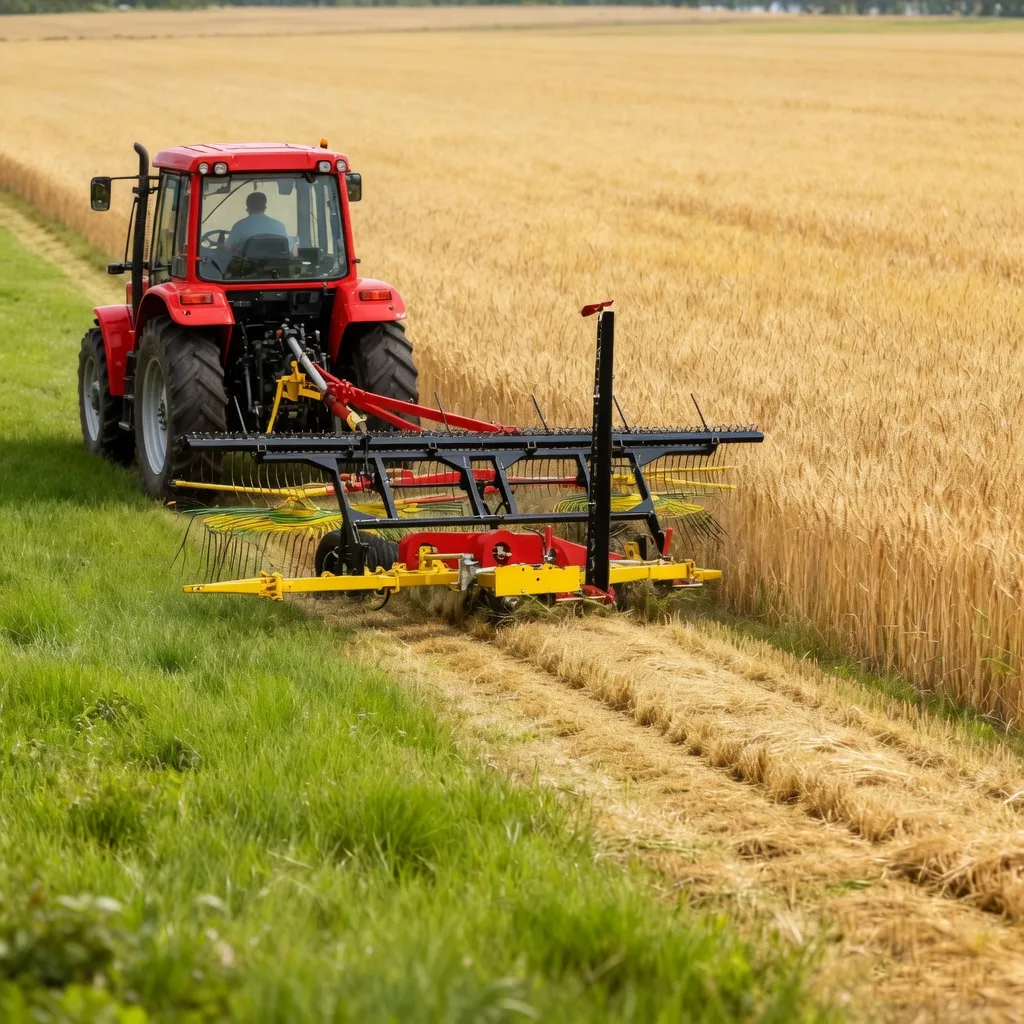
Comparison: 9GL-2.5/2.9 vs 9GL-5.0/5.6
| Specification | 9GL-2.5/2.9 | 9GL-5.0/5.6 |
|---|---|---|
| Cutting Width | 2.5 m | 5.0 m |
| Windrowing Width | 2.9 m | 5.6 m |
| Power Required | 25–55 kW | 30–60 kW |
| Mowing Productivity | 1.2–1.44 hm²/h | 2.4–2.8 hm²/h |
| Raking Productivity | 1.5–1.8 hm²/h | 3.0–3.6 hm²/h |
| Moving Blades | 34 | 68 |
| Rake Teeth | 42 | 78 |
| Machine Weight | 920 kg | 1,100 kg |
| Best For | Small–mid farms, 10–60 ha/season | Large farms, 50–300+ ha/season |
The 9GL-2.5/2.9 is the correct choice for farms with compact tractors and paddock areas under 60 ha per season. The 9GL-5.0/5.6 suits large-scale operations where coverage rate is the primary constraint and tractor power from 30+ kW is available. Both eliminate the raking pass — the decision is purely one of scale.
Maintenance
Daily — 68 Blades and 78 Teeth
Walk the full 5 m cutter bar and inspect all 68 blades for chips, cracks, or uneven edge wear before the first pass. On a 5 m bar, individual blade inspection takes an additional 2–3 minutes compared to the 2.5 m machine — time well spent given the replacement cost of a damaged section. Check all 78 rake teeth for bending; bent teeth on a 5 m windrower create visible gaps in the windrow that are difficult to correct after the fact. Grease the three main daily nipples on the PTO input, cutter gearbox, and rake drive.
Every 15–20 Operating Hours
Check blade edge condition across the full bar — on a 5 m machine, edge wear is not always uniform across the width, particularly if the paddock has hard or stony sections on one side. Sharpen in the field if wear on individual blades is approaching threshold before a full-day run. Inspect rake tooth mounting bolts across all 78 positions for loosening; use a battery-powered impact driver rather than a hand wrench to speed up the torque check on the full tooth set.
End of Season
Replace all 68 cutter blades as a matched set. Replace all 78 rake teeth showing wear. Inspect the folded transport joint at both cutter wing sections for any cracking at the hinge weld — this is the highest-stress point on the frame and the point that occasional paddock obstruction impacts affect first. EverPower stocks full blade and tooth replacement kits for the 9GL-5.0/5.6 at Condell Park NSW.
The Case for 5 m Coverage at 30–60 kW
Twice the coverage of the 2.5 m model per pass. 24–27 ha per day from a single tractor.
Reciprocating design runs a 5 m cutter on 30–60 kW — power class where rotary alternatives offer only 2.5–3 m.
No edge strips, no missed material. 5.6 m windrow wider than the cut for maximum wilting surface.
Safe on unimproved pasture — blade damage on stone contact, not disc shattering.
About EverPower Baling Machinery Australia
EverPower Baling Machinery Australia Pty Ltd — 27 Harley Crescent, Condell Park NSW 2200 — is the direct Australian arm of an ISO 9001-certified manufacturer operating a 32,000 m² factory with 180 staff and a dedicated R&D centre. Every machine carries a genuine Australian warranty administered locally, with spare parts stocked for 72-hour national delivery.
📞 +61 2 9708 3322 | ✉️ [email protected] | silage-baler.com/about-us
Frequently Asked Questions
Five Metres of Coverage, One Tractor Pass
Contact EverPower to confirm which mower-windrower model matches your paddock scale and tractor — pricing and stock availability same day.