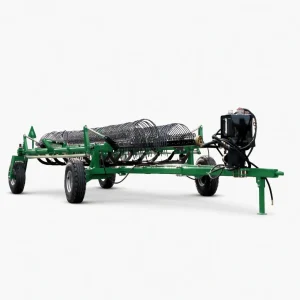
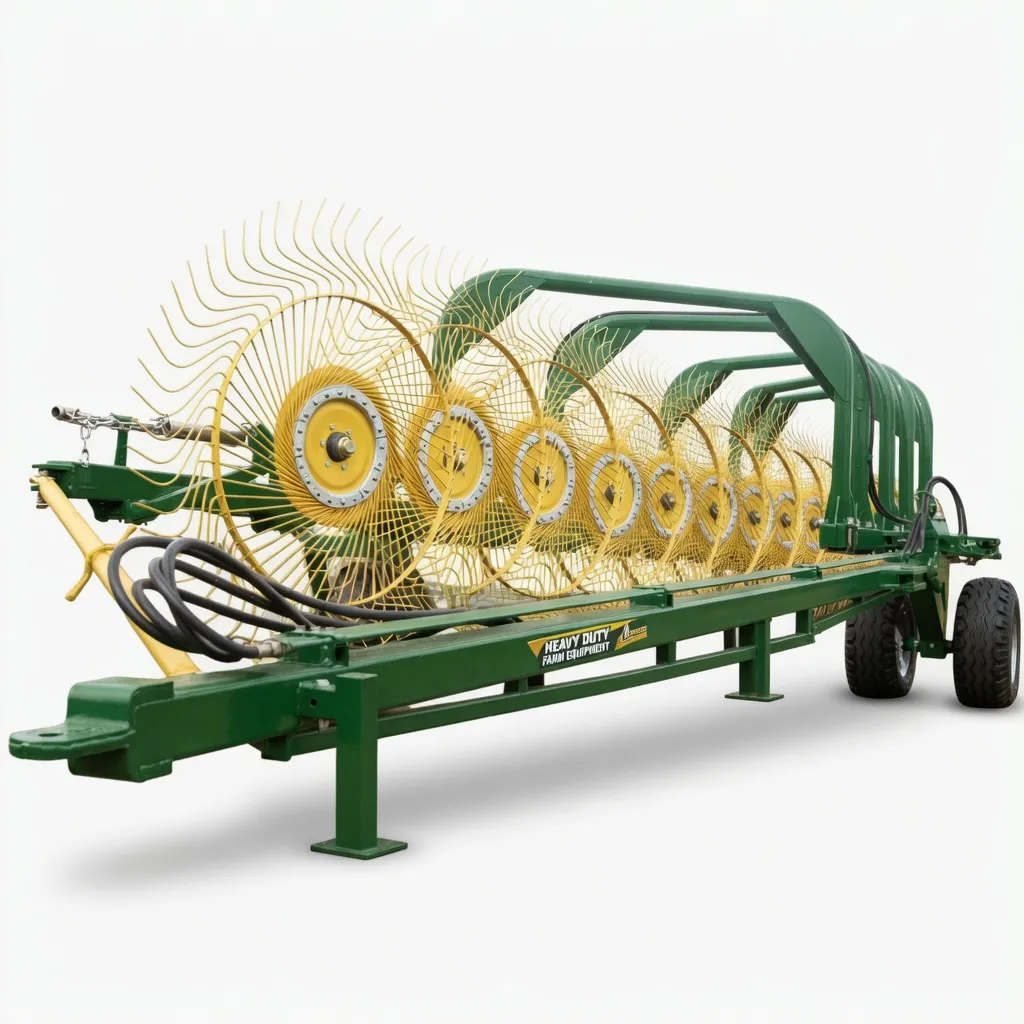
Description
Product Specifications
| No. | Parameter | Unit | Specification |
|---|---|---|---|
| 1 | Model Name | — | 9LZY-9.0 Finger Wheel Rake |
| 2 | Structure Type | — | Finger Wheel Type |
| 3 | Connection Method | — | Towed Type |
| 4 | Matched Power | kW | 50–55 |
| 5 | Working Width | m | 9.0 |
| 6 | Working Dimensions (L×W×H) | m | 8.4 × 11 × 1.75 |
| 7 | Machine Weight | kg | 1,100 |
| 8 | Working Speed | km/h | 8–10 |
| 9 | Transport Speed | km/h | 12 |
| 10 | Number of Finger Wheels | pcs | 15 |
| 11 | Number of Tines | pcs | 900 (15 discs × 60 tines) |
| 12 | Swath Width | m | 0.8–1.2 |
| 13 | Miss-Raking Rate | — | ≤ 2% |
| 14 | Productivity | hm²/h | 7.2–9.0 |
| 15 | Operators | person | 1 |
Product Overview
Raking is the field operation that most farmers consider a necessary but unremarkable step between mowing and baling — until they calculate how much hay they are leaving behind it. A ≤ 2% miss-raking rate sounds like a minor specification detail; against a 500-bale paddock of export-grade lucerne at $250 per bale, it represents the difference between leaving $2,500 of hay on the ground per paddock and leaving $25,000. The 9LZY-9.0’s verified ≤ 2% miss-raking rate is not a marketing claim — it is an engineering outcome of 900 precision-placed tines across 15 finger wheels spanning 9 m of working width.
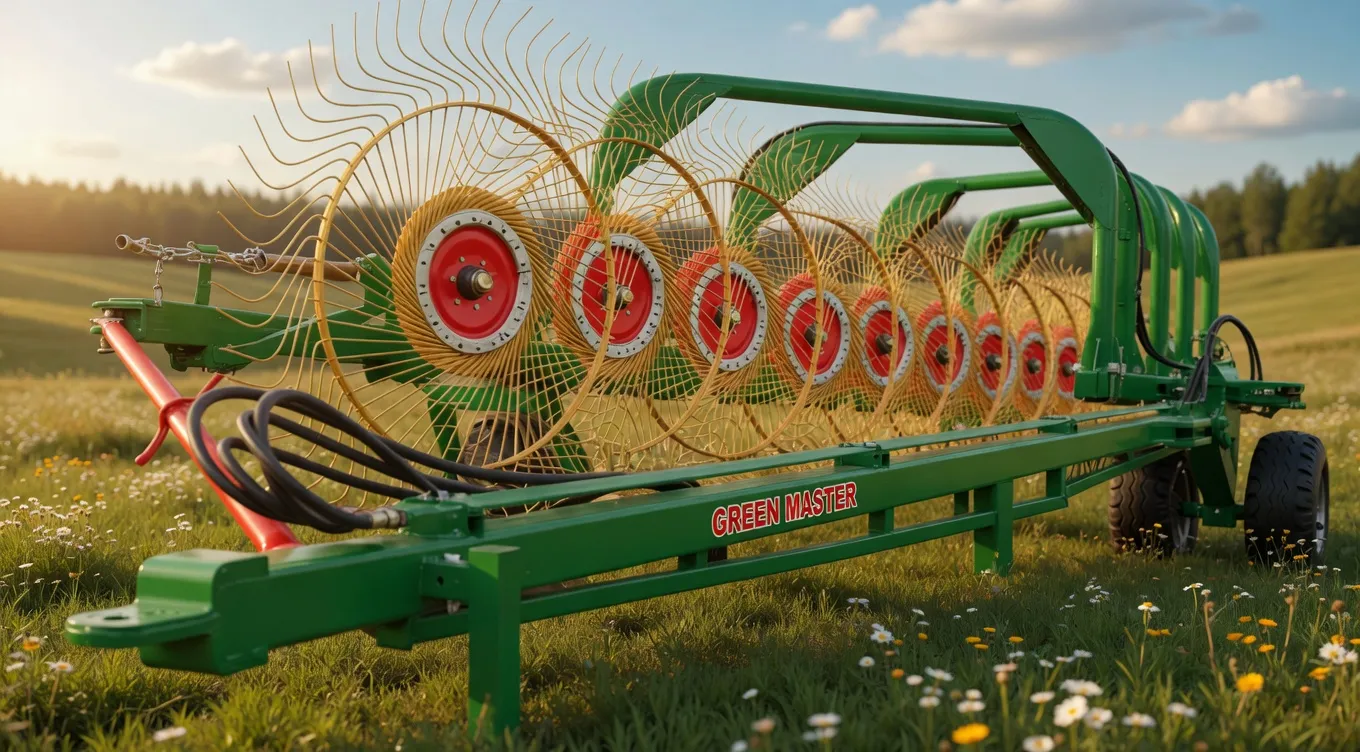
Finger wheel rakes operate on a passive, ground-driven principle: the wheels roll forward and the finger tines sweep cut material into a windrow purely through rotational contact with the crop and ground. There is no PTO drive to the raking mechanism itself — the 50–55 kW power requirement drives the transport function and auxiliary systems, while the 15 wheels spin from ground contact. This means the tines contact cut material at a consistent, gentle rolling speed regardless of tractor ground speed variation, which is why finger wheel designs consistently achieve lower miss-raking rates and less leaf shatter than powered rotary rakes at equivalent working widths.
The 9 m working width at 8–10 km/h produces 7.2–9 hm²/h productivity — among the highest raking output available in the Australian market at this machine weight. A full 10-hour operating day covers 72–90 ha of raking, which matches the mowing output of two or three mowers working in parallel. For operations where the rake is the bottleneck in the cut-rake-bale chain, the 9LZY-9.0 resolves that constraint definitively.
Technical Features — Engineering Behind the ≤ 2% Miss-Rate
15 Finger Wheels, 900 Tines — Complete Ground Coverage
Each of the 15 finger wheels carries 60 tines, and the wheels are positioned in a slight offset stagger that ensures no gap exists between adjacent wheel paths across the 9 m working width. The stagger geometry is the engineering detail that produces the ≤ 2% miss-raking rate: at any given point in the machine’s forward travel, at least one wheel’s tine is contacting every square centimetre of the crop zone. Competing designs with fewer wheels and higher tine spacing rely on individual tine sweep overlap to achieve coverage — when ground speed varies or tine wear changes the sweep arc, coverage gaps appear and miss-raking increases. The 9LZY-9.0’s 15-wheel density eliminates this variability.
Ground-Driven Passive Mechanism — Gentle on Leaf Material
The passive ground-driven raking mechanism is the reason finger wheel rakes consistently outperform powered rotary rakes on leaf-sensitive crops like lucerne, clover, and quality grass hay. A powered rotary rake accelerates tines to a tip speed above ground speed — the impact of fast-moving tines on dried leaf material shatters the leaf from the stem and leaves it on the ground rather than in the windrow. The 9LZY-9.0’s tines contact material at exactly ground speed in a smooth rolling arc. On export-grade lucerne where leaf accounts for 70–80% of feed value, the difference in leaf retention between a finger wheel rake and a powered rake can translate to $15–25 per bale on final sale price.
9 m Width at 8–10 km/h — 7.2 to 9 hm²/h
The productivity figure of 7.2–9 hm²/h at 8–10 km/h deserves context. A standard 3–4 m rotary rake achieves 2.4–4.0 hm²/h — the 9LZY-9.0 produces 2–3x more raked area per hour. On a 200 ha mowing operation where raking has traditionally required 3 days to complete after a 2-day mowing cycle, the 9LZY-9.0 finishes the raking work in a single day. This compression of the raking window materially reduces weather-exposure time between cutting and baling — a genuine quality benefit for the final silage or hay output.
0.8–1.2 m Swath Width — Optimised for Baler Pickup
The adjustable 0.8–1.2 m swath width is set to match the baler’s pickup working range. At 1.2 m — the widest setting — the windrow is wide enough that the baler handles it in a single pass without needing to snake the tractor across the centre line. At 0.8 m — the narrowest — the windrow is concentrated for maximum baler pickup efficiency at high forward speeds on thin crop. Setting swath width from the cab without stopping is standard on the 9LZY-9.0.
1,100 kg — Light for 9 m Width, Low Soil Compaction
At 1,100 kg for a 9 m working-width machine, the 9LZY-9.0 is notably lightweight. The ground pressure from the machine’s wheel load is distributed across the 15 finger-wheel ground contact points plus the transport axle, keeping soil compaction minimal even on wet paddocks. Compare this to driven-mechanism rakes at similar working widths, which typically weigh 1,800–2,500 kg and require correspondingly more tractor power and impose more compaction on the paddock surface.
How the 9LZY-9.0 Works
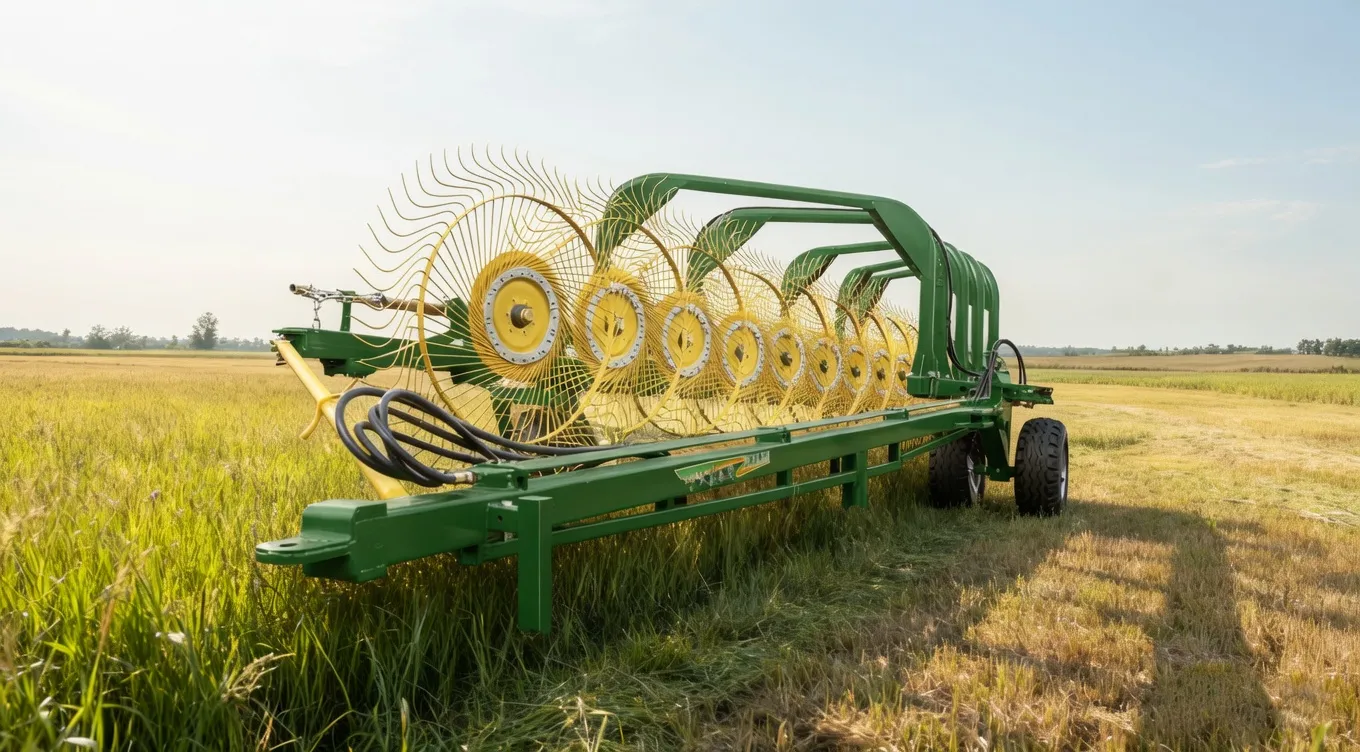
Tractor and rake enter the paddock at working speed of 8–10 km/h. The 9 m working width allows the operator to cover the full paddock in far fewer passes than a standard 3–4 m rake.
As the machine moves forward, all 15 finger wheels roll on the ground at forward speed. The 900 tines sweep cut material laterally into the forming windrow — gently, at exactly ground speed, with no tip-speed shattering of dried leaves.
The staggered wheel positioning ensures complete coverage across the full 9 m width with no gaps between adjacent wheels. Miss-raking rate stays at ≤ 2% regardless of operating speed within the 8–10 km/h range.
The consolidated windrow exits at 0.8–1.2 m width — set by the operator to match the baler’s pickup. The baler follows and picks up the uniform windrow in a single pass.
One operational advantage that experienced rake operators note immediately: the absence of any powered-mechanism noise from the raking system. The finger wheels roll silently — only the tractor engine and the light contact sound of tines on dry material are audible. This makes monitoring the windrow formation by sound practical, and field assessment of miss-raking rate by visual inspection of the paddock behind the machine is straightforward at 8–10 km/h.
Applications — When Raking Rate and Crop Quality Both Matter
Export-Grade Lucerne — Maximum Leaf Retention
The financial case for a finger wheel rake on lucerne is compelling and direct: at $250–350 per bale for export-grade lucerne, every 1% improvement in leaf retention at raking adds $2.50–$3.50 to bale value across the entire cut. The 9LZY-9.0’s passive ground-driven mechanism reduces leaf shattering at raking to the minimum achievable with mechanical equipment. Farms in the Riverina and along the Murray producing 3,000–8,000 bales of export lucerne annually find that the quality premium gained from finger wheel raking recovers the machine cost in a single season on a high-volume operation.
High-Output Hay Operations — 72–90 ha/Day Raking
Large hay operations where raking throughput is the rate-limiting step in the harvest chain find the 9LZY-9.0’s 72–90 ha/day coverage transforms the scheduling mathematics. A two-mower operation mowing 60 ha/day previously needed two days of raking to catch up — creating a quality-risking exposure window for cut hay sitting unraked overnight. The 9LZY-9.0 rakes 72–90 ha in a day, keeping the rake ahead of or concurrent with the mowing rate and eliminating the raking backlog entirely.
Silage — Precise Swath Consolidation Before Wrapping
Silage quality is meaningfully affected by the uniformity of the windrow going into the baler: a loose, irregular windrow produces a bale with uneven density and less predictable fermentation behaviour. The 9LZY-9.0’s consistent 0.8–1.2 m windrow from a ≤ 2% miss-rake operation feeds the baler evenly, producing uniform bale density and weight that improves fermentation predictability and reduces the variance in silage quality at feed-out. Dairy operations particularly value this consistency for TMR ration formulation accuracy.
Mixed Pasture and Cereal Straw — Variable Crop Handling
The finger wheel mechanism’s passive ground-driven action handles the crop-type variation that occurs when raking mixed-species pasture or alternating between ryegrass hay and cereal straw in the same season. There is no powered tine speed that must be adjusted between crop types — the wheels run at ground speed regardless of what is being raked. This crop-type agnosticism means the operator does not need to make any machine adjustment when moving from a ryegrass windrow to a neighbouring paddock of oaten straw.
Maintenance — Simple by Design
Daily Before Operation
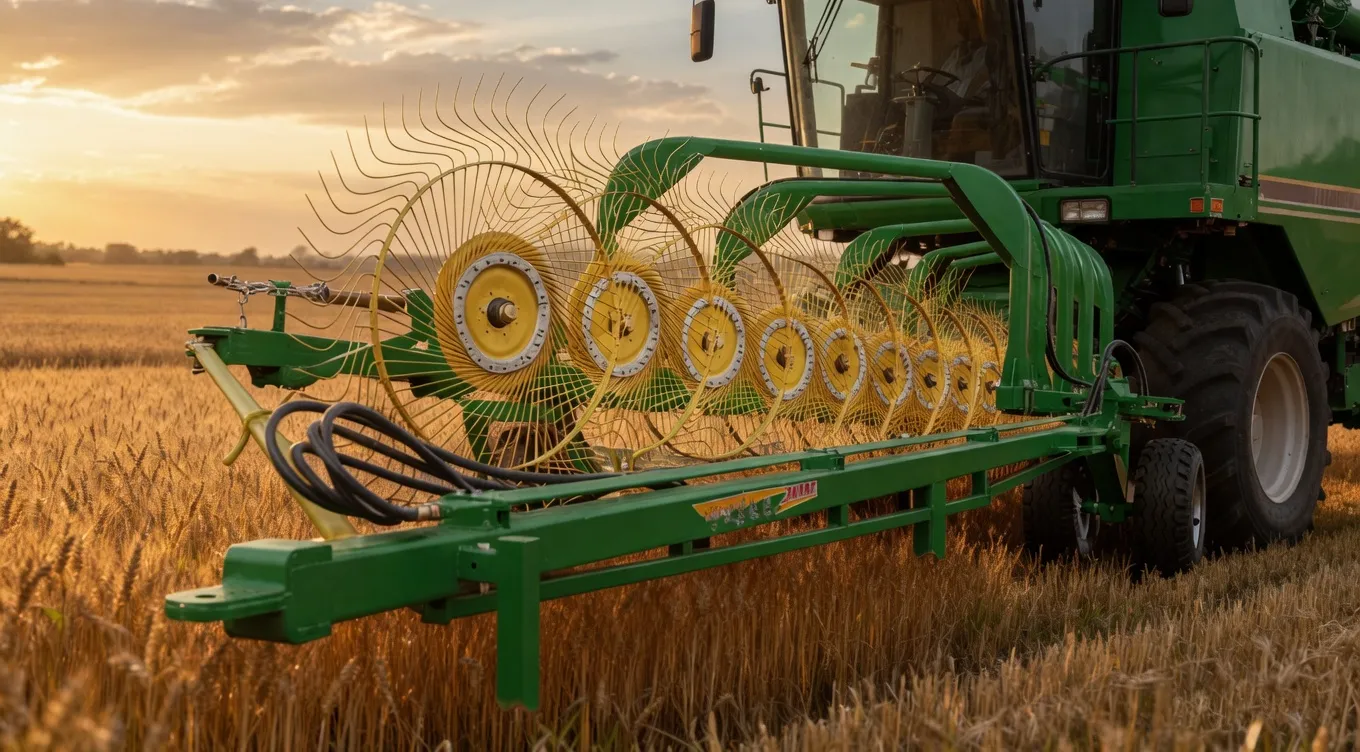
Walk the 15 wheel positions and check that all wheels spin freely. A seized wheel — caused by bearing failure or debris packed around the axle — drags rather than rolls, abrading tines rather than sweeping them. Seized wheels are immediately visible in the windrow as a gap in coverage or as a streak of unraked material behind the wheel position. Check tine condition on a sample of 3–4 wheels across the working width — bent tines reduce sweep arc and contribute to miss-raking at that wheel position. Grease the transport axle and the tow-hitch swivel bearing.
Every 50 Operating Hours
Grease all 15 wheel axle bearings through the hub nipples — the finger wheels rotate continuously during field operation and the bearings carry the full lateral raking force at each wheel. Check and re-torque the wheel-arm mounting bolts on any wheel that showed unusual noise or vibration during recent operation. Inspect the tow-frame hydraulic fold mechanism if the machine is the folding transport-width version — fold joint pins and bushings wear gradually and are worth checking at each 50-hour service.
End of Season
Replace any tines showing wear below the minimum specified tip length — worn tines have a reduced sweep arc that increases miss-raking rate at the affected wheel. Replace in complete sets of 60 per wheel rather than individually to maintain consistent sweep geometry across the wheel face. EverPower holds 9LZY-9.0-spec tine sets at Condell Park NSW for next-day east coast delivery. Inspect all 15 wheel bearings for roughness or play; replace any that feel rough before storage to prevent seized bearings from developing over the off-season.
Why the 9LZY-9.0 Changes the Raking Economics
More hay in the bale, less on the ground. On 5,000 export-lucerne bales, the difference is measurable in thousands of dollars.
Ground-driven, no tip-speed shattering. Leaf stays on the stem where its feed value and export premium live.
2–3x the throughput of a standard 3–4 m rotary rake. Eliminates the raking backlog that keeps hay exposed overnight.
Lighter than most 6 m driven alternatives. Minimal soil compaction even on wet irrigated paddocks.
About EverPower Baling Machinery Australia
EverPower Baling Machinery Australia Pty Ltd — 27 Harley Crescent, Condell Park NSW 2200 — is the direct Australian arm of an ISO 9001-certified manufacturer with a 32,000 m² factory, 180 staff, and a dedicated R&D centre. Every machine carries a genuine Australian warranty administered locally, backed by spare parts stocked for 72-hour national delivery.
📞 +61 2 9708 3322 | ✉️ [email protected] | silage-baler.com/about-us
Frequently Asked Questions
More Hay in the Bale — Every Pass
Contact EverPower for pricing and availability on the 9LZY-9.0 — and whether a finger wheel or lateral rake better fits your operation.